Monday, 4 March 2019

In the Footsteps of Fred

Very little physical evidence in Campbelltown, if anything, is left to reminder us of the brief life of Frederick Fisher. All traces of the house where he lived, a storeroom and brick building he built, his farm and the fence (or possibly bridge) where his ghost appeared have all disappeared. Even the location of his grave has been lost to history.

Records associated with the court case surrounding the murder of Fred Fisher give us some idea of where these sites were. There are also articles written about the appearance of the ghost in the years following the reported sighting. One such early article was written in 1836, only ten years after the murder. Although not entirely accurate (it refers to John Hurley as the man who claims to have seen the ghost of Fisher and not John Farley), it does offer us with some food for thought, especially considering it was written so soon after the murder and ghost appearance.

The article appeared in Tegg's Monthly Magazine. This publication was only in existence for a few months during 1836. The Tegg brothers were booksellers and publishers in London and came to Australia in 1834. There are some descriptions in Tegg's article that gives us clues about some of the Fisher sites. The article described how Hurley (Farley) passed Fisher's house 500-800 yards when he claimed to have seen the apparition of Fisher. Fisher's house was on the site of the old Bank of New South Wales. This bank, demolished around the late 1950s, was in Queen Street and a few buildings to the north of Dumaresq Street. It was located about where today's Romanoff Clothing Store is at 215 Queen Street. Therefore the location of the ghost sighting, according to Tegg's article, would be about 457-731 meters south of this location along Queen Street. It was on the western side of the street, the same side as his house. If this is accurate, it would mean the location is further south of one of the main candidates for the appearance of Fred Fisher's ghost- the old water course at the corner of Queen and Dumaresq Streets. Many people believe it was a bridge that Fred appeared on however, the first mention of a bridge didn't surface until 1859 when a John Lang wrote about the story. This was 33 years after the event.   

The Bank of New South Wales is the building to the right in this photograph. It stood on the site of Fisher's house. The photo was taken in 1893.


Tegg's article also gives a description of a building behind Fisher's house that was built by him: "The visitant to Campbelltown must have observed as he strolled through the village, a large unfurnished brick building, fast mouldering to decay, which seems to have been intended at the time of its erection for a store". Incredibly, this brick building was still in existence in the 1960s. There was also a stone storeroom behind it. Most of this building was demolished in the 1940s.

The sandstock brick building built by Fisher, still standing in the 1960s. (Campbelltown and Airds Historical Society, Alex Goodsell Collection)

Thomas Davies Mutch, a politician and historian in the first half of the 1900s, also provides opinions on where Fisher's sites were located, based on his research. Mutch pinpointed the site of the murder and the blood-stained rails from a contemporary sketch plan. The ghost, therefore, sits on the southern boundary of Fisher's farm, 55 rods westward from Queen Street. The southern boundary of Fisher's farm was in line with the southern side of Allman Street. Therefore, according to Mutch, the site would be about 276 metres (55 rods) west of Queen Street and directly in line with Allman Street.

The location of where George Worrall buried Fisher was researched by historian Verlie Fowler in about 1980. Using maps and descriptions from Worrall's trial, she was able to locate the sight. It is now where the railway line passes over the dry creek. (see photo below).

Fowler Collection, Campbelltown and Airds Historical Society)

The mystery of exactly where Fred Fisher was re-buried in St Peters Cemetery is, and always will be, a mystery. Theories have always been thrown around, but the truth is that we will never know the precise location.


Written by Andrew Allen


Sources:

THOMAS, Ivor G. 1948
Frederick George James Fisher
In Campbelltown and Airds Historical Society: Journal and Proceedings
Vol. 1, No. 1, pp84-89

Fisher's Ghost: A Legend of Campbelltown
In Tegg's Monthly Magazine
March 1836

Tuesday, 26 February 2019

Vale Eric Aarons

Eric Aarons recently passed away at the age of 99, 2 months short of his 100th birthday.  We wrote about Eric in a blog back in 2015 entitled "The Red Menace - Communism comes to Minto!".
Eric died peacefully after a lifetime devoted to advancing the causes of working people and the battlers of the world, and preserving the planet for future generations. He had lived and worked quietly for many years in his bush home at Minto Heights.
He was widely admired for his sculptures in stone and wood and had his first exhibition in 1972. The Casula Powerhouse Art Centre held a retrospective of his work in 1999.
The Campbelltown Arts Centre holds two of Eric's works "Diprotodon"(2000-2002) and "Who wants to know me" (1993), both on permanent display.


Eric Aarons 1919-2019

Written by Claire Lynch

Sources
Sydney Morning Herald 23.1.2019
https://izi.travel/en/0bb8-eric-aarons-head-2010/en


Tuesday, 19 February 2019

Fun in the Mud


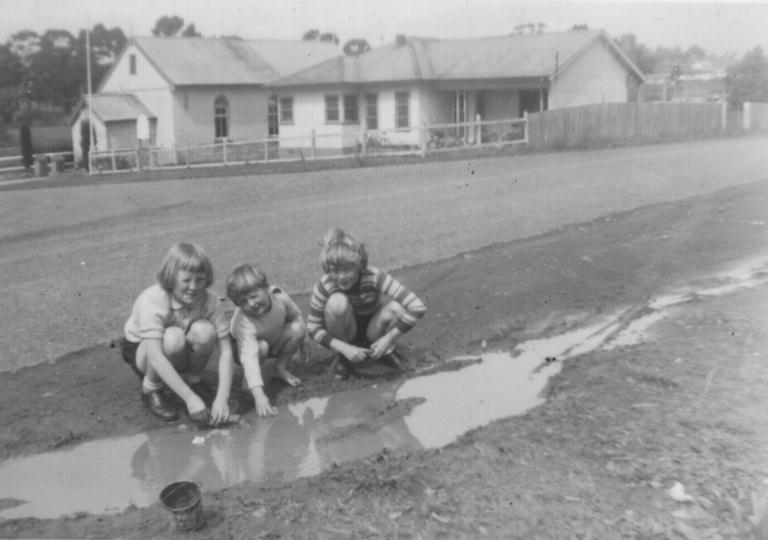
So much has changed since this photo was taken in about 1955. Pictured having great fun playing in the puddle are Marilyn Thorburn, Gillian Walker (now Blackstone) and Diana Thorburn. The location is Allman Street, Campbelltown, close to where it intersected with Oxley Street. Oxley Street has now become Moore-Oxley Bypass. In the background is a house and to its left is the former Wesleyan Chapel, built in 1845-46, and now the Uniting Church. Both these buildings still exist on the site.

The photograph was lent to the library by Gillian Blackstone, formerly Walker. Gillian was the daughter of former alderman and dairy farmer Arch Walker. The Walker family lived for a time at a house called 'Malua', previously located near the corner of Allman and Oxley Streets. It was demolished in the mid-1970s to make way for the new bypass. The children, including Gillian in the centre, would be playing out the front or very near the front of 'Malua'.

Although both buildings still stand today, much has changed. The house is now hidden by a number of trees and shrubs and Allman Street is, of course, now kerbed and guttered. The main change though, is the endless rush of traffic tearing along the bypass.

Wish we could go back to these simpler and more innocent ways of life sometimes!

Thanks to Gillian for this and the other fabulous photographs lent to the library.

Below is a shot of the sun rising at exactly the same spot today.


Written by Andrew Allen


Tuesday, 5 February 2019

Tildsley's Butchery


L to R Unknown, Unknown, Phyllis Cracknell, Grace Tildsley, Reginald Tildsley. Photo is undated. (Roslyn Tildsley Collection)
 
Campbelltown Library was recently fortunate to be given a copy of the this gem of a photograph by Roslyn Tildsley. The photograph shows Tildsley's Family Butchers with Reg Tildsley and his wife Grace with Phyllis Cracknell. The other two men on the left are unidentified but could possibly be Bill Coogan and Charles Jones, who were known to have worked there.
 
The shop was located opposite the old post office in Queen Street. The brothers Reginald and Horace moved there in 1922. An advert in the Campbelltown News that same year refers to them as the new butchers opposite the Post Office. The family had a butchery in Camden as well as Campbelltown. In 1923, the year after they moved into the Campbelltown shop, one of their huge wagons carrying carcases was 'smashed to match wood' on the Campbelltown-Camden railway on the night of June 12. Thomas Tildsley, a brother of Reg and Horace, was driving towards Narellan and at the crossing at Curran's Hill he was overtaken by the 5.15pm train from Sydney. The engine struck the back of the vehicle and smashed it into a thousand pieces. It was described as a miracle that Thomas survived.
 
The family overcame the set back and remained at Campbelltown until late 1937, when New Brothers secured the business. The butcher's shop no longer stands. Reg lived a long life and in his eighties was still trying to have an input into the Camden business. Although long retired, he would creep into the shop and start making sausages!
 

Written by Andrew Allen


Sources:
 
HOLM, Marie et al 1985
Campbelltown 1930-1940 Dumaresq Street and Environs
 
Brisbane Courier, 13 June 1923, p13
 
Camden News, 16 December 1937, p5
 
Leila Spearing Interview 26 April 1978, held at Campbelltown Library

Wednesday, 30 January 2019

The Mounted Infantry goes to war

...continued from last week.
In October 1899, the British Empire went to war against the Boers of South Africa, and Captain John Antill was selected as Adjutant in Command of the Mounted Rifles. The first squadron departed for South Africa on November 3rd, 1899. They saw action in Cape Colony, Free State and Transvaal. Several more contingents of Mounted Rifles followed soon after.
Among the Campbelltown Volunteers were Private Michael Bourke, and Lance Corporal Thomas Lees, who were invalided home 10 months later, and Private Charles Spooner who was also invalided home in December 1900. Lieutentants Joseph and William Newman, Warrant Officer Richard Holman, and Private Frank Axam had 'stuck together' whilst overseas, and returned together in January 1901.


Private Frank Axam - left with the first contingent in 1899
(Town and Country Journal, January 1900

All soldiers were welcomed back to Campbelltown with great fanfare and honour. Joe Newman said "Everywhere we went we met Campbelltown boys, and I believe, that in proportion to population, this town sent more men to South Africa than any other place".
Welcome home parade at Campbelltown Station, 1900, for the soldiers returning from the Boer War.
(Photo: CAHS)
The NSW Mounted Rifles would evolve into the legendary Light Horsemen of World War I.


A more detailed account of the Campbelltown boys can be found in Jim Munro and Jeff McGill's excellent book "Campbelltown and the Boer War".


Written by Claire Lynch
Sources
Bicentennial History of Campbelltown - Carol Liston
Campbelltown and the Boer War - Jim Munro and Jeff McGill
Australia's Boer War  - Craig Wilcox
Trove
Town and Country Journal

Wednesday, 23 January 2019

The Campbelltown Reserve Infantry Corps

In 1885 a Reserve Infantry Corps was formed in Campbelltown in a fervor or patriotism, probably fuelled by the Sudanese uprising for independence from Egypt. How did this affect a small town in New South Wales? The British, who supported the Egyptians, decided to allow the Sudanese self-government. General Charles Gordon was sent to oversee the withdrawal of the Egyptians from Khartoum. Unfortunately Gordon ignored his orders and resolved to crush the Sudanese to ensure stability in the region. The city of Khartoum was then besieged by the Sudanese for almost a year, finally falling in January 1885. Gordon, his garrison, and over 10,000 civilians were massacred. British public opinion forced the reluctant British government to send an expeditionary force to Sudan. The Attorney General of NSW and acting Colonial Secretary, William Bede Dalley offered to send a contingent, making the colonial army of New South Wales the first Australian contingent to fight for the British in an imperial war.
The men of Campbelltown, including the bank manager, storekeepers, farmers, tradesmen and labourers signed up for the Campbelltown Infantry Reserve Corps. 1886 saw the Corps practicing battalion drills, participating in shooting competitions, and competing in military games with other Corps from neighbouring areas. In September a ball was held to celebrate their first anniversary, and an encampment was held at Campbelltown. The volunteers had raised enough money to defray the expense of undergoing a course of training "under canvas". This was highly successful, with prominent citizens such as Mr Gilbert of the Forbes Hotel, and Mr Gore of the Commercial Bank being strong supporters. Men from Picton, Hay, Albury, Narrandera, Young, Braidwood and Mittagong were in attendance at the camp, where military style exercises, marching drills and other manoeuvres were practiced.
A detachment of the Picton and Campbelltown Mounted Infantry
(Town and Country Journal 4.10.1890)
Early in 1889, the Volunteer Infantry Corps from Campbelltown became a Mounted Infantry Corps and it, along with mounted corps from other areas including Camden and Picton, became the N.S.W. Regiment of Volunteer Mounted Infantry. The Campbelltown contingent, under Captain Moore, were the D Company. The Corps attended a camp at Dawes Point, where they were sworn in as special constables, completing ceremonial duties, escorting dignitaries, and peacekeeping, as well as sending teams to various rifle shooting competitions around the state.

A section of the camp of mounted special constables at Dawes Point 1890
(Town and Country Journal 4.10.1890)
 In 1893, the NSW Mounted Infantry was restyled as the NSW Mounted Rifles. In 1894, Captain Moore died, having been with the Corps since its inception in 1885. Early in 1895 the Campbelltown Corps disbanded, and was absorbed into the new Camden Half-Company. Activities continued, with manouevres, drills and a large mock battle held at Sugarloaf. This was attended by His Excellency the Governor Viscount Hampden, and Major General Hutton. Hundreds of locals turned out to witness the action.
 A group of the Rifles and their horses were sent to attend the 60th Jubilee Celebrations of Queen Victoria in England, in 1897. They acquitted themselves very well, described as having "soldierly bearing and exemplary conduct". Prior to returning home, 36 of their horses were sold at Tattersalls for an excellent price. One mare, owned by Private Moore of Campbelltown, was purchased by the Earl of Jersey for 110 guineas.


Next week - The NSW Mounted Rifles and the Boer War.

Written by Claire Lynch


Sources
Bicentennial History of Campbelltown - Carol Liston
Campbelltown and the Boer War - Jim Munro and Jeff McGill
Australia's Boer War  - Craig Wilcox
Trove
www.therocks.com/the-sudan-campaign/
Town and Country Journal

Monday, 7 January 2019

The Daruma gift

Campbelltown officially formed a Sister-City relationship with the Japanese city of Koshigaya in April 1984. A number of gifts were exchanged including a Daruma doll pictured below.


In Japan, the tradition is to paint one eye of the Daruma doll while praying for fertile crops, prosperity, good luck or fortune. If wishes are fulfilled the other eye will then, and only then, be painted.

The doll is inspired by the Buddhist monk, Daruma-Daishi who brang Zen Buddhism to Japan in the 5th century. Legend tells of him meditating for nine whole years and in so doing losing the use of his arms and legs. The Daruma dolls represents this steadfast determination. Many are weighted so that if it topples it will right itself. A good symbolic gift from our sister city.


Mayor Bryce Regan (2nd from left) with guests from Koshigaya in April 1984, two years after the idea was first mooted in Tokyo.


Koshigaya's reciprocal park named aptly, "Campbelltown Park"

sources:
P. Staats B.H.S.
Local Studies Pamphlet file.
by M Sullivan