Monday, 28 November 2022

Remembering the Victims

On Friday morning November 25, I  had the privilege of presenting a talk on the Richardson-Lack massacre on the front lawn of the Council building. The presentation was combined with a convoy against domestic violence. Campbelltown Council today installed two purple benches as part of its 16 days Activism Against Gender-based Violence- one on the site of the massacre and one at Koshigaya Park. The Purple Bench Project honours all victims of family based domestic violence.

If you haven't already, I recommend you read our post from some years ago on the massacre at the following link:

https://campbelltown-library.blogspot.com/search/label/Lack%20Sarah%20Sophia


The above photograph was taken on the exact site of the 1849 massacre. Seated on the purple bench are Alan Jarman and his daughter. Alan is a descendent of the victims and pinpointed the site from original police records.

Written by Andrew Allen


Thursday, 3 November 2022

The Immigrants Home mystery

 For some time now we have been researching the old “Immigrants Home” in Campbelltown, which was part of Caroline Chisholm’s scheme for placing new immigrant women into situations in the country where they would not fall prey to the temptations and poor conditions rife in Sydney for single women. 

The home in Campbelltown was a stopover for further travels into the “interior”. Similar homes were created in Goulburn, Maitland, and other locations. 

The good citizens of Campbelltown held a public meeting on the 5th February 1842, and resolved to “form a home for Immigrants in Campbelltown upon the plan adopted by Mrs Chisholm.” They felt that “it would afford great facilities to the settlers in the district, besides being attended with numerous advantages to the Immigrants themselves”. The home would be funded by public subscription. 

It was noted that the meeting was held at the Roman Catholic School House, which was what is now known as Quondong, the Visitor Information Centre. 

There has been some dispute as to where exactly the Immigrants Home was, but we believe we have solved the mystery.  We have a very poor photo of the “Old Immigrants Home” from the Town and Country Journal with a small accompanying article. The image was taken by P.C. Marlow. Many people believed Quondong was the immigrants’ home, but the article and photo in the Journal does not bear this out. We have tracked down a couple of sources that place it on the opposite side of the road to Quondong, on a block that ran between the convergence of Old Menangle Road and Appin Road. Where these two roads came to a point was where the house was. (1979 Aileen Hayden Oral History). 

In the obituary of John Hurley, it was noted that “Mr Hurley came to her (Mrs Chisholm) and besides materially helping her by his influence and purse in her admirable scheme he gave her a large house in which the immigrants could find a home whilst awaiting a situation.” This makes complete sense, as the block on which the old house stood was originally John Bolger’s grant, which had been sold to James Meehan, and eventually leased by John Hurley in around 1833, and known as Hurley’s Farm. 


Written by Claire Lynch

Sources - Trove, Oral Histories


Friday, 7 October 2022

Korean Comforts Fund

The Ingleburn RSL and Citizens' Comforts Fund was set up to provide support to servicemen in the Korean War 1950-1953. In 1953, the fund provided comfort packs that were sent directly to the soldiers. The packs were greatly appreciated by the men and reminded them of what they were missing from back home. Perhaps most importantly they demonstrated that the boys were not forgotten and that their service was appreciated by people they left behind. 

Two of the contents that appeared to be the most welcome were candles and beer. The candles were particularly useful, as in many places artificial light was the only source of illumination for the men. However, for the thirsty local soldiers, Aussie beer was the highlight in the comfort packs. The diggers sent back letters of thanks that probably shocked some local wowsers. 

The Campbelltown-Ingleburn News published a selection of the messages of thanks sent back by the soldiers. One such message from an L.A.C. Miller read "I was wondering if you may know of a girl of 17-18 who would like to write to me, I only get a few letters." I wonder did he receive a reply?

A total of £307 was raised for the comfort packs by the fund.


Above is an example of a comforts fund hamper from World War II (Australian War Memorial)


Sources:

Campbelltown-Ingleburn News 15 September 1953, 26 May 1953


McGill, Jeff 1993

Campbelltown Clippings

Campbelltown: Campbelltown City Council


Written by Andrew Allen


Tuesday, 20 September 2022

Coronation Day

Campbelltown awoke to the sound of bells chiming from St Peter's Church on the morning of the Queen's coronation. They started at 8am and continued until 11am, echoing around the town and for miles away. An amplifying system was intricately set up in the bell tower the night before.

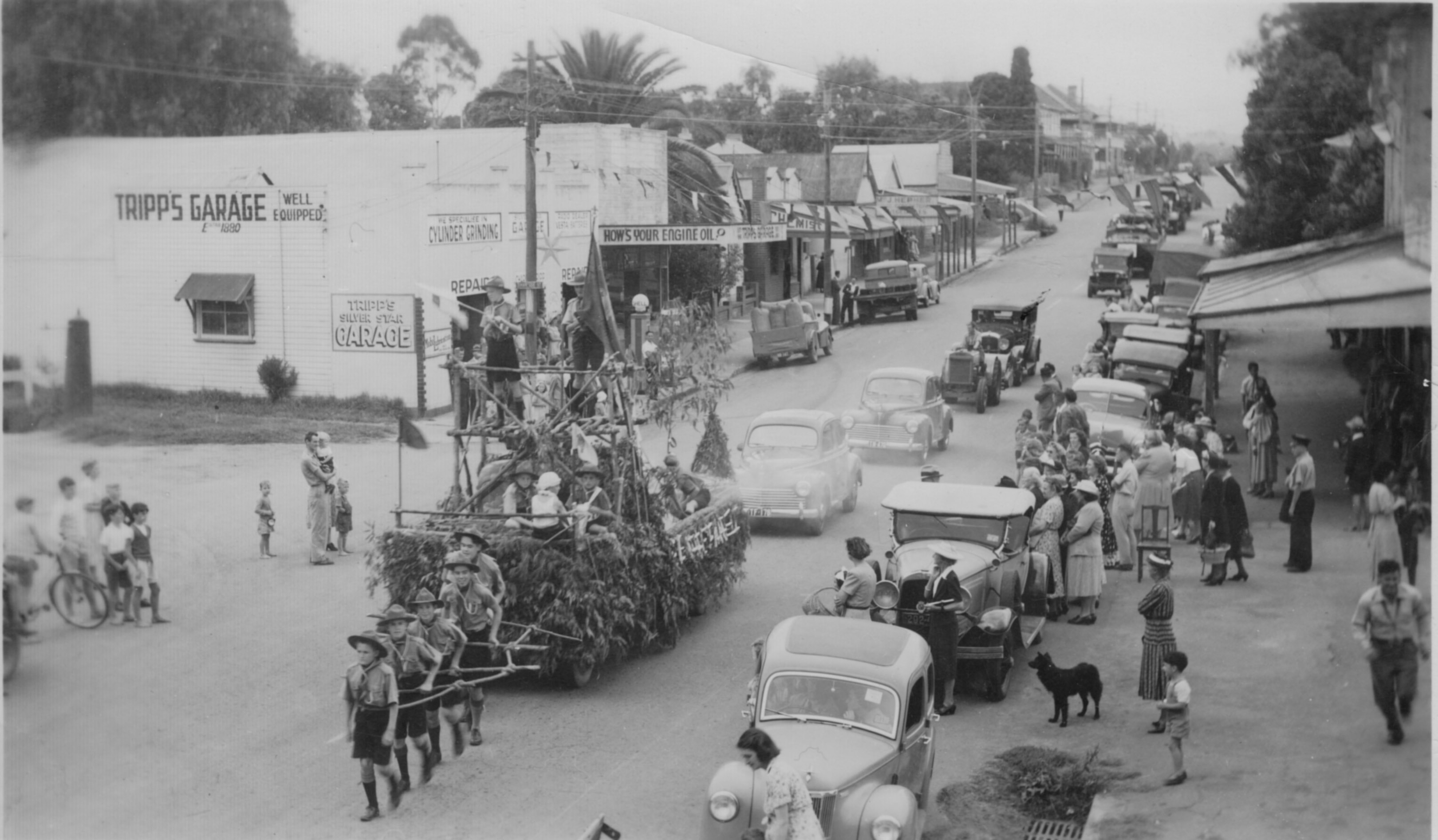
Campbelltown has always loved a street parade and this day was no exception. A procession made its way up Queen Street to the showground, where an impressive Dedication Service was held, followed by a full sports program for children. The newspaper reported that Queen Street was "a flutter with bunting, flags were flying and the Town Hall facade a brilliant fairy land of lights. However, the window dressing of shops left a lot to be desired according to the newspaper reporter!

At 10.30am the procession started from Fisher's Ghost Creek, linking up with school children at Dumaresq Street and the army at Allman Street. Following the army detachment came the Mayor and Mayoress and the Town Clerk and then the floats. The candidates in the Queen competition followed, and then a decorated ambulance and a Leumeah float with the title "The Greatest Show on Earth". All up the procession was about three quarters of a mile in length and the marching was in time! Crowd estimates for those watching were estimated at an impressive three thousand.

Mayor Farnsworth gave a speech at the Dedication Service at the showground. Miss Joyce Channell was announced the Queen competition winner and children's sports followed. Coronation certificates were presented to the children as a memento of the day.

The day's celebrations showed how much the monarchy still played an important part in people's lives. Almost 70 years later after the Queen's passing we have paid our respects to this amazing woman and her long rein.


Written by Andrew Allen


This image is believed to have been taken on the day of the coronation in 1953

Monday, 19 September 2022

How we planned our Coronation Celebrations

It was almost 70 years ago that Queen Elizabeth II was coronated at Westminster Abbey. I thought I would see what Campbelltown had planned through the Campbelltown Ingleburn News on the date of the coronation 2 June 1953. I will post again tomorrow on how it all went.

Miss Campbelltown Tops the Poll- Splendid Voting in Queen Competition was the title on the front page of the local paper on the day of the coronation. Suitable female candidates were chosen from various local committees to raise funds for the Coronation Celebrations at the Campbelltown Showground. The funds would go towards refreshments and entertainment. A program of events for the day was drawn up that included a procession of floats from Fisher's Ghost Bridge; an address by the Mayor at the Showground; dedication service; investiture of the winner of the Queen Competition; dancing by Mrs Lowe's pupils; sports and Rovers' Programme and Barbecue.

The newspaper featured an article about Minto's candidate for the Queen Competition Noreen Hunter. She was the centre of attention and mixed with the "gay competitors" at a dance held at Minto School of Arts the Friday before the coronation. The gala dance was attended by a "sprinkling of men in uniform". Noreen looked striking in a dress of broderie Anglaise.

Apart from the Queen Competition and the program of events for the day, other stories in the issue were the usual mundane regulars. Closure of a slaughter house at Campbelltown was prominent, as was news on the development of a site on Pembroke Road for a new Leumeah school. A coroner's inquest into the death of Reginald Rix on Sydney Road was another article of interest. Otherwise, the usual wedding reports, including the wedding of Theresa Foreman to Gordon Clegg, along with sports reports and classifieds dominated the rest of the paper.

I will post again tomorrow with how the day went.


Written by Andrew Allen


Queen Competition entrants


Source:

Campbelltown Ingleburn News 2 June 1953


Friday, 26 August 2022

The Bricklayer's Legacy

The research for this blog post comes mostly from Carmel Peek, descendant of Francis Lawless. Carmel wrote for the Gunning History blog, the website of which my post has taken extracts from.


St Peter's Anglican church has stood proudly in the centre of Campbelltown's CBD for almost 200 years. Planning has already begun for its bicentenary next year. Built in 1823, it is the oldest building in the CBD and believed to be the third oldest church in the country. The church holds a special place in the hearts of the Campbelltown population. But who built and designed this wonderful old building and what is their story? Thanks to meticulous research by a descendant, we can provide a clear answer to both questions.

Francis Lawless was baptised on 6 March 1786 in County Meath, Ireland. In 1807 at the age of 23, he was sentenced to life imprisonment in Dublin for highway robbery. In March 1809 he was transported to the Colony to serve out the rest of his life sentence. Francis was described as being a bricklayer "Height 5ft 10 and a half inches, Hair Brown, Complexion Fair/Ruddy, Eyes Grey".

Francis' skill as a bricklayer was probably about to save his life, not long after he arrived in the Colony. In 1810, he was charged with forging and uttering a paper purporting to be a Paymaster note for the sum of two pounds. Francis along with another man named Dalton pleaded not guilty. Dalton was freed but Francis was committed to stand trial. He was found guilty and sentenced to be hanged. Fortunately for Francis, his sentence was commuted and he was sent to Newcastle "to replace Edward Young in the lime burners". It was likely his bricklaying skills and the use that would bring to the settlement that saw him reprieved. 

In 1816, Francis married Catherine Kearns at St Phillip's Church of England in Sydney. They lived at 10 Pitt Street, formerly known as Pitts Row. The happiness gained from the marriage was continued a few years later when Francis was granted Conditional Pardon in 1819. This, along with secure employment as an overseer for the Government, meant Francis Lawless was probably in a good space at this time in his life. Further happiness arrived in the form of an Absolute Pardon in 1821.

The building and designing of St Peter's Church at Campbelltown was one of a number of constructions Francis worked on whilst living in Sydney. Other buildings included the convict barracks at Parramatta and the Benevolent Society for Sydney. Building work commenced in 1821 and was completed in 1823. The design and solid construction of the church demonstrates the competency of Francis.

Francis (better known as Frank) and Catherine eventually moved from Pitt Street after Frank received a land grant in 1826. The grant was in the Gunning district and the locality of their property was named Lade Vale. Frank lived until 1874 at his son John's property at "Erindale".


Written by Andrew Allen


Source:

Gunninghistory.blogspot.com


Tuesday, 9 August 2022

Robert Lack

Compiled by Barry Lack using sources from Alan Shaw.


Most of what we know about the early life of Robert Lack comes from his still-extant enlistment form, dated 7-7-1795, on the occasion of his entry into the British Army at Waverley Camp (a temporary military camp set up in 1742 in Great and Little Warley, Essex, at Warley Common, an area used for several later camps, of which the 1778 one was visited by George III and by Dr Samuel Johnson). This document states that he was aged 21, had a brown complexion, brown hair, black eyes, was five foot six inches tall on admission, and could neither read nor write. Most importantly for research, he stated that he was born in the Parish of Lynn (now “King’s Lynn”) in Norfolk, England, and was by trade a shoemaker. 


Researching baptisms in 1773 and 1774 at the few churches then operating in King’s Lynn, we have identified two Robert Lacks, born in 1773 within a few months of each other. In the village of Syderstone, Robert Lack, son of John Lack and Sarah Freezer, was baptised at St Mary’s Church on July 10, 1773. In the township of Gaywood, Robert Lack, son of Robert and Ann Lack, was baptised at St Margaret’s Church on September 7, 1773. While no firm conclusion can be drawn regarding which Robert eventually enlisted at Waverley Camp, most researchers record Robert and Ann as the more-likely parents, as there was a strong tradition for Robert and his New South Wales descendants to name their first son after the father, perpetuating the name “Robert” for several generations. 


On enlistment, Robert was placed under the command of Colonel Sir Charles Asgill. By May, 1797, he was a gunner in the Fifth Battalion of the Royal Regiment of Artillery, the Company's Commander being Captain Edward Wood. He received nineteen shillings in pay for the month of May, 1797, at which time his army career came to an abrupt and inglorious end.


He was discharged from the army on May 27, 1797, charged – along with another gunner, John Halbert, both men being stationed in the Park of Artillery in the parish of St. Peter and St. Mary, near the town of Lewes, in the county of Sussex, England –  on the confession of William Akine, that, in April 1797, he “did steal with force and arms in the company of others, 250 lbs of gunpowder, 3 barrels made of wood and copper (value 6 shillings), 4 tents made of hemp, linen, cotton, wood and tin (value 3 pounds), 1 marqee made of same materials (value 30 shillings), the goods and chattels of Lord King George III”. 


Committed to Lewes Gaol on June 7, 1797, by William Green Esquire, Robert was found guilty at the Sussex Assizes and sentenced, in August, 1797, to be transported “beyond the seas for the term of seven years to such place, etc.”.


He was transported, along with 103 other males, to the colony of New South Wales, departing from Spithead, England on June 21, 1801, on the ship Canada, in company with two other transport ships, Minorca and Nile. The Canada (393 tons) was built at Shields, Northumberland in 1800. It was under the command of Captain Wm Wilkinson, and the surgeon was Jn Kelly.


While three males died on the journey (which took 176 days, arriving in Sydney December 14, 1801), fortunately for Robert, his journey to Australia was in more humane and favourable conditions than other fleets and ships. This is reinforced by the following extract from page 93 of Frank Clune's book, 'Rascals, Ruffians and Rebels of Early Australia': "On 1st March 1802 Governor King wrote to the Duke of Portland saying, "All the settlers and convicts arrived by the Canada, Minorca and Nile in good health, and were by far the best conditioned that have ever arrived here....."".


Robert recognised his new home offered him a ‘second chance’. He was granted his Certificate of Freedom in 1804.  However, on August 18 that year, five men employed in a Government boat, viz. Peter Ware, Edward Loug, Robert Lack, George Howell, and Henry Hart, were taken before a Magistrate, and charged with stealing a quantity of corn out of a boat; which offence being clearly proved, they were severally ordered to be corporally punished, and the last named four sent to hard labour at Castle Hill. Governor King had begun a government farm there, on July 8, 1801, referring to it as ‘Castle Hill’ on March 1, 1802. In 1804, the convicts rebelled in the ‘Castle Hill convict rebellion’, also known as the second 'Battle of Vinegar Hill'. I am unable to confirm whether Robert was involved in this rebellion.


In the NSW General Muster of 1806, Robert was described as Free By Servitude, and a self-employed shoemaker. He joined the Loyal Sydney Volunteers under Governor William Bligh (1806-1808). In 1810, by his good conduct and behaviour, he was granted 50 acres of land at what is now Riverwood, NSW, by Colonel Paterson, the grant confirmed by Governor Lachlan Macquarie (emancipists figured prominently in Macquarie’s plans for the colony. As a result, he readily issued them with land grants of good farmland around Airds and Appin).


Robert was one of the early grantees in the Riverwood area, for, from 1788 to 1810, the area was inhabited by aboriginal tribes with an occasional visit by escaped convicts or hunters in the government’s employ. White settlement officially began in this area with land grants such as Robert’s.


On February 1, 1811 Robert was granted his Certificate of Emancipation and entrusted by Macquarie with keeping “in good perfect Substantial and proper repair” the road from “the Toll Gate Opposite the Factory in Parramatta to the Howes Bridge Windsor”, for which he was paid in rum (a contract – dated 28-2-1815, signed with an ‘X’ by Robert Lack, and witnessed by four government officials, including D’Arcy Wentworth -- and authorisations of payment -- dated 2-6-1815, 4-9-1815, and 16-4-1816, and signed by ‘L.M. His Excellency, Governor Macquarie’-- still survive).


Robert subsequently became an employer of convicts, for which service he was granted additional land, as is evidenced by a surviving letter (29-11-1825) from Robert Lack to Surveyor-General John Oxley requesting “one such quantity of Land as I may be entitled to” in return for maintaining convicts “free of expense to the Crown” (researcher Shirley White mentions a grant “of 60 acres at ‘Botany Bay’, later Peakhurst”). 


The 1822 Muster records William Eggleton as being an employee of Robert Lack in Liverpool; he also employed William Thompson on this site, and William Dyson on still more land, in Campbelltown, of which Shirley White notes that “he must have bought, because he didn’t receive it in the form of a grant” ). 


As Robert’s land grant was insufficient to maintain his stock and carry on cultivation, he requested (September 4, 1824) a further land grant from the governor, Sir Thomas Brisbane, due to his having maintained “free of expense to the Crown a number of convicts, to which he might be entitled under government regulations”. It is not known whether this last request was successful, as a further letter to the Surveyor General, John Oxley, dated November 29, 1825, provides details of convict maintenance. However, after 1825, due to the Bigge Report, governors were no longer authorised to issue land grants to those who had completed their sentences or had been otherwise pardoned.


In March, 1823, Robert was an Honorary Constable in the District of Airds. He and the other Honorary Constables in the district signed and submitted a list of eight measures to the government, to aid in “preserving that Tranquillity in the District which, for some Months past, it has enjoyed”.


On March 20, 1826  he  married Elizabeth Frazier (nee Eggleton, daughter of William Eggleton, his employee from 1822) at St.Peter's  Church of England, Campbelltown, NSW. Both were classed as "free" and signed the register with an 'x', following banns. The ceremony was performed by Rev. Thomas Reddall and witnessed by John Patrick of Airds, and Catherine Patrick, also from Airds, who signed with her ‘x‘ mark. Elizabeth Eggleton was born on February 18, 1796, at Prospect, NSW, to William Eggleton and Mary Dickenson, both First Fleet convicts. Before marrying Robert Lack, Elizabeth was married to John Frazier (Frasier).


Robert and Elizabeth had four children :

1. Robert Lack, b. 1824

2. Eliza Lack, b.1826

3. Sarah Sophia Lack, b. 1828

4. Elizabeth Mary Lack, b. 1831


Robert had a shoe making business in Airds, and established the first bakery in 1827, from which it is said, he supplied the government stores with bread. At the time of the 1828 census, he had acquired 60 acres of land, two horses and three head of cattle. In December, 1828, he had three bullocks and a cow either strayed or stolen from him. He placed ads in the newspaper offering a £1 reward or subsequent prosecution.


In 1831 Robert had a candle factory in Airds, using animal fats or tallow to make the candles. A second candle factory owned by Paul Huon also existed at the time. The Economic History of Campbelltown records that Robert and Paul were in partnership. Robert was also a Licensed Auctioneer.


Robert Lack died in Campbelltown, NSW, on April 12, 1832. He was buried April 16, 1832, by Rev. T. Reddell, in that part of the cemetery set aside for former convicts, at St.Peter's Church of England, Campbelltown, NSW. It has been suggested that there was never a headstone to mark his grave, as there had been opposition to him being buried in a church cemetery (consecrated ground) due to his former-convict status; however, some former convicts buried in St.Peter’s cemetery do have headstones, e.g. Edward Fletcher and Thomas Hammond.


In Robert’s Will he was classed as a settler in the district of Airds. He bequeathed to his eldest son, Robert (who would become the father of the lone survivor of the 1849 Lack Cottage murders) his farm of 30 acres in the district of Airds, adjoining Messrs Patrick and Riley. The residue of his real and personal property was left to his 3 daughters, Elizabeth, Sarah, and Eliza; the whole to be under the control of his wife, Elizabeth, for the maintenance and support of herself for her natural life, should she not again enter into marriage (she did, however, remarry, on 25-8-1834, to James Richardson, the sexton of St Peter’s Church, who would, on January 20, 1849, brutally kill her, her daughter, and her granddaughter, and critically injure her niece, inside the cottage that Robert had built for them). There is also reference in his Will to allotments granted to him in Campbelltown as well as land in Campbelltown, bought….Mr Daniel Cooper and now partly built upon. One of the Executors of Robert’s Will was Thomas Rose.