Showing posts with label Queen Street. Show all posts

Wednesday, 6 August 2025

Early Queen Street Photos

Most of Campbelltown Library's earliest images are of Queen Street. They all date back to the early 1870s. It's hard to imagine a main street without cars and traffic lights. They are replaced with horses, dung and serenity. I have included brief descriptions of each of these photographs, some of which there is plentiful information and others not so.


Photo date: 1870

Patrick's Inn pictured on the right was built about 1842 and licensed to Anne Byrne. Not long after it was changed to the Coach and Horses Inn and later known as Hammond's Grammar School. By 1860 it was used as a School of Arts. Prominent pioneer John Hurley lived there from the 1870s and he died in the building in 1882. By then it was known as Alpha House. In later years it became a private school run by Miss Whittingham. Alpha House was demolished in 1938 to make way for the Good Intent Hotel.


Photo date: 1870

This building was located at 158 Queen Street, opposite Patrick Street. It was owned by John Bray and operated by John Boag from 1863 and later Henry Rose from 1868, until he was replaced in January 1870. The building combined the post office with living quarters. It served as a post office until 1881 when the lack of space became an issue, and a new post office was constructed in Queen Street further south. The building was the newspaper printing office in the 1890s and later Annie Marlow's dressmaking business. 


Photo date: 1870

Doyle Henty & Co. Auctioneers was located a couple of doors north of Alpha House. The building was made from weatherboard with shingles on the roof. The business became insolvent in 1879. Today it would stand about where the entrance to Campbelltown Mall is located in Queen Street.


Photo date: 1871


The Railway Hotel was built about 1850 by the Doyle family. The hotel was named this because of the anticipation that the new railway line would result in increased patronage. This never eventuated. It was known as Doyle's Railway Hotel up until at least 1896. The Meredith family owned it from 1921. From 1943 it was owned by JL Froggatt and known as "Bonito". This building and the surrounding colonial group were restored in the 1960s and saved from demolition.


Photo date: 1871


This image was taken by William Boag in 1871 and is one of a number of Campbelltown shots taken by this photographer in the same year. The characteristics of the image indicate that this is from that period. The library's description for the photo claims that it shows Barney Bugden's Blacksmith. Barney was born in 1884 and didn't come to Campbelltown until he was aged 21, where he started work as a blacksmith. He went into partnership with a man named Phillips a few years later when he was aged 24. Their blacksmith shop was in Queen Street. Therefore, it is impossible that this photo is of Barney Blacksmith's shop. It could possibly be of the same shop as Barney's but much earlier than his partnership. The men are unidentified.


Photo date:1871


Mrs Hickey ran a store in Queen Street at this time. Records reveal the shop would have been located around the vicinity of today's car wash opposite KFC in southern Queen Street.


Photo date: 1871


The Forbes Hotel was built in 1827 by Daniel Cooper and named after the Chief Justice who presided at the first Circuit Court held in the Campbelltown district. It had nine bedrooms, two parlours, a tap room, bar and cellar. In 1901 it was refurbished and became the Federal Hotel. It was located at the corner of Queen and Railway Streets and demolished in 1984.


Photo date: 1875


The main street of Campbelltown looking north. On the left is Alpha House. The Railway Hotel and the other colonial terraces are opposite. The building visible on the left in the distance at the time was the Family Hotel. It was leased to James Campbell by owner John Hurley and became the Bank of NSW in 1878. It remained in operation until 1943.

Written by Andrew Allen

Sources:

More Than Bricks and Mortar: Remembering Campbelltown's Lost Buildings by Andrew Allen 2018

Queen Street Terraces, Campbelltown: Historical Investigation by Carol Liston 1990

Demolished Heritage Buildings of Campbelltown, A Joint Project of Campbelltown-Airds Historical Society and Campbelltown City Council, November 2005


Wednesday, 7 August 2024

Oh no! Not traffic lights!

In December 1977 the question of whether Campbelltown needed traffic lights was a hot topic. The idea absolutely horrified some residents, with such comments as “Sydney is saturated with these electronic monstrosities” and “let’s not get carried away with the traffic light installations”. There was no stopping progress however, and the lights were given the go-ahead.

The lights were to be situated at the intersections of Queen and Railway Streets, and Queen and Dumaresq Streets. They were installed by the Department of Main Roads and ancillary work such as kerbing and guttering was undertaken by council. On Thursday 8th June 1978 an electrical engineer made final checks on the system and at the end of June the lights became active.

Intersection of Dumaresq and Queen Sts.circa 1970 prior to traffic lights.
Geoff Eves Collection, Campbelltown City Library

It’s hard to imagine a Queen Street today without traffic lights, but those original locations are still the only traffic lights along the main drag of Queen Street, from Allman Street to Railway Street!

Written by Claire Lynch

Sources - Campbelltown Ingleburn News.

Tuesday, 20 September 2022

Coronation Day

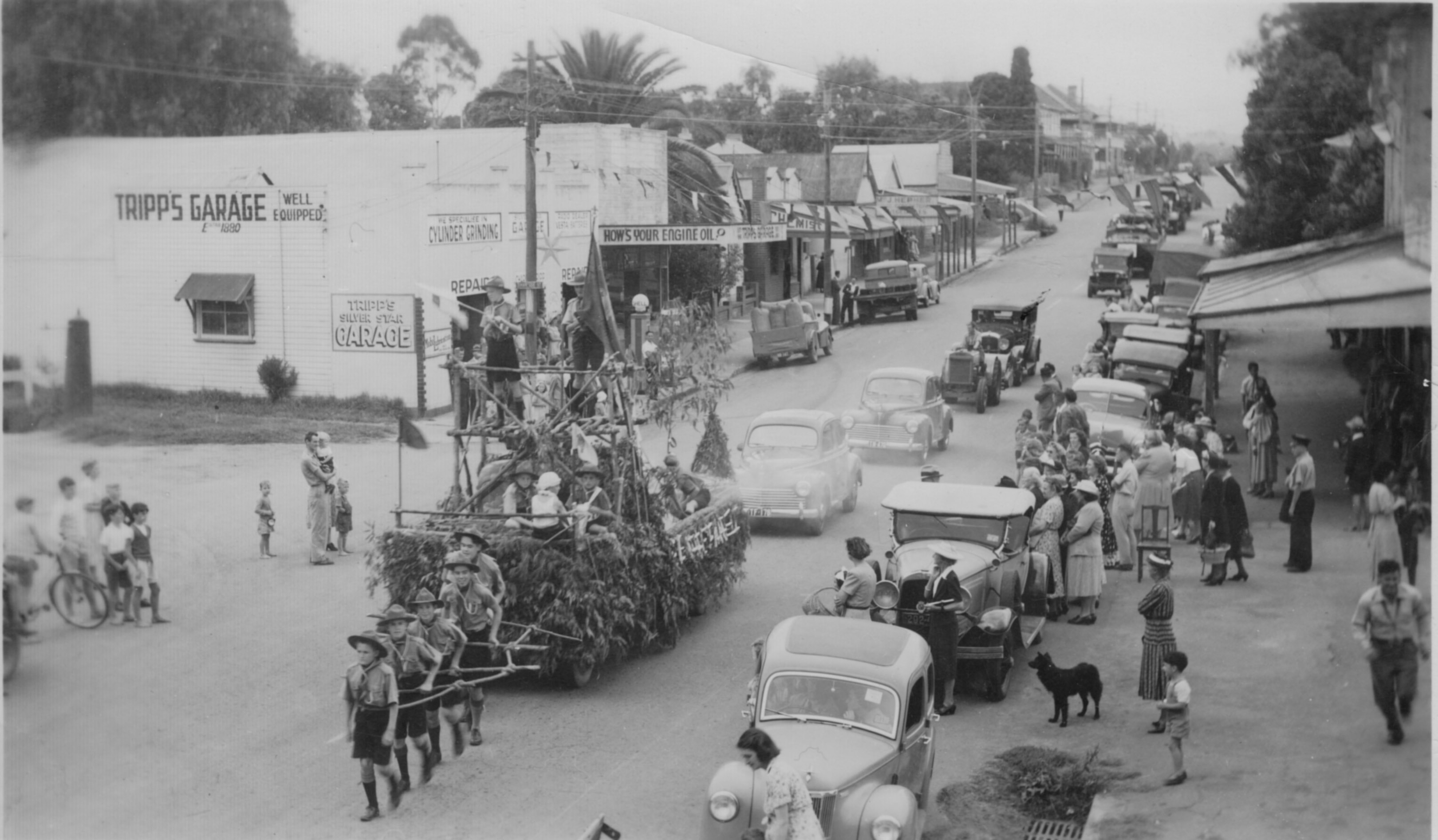
Campbelltown awoke to the sound of bells chiming from St Peter's Church on the morning of the Queen's coronation. They started at 8am and continued until 11am, echoing around the town and for miles away. An amplifying system was intricately set up in the bell tower the night before.

Campbelltown has always loved a street parade and this day was no exception. A procession made its way up Queen Street to the showground, where an impressive Dedication Service was held, followed by a full sports program for children. The newspaper reported that Queen Street was "a flutter with bunting, flags were flying and the Town Hall facade a brilliant fairy land of lights. However, the window dressing of shops left a lot to be desired according to the newspaper reporter!

At 10.30am the procession started from Fisher's Ghost Creek, linking up with school children at Dumaresq Street and the army at Allman Street. Following the army detachment came the Mayor and Mayoress and the Town Clerk and then the floats. The candidates in the Queen competition followed, and then a decorated ambulance and a Leumeah float with the title "The Greatest Show on Earth". All up the procession was about three quarters of a mile in length and the marching was in time! Crowd estimates for those watching were estimated at an impressive three thousand.

Mayor Farnsworth gave a speech at the Dedication Service at the showground. Miss Joyce Channell was announced the Queen competition winner and children's sports followed. Coronation certificates were presented to the children as a memento of the day.

The day's celebrations showed how much the monarchy still played an important part in people's lives. Almost 70 years later after the Queen's passing we have paid our respects to this amazing woman and her long rein.


Written by Andrew Allen


This image is believed to have been taken on the day of the coronation in 1953

Wednesday, 22 September 2021

Mayhem in the Main Street

Driving down Queen Street today is an exercise in patience. The battle for the elusive parking spot, traffic lights and speed limits make the journey down Campbelltown's main thoroughfare a painstaking one. The result is very few accidents; something that was not always the case in years gone by. One of the first fatalities resulting from an accident in Queen Street was the death of Thomas Hyndes. On the evening of Sunday, 19 July 1846, Thomas Hyndes was riding with three companions down Queen Street. When he got to the courthouse (site of present courthouse) he started to ride at a furious pace and when he got to opposite the King's Arms (site of present First Nation Real Estate on corner of Queen and Cordeaux Streets) he was thrown from his horse and killed instantly.
Truck and trailer bogged in front of Wilkinson's plumbing business in Queen Street 1926-1932. (Campbelltown and Airds Historical Society)

On 1 August 1898, an accident occurred in Queen Street in the vicinity of W.W. Lee's store. A horse and sulky owned by Mrs Fowler was standing by, when young Austin Tripp rolled the wheel of a vehicle up the street. The horse took fright and bolted, striking another conveyance owned by Rev. J. Ashmead with considerable force. Miss Ashmead was thrown out of the vehicle but was not seriously injured. The sulky was badly damaged.

A fatal accident occurred in 1926 when James Carroll was driving a horse attached to a sulky along Queen Street when a shaft broke, causing the horse to bolt. The runaway horse and sulky crashed into a cart driven by Aby Adams driving in the same direction. A shaft from the sulky penetrated the rear of the car and went through the lungs of John Adams, the father of the driver. He was rushed to hospital but died soon after.
By the early 1920s, the main street was becoming a dangerous place to navigate. Cattle were still being driven down the street by drovers. A couple of accidents prompted the Council to change the stock route to surrounding streets. Two of these incidents happened in 1921, with one fatal. A young girl was struck in Queen Street by cattle and knocked over, injuring herself. Another accident was fatal. Chun Yueon was killed by a cow that charged at him on Menangle Road near the southern end of Queen Street. Although not in the main street, this accident resulted in the coroner recommending that Council have proper times and stock routes for droving cattle. This lead to a change from droving cattle down Queen Street to running them down surrounding streets, thus avoiding the busy main street. The route was changed a few years later after the Inspector of Nuisances was harrassed by drovers claiming the old stock route was to difficult to navigate. Accidents in Queen Street kept occurring up until 1947. Mary Loftus was desribed as being "hale and hearty" for her age, 75, when a tragic accident took her life. Stepping off the footpath in Queen Street on Christmas Eve at about 8pm, Mary was struck by a truck and fatally injured. She was taken to Camden Hospital where she died not long after. The driver was later cleared of manslaughter.


Written by Andrew Allen

Wednesday, 1 May 2019

Mystery Solved...possibly!


A few weeks ago I posted about the very difficult task of identifying more (actually anything) about the above photograph. I knew my chances of finding anything were remote. However, after some intense detective work, I think I'm on to something!

Very few details about this photograph in our collection existed. There was no date, location or names of the people. All we have is that it was taken in Campbelltown. We do however, have the name of the photographer. The image was taken by Boag and Milligan, Sydney. Research by the State Library of Queensland reveals that these two operated a photography business. The early part of William Boag's career was spent in Sydney where he was in partnership with portrait photographer Joseph Charles Milligan. Boag then went to Queensland in November 1871.

The library was fortunate enough to have two other images of Campbelltown in its collection by William Boag. Both these images were taken in 1871. It can be fairly certain then that this particular photograph therefore dates to 1871. Both the other photographs are of buildings located at the southern end of Queen Street: Mrs Hickey's shop and Bugden's blacksmith shop. In fact both buildings, from the records we hold at the library, appear to have been located virtually side-by-side to each other.

I decided I would search all the 1156 images we held of Queen Street for a building at the southern end of the street that looked like the one above. After trawling through hundreds, there was one that caught my attention. It was taken in the 1950s. It shows what appears to be a very old house and to the left of it, another house. A closer inspection of it however, reveals that it is two houses very close to each other. At first glance the building or buildings don't appear to resemble our building. However, if you imagine looking at them from a different angle, you get a different picture.

Below is the house taken in the 1950s.


If you examine the 1871 house, you will notice a building adjoining it that has a verandah  and roofline elevated from its verandah. The house, like the one in the 1950s photograph, is very close and almost attached to it. Other similarities include the chimneys and the verandah posts. There is also a similar gap where gates can be found at the side of both houses. About 80 years separates both photographs, so changes will obviously have occurred in that time.

It's a shame we don't get a decent shot of the 1950s house from the other angle, as this would probably show where the windows are located and therefore prove one way or another if it is our house.

If we can be sure this is the same house we are looking at, maybe we can then go close to identifying the people in it. Norm Campbell, who is now in his mid 90s, remembers the houses that were taken in the 1950s. He said that Mears family lived in the smaller one on the left (same house as the 1871 one) and the Reynolds family in the larger house on the right.

Norm also confirmed that Bugden's also lived in the house to the left of the other houses in the 1950s photograph. This is of course a much later house and would've replaced Bugden's old blacksmith shop. Mrs Hickey's shop was located 50 metres to the south of the Queen Street and Bradbury Avenue intersection. I measured this and it is exactly where you drive in to the car wash today. Therefore I believe it would've been in the same vicinity as the above buildings, possibly even between Bugden's and the 1871 house. Norm also said that the post in the extreme right of the 1950s image was part of Dredge's cottage.

So, I believe I could possibly have solved this. I can't be certain of course. However, it would make sense that Boag took the three buildings next to each other on that day in 1871.

I welcome your thoughts on this.


Written by Andrew Allen

Monday, 4 March 2019

In the Footsteps of Fred

Very little physical evidence in Campbelltown, if anything, is left to reminder us of the brief life of Frederick Fisher. All traces of the house where he lived, a storeroom and brick building he built, his farm and the fence (or possibly bridge) where his ghost appeared have all disappeared. Even the location of his grave has been lost to history.

Records associated with the court case surrounding the murder of Fred Fisher give us some idea of where these sites were. There are also articles written about the appearance of the ghost in the years following the reported sighting. One such early article was written in 1836, only ten years after the murder. Although not entirely accurate (it refers to John Hurley as the man who claims to have seen the ghost of Fisher and not John Farley), it does offer us with some food for thought, especially considering it was written so soon after the murder and ghost appearance.

The article appeared in Tegg's Monthly Magazine. This publication was only in existence for a few months during 1836. The Tegg brothers were booksellers and publishers in London and came to Australia in 1834. There are some descriptions in Tegg's article that gives us clues about some of the Fisher sites. The article described how Hurley (Farley) passed Fisher's house 500-800 yards when he claimed to have seen the apparition of Fisher. Fisher's house was on the site of the old Bank of New South Wales. This bank, demolished around the late 1950s, was in Queen Street and a few buildings to the north of Dumaresq Street. It was located about where today's Romanoff Clothing Store is at 215 Queen Street. Therefore the location of the ghost sighting, according to Tegg's article, would be about 457-731 meters south of this location along Queen Street. It was on the western side of the street, the same side as his house. If this is accurate, it would mean the location is further south of one of the main candidates for the appearance of Fred Fisher's ghost- the old water course at the corner of Queen and Dumaresq Streets. Many people believe it was a bridge that Fred appeared on however, the first mention of a bridge didn't surface until 1859 when a John Lang wrote about the story. This was 33 years after the event.   

The Bank of New South Wales is the building to the right in this photograph. It stood on the site of Fisher's house. The photo was taken in 1893.


Tegg's article also gives a description of a building behind Fisher's house that was built by him: "The visitant to Campbelltown must have observed as he strolled through the village, a large unfurnished brick building, fast mouldering to decay, which seems to have been intended at the time of its erection for a store". Incredibly, this brick building was still in existence in the 1960s. There was also a stone storeroom behind it. Most of this building was demolished in the 1940s.

The sandstock brick building built by Fisher, still standing in the 1960s. (Campbelltown and Airds Historical Society, Alex Goodsell Collection)

Thomas Davies Mutch, a politician and historian in the first half of the 1900s, also provides opinions on where Fisher's sites were located, based on his research. Mutch pinpointed the site of the murder and the blood-stained rails from a contemporary sketch plan. The ghost, therefore, sits on the southern boundary of Fisher's farm, 55 rods westward from Queen Street. The southern boundary of Fisher's farm was in line with the southern side of Allman Street. Therefore, according to Mutch, the site would be about 276 metres (55 rods) west of Queen Street and directly in line with Allman Street.

The location of where George Worrall buried Fisher was researched by historian Verlie Fowler in about 1980. Using maps and descriptions from Worrall's trial, she was able to locate the sight. It is now where the railway line passes over the dry creek. (see photo below).

Fowler Collection, Campbelltown and Airds Historical Society)

The mystery of exactly where Fred Fisher was re-buried in St Peters Cemetery is, and always will be, a mystery. Theories have always been thrown around, but the truth is that we will never know the precise location.


Written by Andrew Allen


Sources:

THOMAS, Ivor G. 1948
Frederick George James Fisher
In Campbelltown and Airds Historical Society: Journal and Proceedings
Vol. 1, No. 1, pp84-89

Fisher's Ghost: A Legend of Campbelltown
In Tegg's Monthly Magazine
March 1836

Tuesday, 5 February 2019

Tildsley's Butchery


L to R Unknown, Unknown, Phyllis Cracknell, Grace Tildsley, Reginald Tildsley. Photo is undated. (Roslyn Tildsley Collection)
 
Campbelltown Library was recently fortunate to be given a copy of the this gem of a photograph by Roslyn Tildsley. The photograph shows Tildsley's Family Butchers with Reg Tildsley and his wife Grace with Phyllis Cracknell. The other two men on the left are unidentified but could possibly be Bill Coogan and Charles Jones, who were known to have worked there.
 
The shop was located opposite the old post office in Queen Street. The brothers Reginald and Horace moved there in 1922. An advert in the Campbelltown News that same year refers to them as the new butchers opposite the Post Office. The family had a butchery in Camden as well as Campbelltown. In 1923, the year after they moved into the Campbelltown shop, one of their huge wagons carrying carcases was 'smashed to match wood' on the Campbelltown-Camden railway on the night of June 12. Thomas Tildsley, a brother of Reg and Horace, was driving towards Narellan and at the crossing at Curran's Hill he was overtaken by the 5.15pm train from Sydney. The engine struck the back of the vehicle and smashed it into a thousand pieces. It was described as a miracle that Thomas survived.
 
The family overcame the set back and remained at Campbelltown until late 1937, when New Brothers secured the business. The butcher's shop no longer stands. Reg lived a long life and in his eighties was still trying to have an input into the Camden business. Although long retired, he would creep into the shop and start making sausages!
 

Written by Andrew Allen


Sources:
 
HOLM, Marie et al 1985
Campbelltown 1930-1940 Dumaresq Street and Environs
 
Brisbane Courier, 13 June 1923, p13
 
Camden News, 16 December 1937, p5
 
Leila Spearing Interview 26 April 1978, held at Campbelltown Library

Friday, 30 June 2017

Golden Arches

Campbelltown's first McDonald's restaurant dates back to 1976. This was one of the first McDonald's restaurants in the Sydney metropolitan area. The original restaurant was located at the same position as today's building on the southern end of Queen Street. CC Tyre Service occupied this spot prior to McDonald's. The restaurant opened for business on Monday 5 January, 1976. More than 80 local people were employed to staff the new McDonald's which was built at a cost of $250,000. The building in Queen Street was considered to be a modern design and a significant improvement on the company's other restaurant chains. The new manager Tony Puccio estimated that the restaurant would turnover $15,000 weekly. Compare this to today! Take a look at the advertisement for the new "Queens Street" chain that appeared in the local newspaper, the week it opened. Imagine paying 25 cents for French Fries (described as "chips" for the uninitiated) and 25 cents for a coke!


It seemed Campbelltown was gripped with McDonald's fever after it first opened. On 7 February, a month after the opening, an enormous record-breaking crowd was drawn to an appearance by Ronald McDonald at the restaurant.

When the Queen Street McDonald's was taken over by Ken and Maureen Tagg in August 1984, they changed the restaurant's image, transforming it to depict Campbelltown's pioneer origins, complete with a homestead style verandah. Ken Tagg became one of the town's leading business identities. He had already opened a McDonald's at Minto in 1982 and by the late 1990s would own a dozen local outlets. He invented the Happy Meal and his generosity to local groups saw him voted Citizen of the Year in 1994.

The Queen Street restaurant made a number of improvements over the years, including a new drive-thru service on 5 January, 1981, exactly five years after it opened. This was regarded as cutting edge technology for the day. In 1983 a bomb hoax made headlines after the restaurant was forced to evacuate.

In 1987 a new location was opened in Woodbine. The Queen Street building was demolished in 2005 for a new restaurant on the same site. This new building was set further back from Queen Street.


The original "Maccas" built in 1976. Note how close it was to Queen Street.


Written by Andrew Allen

Friday, 16 June 2017

Zillah's Fortunate Life Recalled


Zillah Dredge photographed in 1931 (Sue Dredge Colection)


Zillah Dredge had much to tell about her amazing life when she was interviewed in 1979. She had endured hardships like the First and Second World Wars, The Great Depression, suffered the shattering loss of a child and the premature death of her beloved husband. Yet she had many joyous moments mixed in with the tough times. Her long life, lived entirely in Campbelltown, saw many changes to her beloved home town and she recalled some amazing stories and characters in her interview to the library. I thought I'd share some of her thoughts with you.

She was born Zillah Victoria Cooper in a house on Camden Road in 1897. Her father drove a bullock team. Not long after the family moved to a house in Broughton Street, then to Allman Street and then again to Airds Cottage, where the Campbelltown Craft Society now meet. She referred to it as the Red House when she was living there. Her first school was the Catholic School on Old Menangle Road where Quondong is today and then at Miss Clark's private school in Cordeaux Street.

Zillah recalls how her mother would tell her the story of how her grandfather allegedly saw the ghost when returning home from the markets on his bullock dray one night. 'I think the spirit he saw was more of the drinking variety than ghostly" she said. "We sort of grew up with Fisher's Ghost; it was something that we always accepted".

Zillah married her husband Ray during the war years in 1916. The happy couple married a few months after Ray enlisted. She recalled that it was a war romance which was "pretty hard to take". She continued: "I can remember coming home crying on the mail train and someone saying "it is so sad", but you got accustomed to it". Their first home was in a house next to the Club Hotel (today's City Hotel). They then bought a milk run which they ran almost up until World War Two. In this time she and Ray lived in three more houses: in a brick house on the corner of Oxley and Dumaresq Streets; in a house in the middle of Queen Street that belonged to Sam Bursill; Queen and Dumaresq Streets where the 7-11 stands today.

The Depression hit the family hard and Ray was forced to supplement his income by trapping rabbits at Douglas Park, selling the skins and providing local butchers with the carcasses. Families like the Dredges had to improvise just to live. Zillah's daughter Joyce recalled picking blackberries to make jam and catching rabbits to put in a stew. In the late 1930s, just as things were beginning to pick up, their two horses and the cart were stolen. With no money to replace them, Ray had to give up the farm and sell their milk and ice run business.

Zillah and Ray had five children. The youngest Royce died when he was only two in 1935. Zillah recalled that this was the only unhappy time in her life. Her third youngest was son Doug who, according to Zillah, got into more trouble than the others put together. She recalled an amusing story about him in her interview: "For instance the old Camden tram. He was keen on mushrooms and he was out mushrooming and he was coming home and was caught on the bridge and the tram was coming. He lay down and the tram went over him. He had a silk shirt on and I searched high and low for that shirt and never knew where that shirt went to until we moved the wardrobe and there was a small crevice behind it. Right pushed against the wall where you couldn't possibly reach it was that shirt covered in oil where the tram went over him. He said he had to do something so he lay down."

The family moved again in the late 1930s to 303 Queen Street in the house now known as Dredge's Cottage. Zillah lived here until just before her death in the late 1980s. She spoke fondly of her days here. One day that wasn't so pleasant was in 1972 when a truck loaded with roof tiles crashed through her front door. "Fortunately I was next door with Mrs Taylor who had the shop next door". She had been talking on the telephone for about ten or fifteen minutes before the truck came crashing through. "The truck had swerved to miss a car, hit the car and swung it around about three times, came in directly over the veranda and right in".

Zillah took an active interest in sport and making bark paintings. She was involved in the CWA and Legacy. Her husband Ray died in 1966.

Zillah's long and happy life came to an end in June 1988. She was buried with her family in St Peter's Cemetery. The house in Queen Street, Dredge's Cottage, became the Veteran's Recreation Centre.


Zillah in her garden at the back of Dredge's Cottage after the land was sold to Campbelltown Mall (Sue Dredge Collection)


Written by Andrew Allen


Sources:

From the Trenches to Sewer Lane: A Story of the Dredge Family by Des Lowe

Zillah Dredge Interview at Campbelltown Library in 1979


Saturday, 17 December 2016

Stuck in the Mud


Every now and then I discover a photograph in our collection that fascinates me. Images like the one above are remarkable for highlighting how much Campbelltown has changed over time. This photograph was taken around the late 1920s to early 1930s and shows a truck bogged in mud in Queen Street.

There are many components of this image that are interesting. Firstly, it's difficult for us to imagine today that a truck could get bogged in Queen Street! Also, look at the simple design of the truck. Definitely no bells and whistles with this one. Look at the small child on the left posing rigidly for the camera. There's even a small dog in front of the truck that seems to know he has to look straight at the photographer. Someone has ridden to the scene on a push bike. Look at the number of people crammed into the trailer so they could be part of the photo, although those at the back could not stay still, and therefore appear as a blur.

The truck is bogged in front of Wilkinson's Plumbing business in Queen Street. William Wilkinson was a plumber who had businesses in Camden and Campbelltown. He began his Campbelltown business in 1912 and shared this building with saddler Cyril "Midnight" Brown. You can just make out the name Brown on the side of the awning on the right hand side. William Wilkinson's son Fred took over his father's business when he returned from the First World War. The building to the left of the plumbing business with the two tall chimneys would be the Old Post Office building.

The location of this photo today would be approximately in front of Campbelltown Newsagency and H & R Block Tax Accountants buildings.


Another photograph of Wilkinson's Plumbing. This image is an earlier one and is dated 1912.

Both images come from the Campbelltown and Airds Historical Society Collection.


Written by Andrew Allen


Tuesday, 23 August 2016

Carolyn's - a fashion icon.

Mrs Alice Minut, (born Alice Penrose Hepher in 1926) owned and ran Carolyn's Frock Salon in Campbelltown for many years. In 1951, the frock shop trading under the name "Miami Fashions" was bought out, and became "Carolyn Fashions". Alice Minut was employed there for five pounds a week. She eventually bought the business, and the name "Carolyn's" stayed.
On one side of the shop was Alice's brother Jack Hepher's bicycle shop, and on the other, Mrs Fairburn's fruit shop where Alice's sister Nell worked. With a tiny seven foot frontage, and a tiny turnover to match, Alice would be buyer, sales lady, cleaner, and also do alterations when required.


In about 1956 the shop moved to a new location, in the old Bagley's Newsagency building. The business grew, and so did the team. Carolyn's held fashion parades, entered floats in local parades, did fancy window displays for special occasions, and ensured that their clientele were offered up to the minute fashion choices.


Through the sixties and seventies the iconic Carolyn's Frock Salon continued - does anyone know when it finally closed it's doors? Or have memories of shopping there? We would love to hear from you!


Written by Claire Lynch

Sources
www.heavenaddress.com/Alice-Penrose-Minut/423741/obituary
Campbelltown Ingleburn News 11.4.1967 & 15.6.1976
Our Past in Pictures Database, Campbelltown Library


Wednesday, 15 June 2016

The One Armed Butcher

 
Photograph coutesy of Campbelltown and Airds Historical Society

The man with his head down in the back row and second from the right in this 1947 photograph is Ted McPherson. Look closely and you can see he is missing his right arm! Ted McPherson was affectionately known as "the one armed butcher". His shop was located next to Lack's Hotel near the corner of Queen and Railway Street. Ted worked with Bill Coogan when it was known as Coogan's Butcher Shop and took it over on Coogan's death in 1962. It seems Ted moved to the Illawarra after leaving Campbelltown and died there in 1991.


The butcher shop can be seen in the undated photograph above on the extreme left. Lack's Hotel is the large building on the right. (photo courtesy of Mick Murgatroyd)


Does anyone remember the one armed butcher? Perhaps you remember the butcher shop? I'd love to hear from anyone who does.


Written by Andrew Allen

Wednesday, 6 April 2016

Cemetery Walking Tours and Queen Street Display


Check out what the library's planning for the Heritage Festival this year! We will celebrate Campbelltown’s extraordinary past with walking tours of two local cemeteries and revisit historic Queen Street through a photographic display at HJ Daley Library, as part of the 2016 National Trust Heritage Festival, from 16 April to 29 May. 
 
Take a guided walk through St David’s Presbyterian Cemetery on 4 May or the Methodist Congregational Cemetery on 12 May, and be amazed as I recount fascinating facts and quirky stories about Campbelltown’s most famous former citizens. Both tours run from 11am to noon and are free, but bookings are essential on 4645 4436. 

Or re-live the past and take a nostalgic ‘stroll’ down the Queen Street of days gone by, as HJ Daley Library presents the history of Campbelltown’s main street in a photographic display, highlighting businesses from the town’s past. ‘Rediscover Queen Street’ will be on display at HJ Daley Library from 26 April to 26 May.


Wednesday, 9 December 2015

The Clayton Sisters

The library recently came into the possession of some fascinating photographs. They have been shared with us by the Campbelltown and Airds Historical Society and were donated to them by Michael Clayton from Young.

The photographs are taken in 1926. They show two unmarried sisters named Clayton who were living at the Club Hotel at the time as well as members of their family who were on a family visit. Some of the shots are of locations nearby. I personally like the one of the two sisters in the garden at the back of the bank all dressed up and posing in their finest attire.

I find it fascinating that two spinster sisters would choose to live together at a country hotel- something that belongs to a bygone era I guess. I wonder what became of the Clayton sisters?

The Club Hotel was on the corner of Queen and Cordeaux Streets. It was demolished in 1986.


Club Hotel 1926
 

Club Hotel 1926
 
 
Margaret, one of the resident sisters, with Jess and Ellen on the veranda, Club Hotel
 
 
Margaret and Ultima on the veranda
 
 
Bland Clayton visiting his sisters
 
 
Sisters in the garden at the back of the Bank of NSW. Photo taken by Mr Brown the Bank Manager.
 
 
Clayton sisters at the top end of Mawson Park with St Peter's Church in the background.
 
 
Colleen on swing, aged 4, niece of Ben Clayton. Photo taken by Ultima in Mawson Park with St Peter's Church in the background
 
 
Clayton family

Thursday, 12 November 2015

More Rare Photographs

The library has purchased the remaining rare historical photographs of Campbelltown places from the State Library of Victoria (see http://campbelltown-library.blogspot.com.au/2015/05/historic-photographs-unearthed.html). It's exciting to be able to show these wonderful old images to you at a high resolution. So here they are! Remember to click on the image for a larger one.


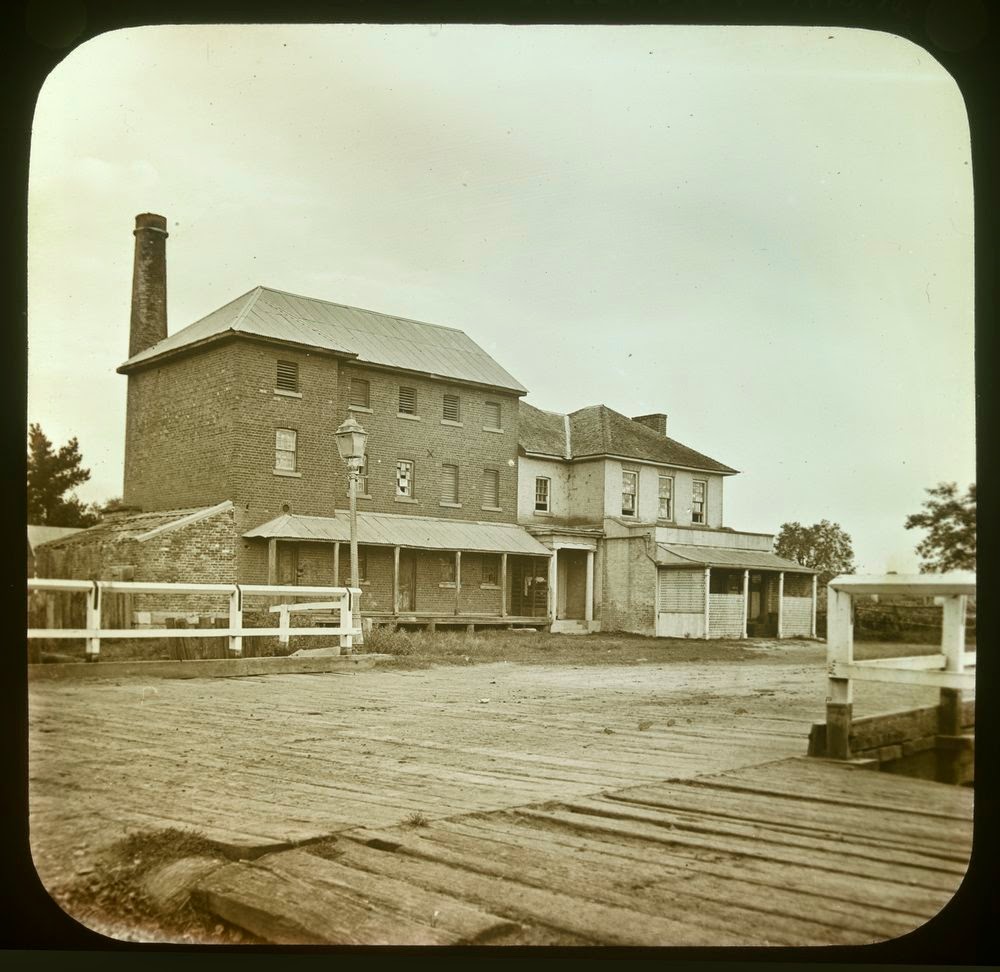
This photograph has the title of "One of the 1st Mills in the Colony Erected about 1817". The mill was actually erected in 1845 by Laurence Kendall and William Orr. It operated as a steam-driven flour mill. In 1861 Sims, Barker and Bocking leased the mill. James Bocking later purchased the property and it became Commerce House. Bocking and his sons used it as a grocer, baker, draper and general store.

Dr William Mawson demolished the mill in the 1920s and converted the adjoining mill house into Milby Private Hospital.

This scene has changed dramatically. The only structure remaining is the now dilapidated old Fisher's Ghost Restaurant, the former mill house. The waterway now runs underground close to where McDonald's drive through is now located. It once ran under a bridge that spanned Queen Street in front of today's entrance to Campbelltown Mall's underground car park. The photo is dated 1924.


This image has the title of "Old Mill at Mt Gilead, Campbelltown". Note the man sitting in the window at the bottom. The wooden sails have almost gone. This shot was taken in 1924, almost a hundred years after it was constructed. The windmill still stands today on the property and can be seen from Appin Road.


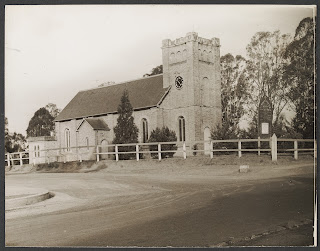
This one is of St Peter's Church of England taken on April 4, 1940. On the western side of the church is Howe Street which used to run from Browne Street to Cordeaux Street. It was removed in late 1969 and grass laid on it for an extension of Mawson Park.


The title of this photo really intrigued me when I first read it. It's titled "Convict Gaol at Mt Gilead Near Campbelltown" and taken in 1925. I had never heard of a gaol at Mt Gilead and wondered why it was there. After doing some research I believe the photograph could be the old servant's barracks. In the July 1994 issue of Grist Mills, Verlie Fowler refers to a photograph taken by Frank Walker entitled "the old barracks, used for accommodation of the assigned servants in the early days". It showed the building without a roof like this one. Is this Walker's actual photograph? She did, however, state that evidence had yet to be found to support this being a barracks.


Written by Andrew Allen

Friday, 4 September 2015

Queen Street in the Late 1960s


Time for a walk down memory lane. This photograph would've been taken from the roof of the old Macquarie Cinema on the corner of Queen and Browne Streets looking south west. Those of you living in Campbelltown in the late 1960s would remember this part of Queen Street back then. (Click on the image for a larger version)

In the foreground on the left is Mawson Park with the Club Hotel also on the left on the corner of Queen and Cordeaux Streets. On the other side of Queen Street starting from the right is Ted McPherson's butcher shop which was at 151 Queen Street. Moving left and next to the butcher is Richie Hand's barber shop. Next to that is a milk bar owned by Con and Peter Papapandos and formerly operated by Grallelis'. Then we have a group of 2 storey buildings. The first on the left belonged to Ryall, Smith & Co, accountants, typing, duplicating and photocopying. It was upstairs and above Carolyn's Frock Salon. G E Eves, photographer was next at 157 Queen Street and this was also upstairs. Geoff Eves took this photograph and took many street scenes around this period. He still lives in Campbelltown. Moving left we had William B. Leckie, Chemist, at 159 Queen Street.

Moving further to the left, a vacant block of land sits beside two large buildings. On the right is the Bank of NSW, previously the Balalaika Cafe. On the other side of the vacant block is the Commercial Bank of Australia, later Bank of NSW and then Westpac. On the first floor was M R Newton, solicitor and J M Daly, surveyor. This site used to be occupied by Reeve's Emporium. Patrick Street is on the other side of this building.

Just out of the picture to the left is Lack's Hotel which was on the corner of Queen and Railway Streets.

Do you remember these businesses? We'd love you to share your memories with us!


Written by Andrew Allen


Source:

Campbelltown Ingleburn News, September 30, 1969

Thursday, 4 June 2015

Alpha House

Alpha House was originally known as Patrick's Hotel and not long after the Coach and Horses Inn. It was built in 1842 by Anne Byrne and was then owned in the 1840s by Charles Morris who had a mill coaching service.

The building had many uses during its existence. There is evidence that it was once used as a court house and even a gaol. The building was also used for Presbyterian church services by Reverend Gilchrist. It was once known as Hammond's Grammar School and about 1860 it acted as a School of Arts. It then became well known as the home of local politician John Hurley MLA. Hurley died here in 1882. The Hurley's continued to live there at least up until the death of John's wife in 1892. Some time prior to 1930 it was used as a private school run by Miss Whittingham. She boarded upstairs and used a room as a classroom.

The building was wonderfully palatial.  It had two storeys at the front and three at the back and eight bedrooms, four sitting rooms, a large ballroom and hall, cellars, detached kitchen and laundry. There was also a coach house and stabling for 16 horses. It was made of brick with its front verandah flagged in sandstone and the slate roof supported by Georgian pillars of wood.

After Miss Whittingham left, the building was used by Daniel Longhurst up until 1938. Demolition of the building commenced on 5th July that year to make way for the new Commonwealth Hotel which was to later become the Good Intent Hotel. Bricks from Alpha House were used in its construction. The Good Intent was demolished in 1982 to build the new Campbelltown Mall which opened in 1984.

Luckily there are a few photographs of Alpha House. They show us what a grand building it was.


                                               Alpha House taken in 1871


Looking North on Queen Street with Alpha House on the left. Taken in 1875.


This is a later photograph (1920) of Alpha House (Courtesy Campbelltown and Airds Historical Society)

1937 photograph of Richard Watkins in front of a horse-drawn baker's cart in Queen Street with Alpha House in the background (Cooper Collection. Courtesy Campbelltown and Airds Historical Society)


Written by Andrew Allen

Thursday, 7 May 2015

Historic Photographs Unearthed

My colleague at the library recently discovered a number of historic photographs of Campbelltown held in the records of the State Library of Victoria. These photographs are unfamiliar to myself and other active historians in the town. They're of a high quality and provide a fascinating insight into our town's past.

I've included 5 from the list that are all out of copyright and therefore able to be copied at a high resolution. We are in the process of purchasing the remaining photographs from the State Library of Victoria and I will show them when ready. I hope you enjoy looking at the photographs below as much as I have.


This photograph shows Kendall's Mill later to become Bocking's Mill. The building on the right is all that remains today and is known as the old Fisher's Ghost Restaurant. Note the bridge in the foreground over a creek that no longer exists. The image is undated.


An undated photograph of St Peter's Church, Campbelltown
 
 
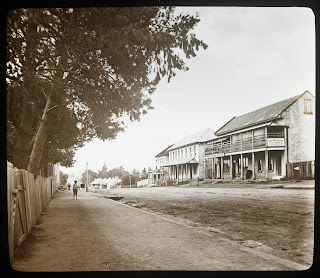
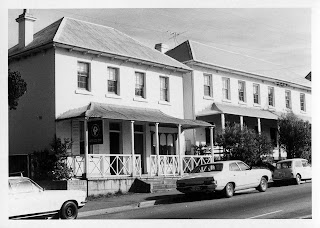
A wonderful and previously unseen photograph of the colonial houses in Queen Street opposite today's Campbelltown Mall. From the evidence available the photograph can be dated to about 1884-1886.


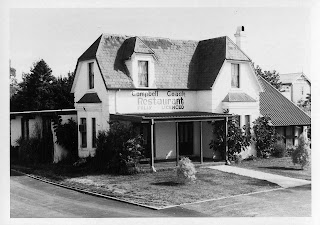
Today's Golden Wheel Chinese Restaurant in Queen Street which was previously the Campbell Coach Restaurant and before that the Congregational Manse. 
 

This photograph was taken in the 1970s and is one of the colonial terraces in Queen Street mentioned above.