Showing posts with label Ingleburn Council. Show all posts

Wednesday, 20 January 2021

The night they blew the safe!

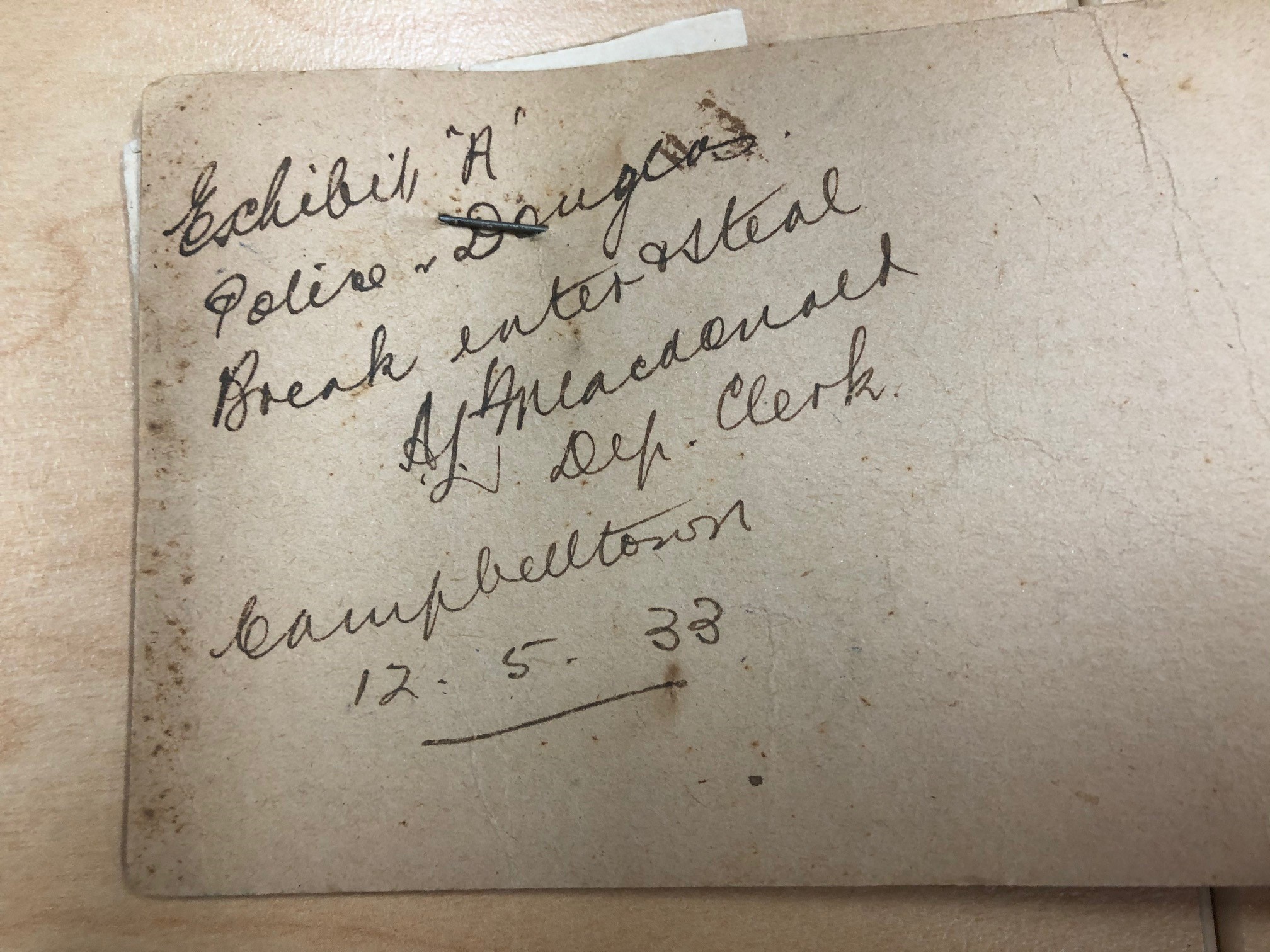
I recently opened a pamphlet file which contained a very old cheque book. My curiosity was piqued by the little note on the front of it – see photo below. 

The note on the front of the cheque book

Inside the cheque book - Police v Douglas


This led to an interesting tale of theft and forgery!
During the night of the 19th and 20th April 1933, Ingleburn Council premises were broken into. The safe was blown, and a number of items stolen. These included a pistol and cartridges, postage stamps, cash, some loose cheques, and a cheque book. Constable Best of Campbelltown attended the Ingleburn Council Chambers at 10.30 am on the 20th April, where he saw that the safe had been blown open, with the safe door off its hinges. There were books and papers strewn about, plus a quantity of putty (explosive) in a paper towel. Most importantly was a paper match case on the floor near the safe. The side window had been forced open.
Shockingly, another go was had at the Council Chambers on the 28th April, just 9 days after the first robbery. Not as competent as the first attempt, the robbers left a large amount of putty all over the Town Clerk’s office, to his considerable annoyance, and only escaped with a few pounds.

Ingleburn Council Chambers as they were in 1933

In the Campbelltown Police Court on the 19th May Mr John Charles Douglas was charged with breaking and entering the Ingleburn Council Chambers. Douglas had been questioned by Detective Surridge of the Parramatta Police. Douglas tried to explain away the cheque book he had in his possession by stating it had been given to him by another man, who, not surprisingly, was unable to be located. Douglas had passed two cheques on Gowing Bros and Hordern Bros, after forging the name of H.J. Daley on them.

Cheques in the stolen cheque book


Detective Surridge showed Douglas a cardboard match case bearing the words “Boomerang” 53 Market Street, Sydney – the same match case that had been left behind at the robbery. Douglas admitted to having one ‘similar’.
Douglas was remanded to stand trial at the Parramatta Quarter Sessions on the 6th June, which he did. He was charged with breaking and entering, and was convicted on an alternative charge of receiving. He was sentenced to 12 months hard labour.
The Council Chambers must have been seen as an easy target, as they were broken into yet again on the 21st June. The safe door withstood the charges, and nothing of value was taken. Bryan Chrystal recalls this incident as follows - "I think he (Harley Daley) got the job of Town Clerk in the 30s. This was right in the middle of the depression. Part of his job was handing out the dole and also if they did any relief work. They had a big strong room in the middle of the Council offices. This particular night, apparently they all knew that the money had come in and he had put it away to pay out the next day. These two characters must have come in and put gelignite on the door of the safe and they detonated it. They didn’t get the money because the building fell down all around the strong room. It made a real mess of the Council Chambers. He always told that story."

Written by Claire Lynch
Sources 
Trove
"Campbelltown Recollections"
 https://www.campbelltown.nsw.gov.au/ServicesandFacilities/Libraries/LocalStudies/CampbelltownRecollectionsStoriesFromOurPast

Monday, 9 April 2018

Ingleburn Weir

What exciting news it must have been for the people of Ingleburn when they found out they were getting a pool built in the George's River for them. This was pre World War Two and ahead of its time compared to other councils in Western Sydney. The pool proved to be very popular with Ingleburn families, with almost every child from then on recalling fond memories of the Ingleburn Weir as it was known.

The first reference to building the Ingleburn Weir is in the Ingleburn Council meeting of 10 November 1936 when it was resolved that "the clerk [HJ Daley] be authorized to obtain information and estimates for the construction of a weir across the George's River for the purpose of providing a swimming pool". A recommendation to proceed was adopted the following month. Council records indicate that the weir was constructed between 6 March 1939 and 22 January 1940.

 
Above photograph: How Ingleburn Weir looks today
 
The weir was constructed by local Fred Goodsell. According to Arthur Hounslow "he was a builder of sorts and he lived locally and he was given the job." It is believed that stone for the weir was quarried in an area off Cumberland Road. Bert Wallace was the overseer.While Fred Goodsell was responsible for building it credit for organizing its construction is given to Harley Daley. Peter Benson explained that unemployed people were used to help with the building the weir. It became known by Ingleburn people as "Harley's Folly".
 
The weir became the recognized swimming hole in Ingleburn in the years after its construction. Scouts would regularly attend camps near the weir and it was used for swimming events. This remained the case for many years.
 
Campbelltown City Council have identified Ingleburn Weir as having local heritage significance. The weir has also been identified by the Department of Primary Industries (Fisheries) as a high priority site for remediation work to facilitate the passage of fish, which may impact on the heritage significance of the weir. Despite its heritage significance, the weir was in a dilapidated state until conservation works were undertaken in recent years.
 

Written by Andrew Allen


Sources:
 
Ingleburn Weir Heritage Impact Statement, November 2007
 
Leishman, Alan J. July 1997
Ingleburn Weir: History and Status Discussion Paper


Friday, 20 March 2015

Harry and Vic Chivers

The Chivers family of Ingleburn were much loved and respected. Harry is best remembered as the former Ingleburn Council's longest serving mayor from 1921 to 1931. His son Vic had a distinguished war record and played a prominent role in early Ingleburn's commercial life.


Harry Chivers as mayor (on the extreme left) is on the platform with 3 other unidentified men


Thomas Henry Chivers, better known as Harry, was born in New Zealand in 1871. He came to Ingleburn around 1907 and joined Ingleburn Council in 1913 before becoming mayor in 1921 and for the next 10 years. He had endless energy and achieved much for the Ingleburn community. Water from the city was connected to Ingleburn homes during his term but his crowning glory came in 1930 when electricity was first switched on in Ingleburn. Harry was listed as a farmer but also had a shop in Ingleburn. The family home was a beautiful old house known as "Dunrobin" in Sackville Street. He lost his first wife Sarah in 1918 and re-married in 1919 to Alice Smith. Harry died in 1935.


Chivers family outside their shop in Oxford Road, Ingleburn 1925-1925. Harry is on the left with 2 unidentified girls. (Verlie Fowler Collection)


Albert Victor Chivers, better known as Vic, was one of two sons of Harry that served in the First World War. He was born in 1897 and was working as a printer when he enlisted in 1915. He served at the Somme but in February 1917 was sent to England with bad trench foot and did not rejoin until August. He served at Ypres and in April 1918 was admitted to hospital ill.    


 Chivers family outside their home Dunrobin, Ingleburn (Verlie Fowler Collection)


After the war Vic worked as a shop assistant. He married Hilda McIlveen, the daughter of a local shop owner. He joined the 4th Battalion in World War 2 and was discharged in January 1945. Vic Chivers lived with his family at 34 Chester Road, Ingleburn. He died in 1976.


L. to r.: "Wac" Allan, Victor Chivers and Bill Hilder at the opening of Ingleburn RSL in Chester Road, Ingleburn (Enid Lowsby Collection)