Helm's Cottage, 160 Lindesay St (Bagley Collection, CAHS) |
Thursday, 23 June 2022
Jimmy Helm's Cottage
Tuesday, 7 June 2022
Rachel
Last week I was invited to the launch of Jeff McGill's new book titled Rachel. Jeff's book has been 40 years in the making and is the result of meticulous research and passion, typical of his books. I enjoy the way Jeff transports you back in time. I feel as though I am there on the crowded and chaotic goldfields; with Rachel on her horse as she chases brumbies through the Warrumbungles or sharing her overwhelming grief for her husband, taken so early as many from that period were. What a life she led. Too often the lives of women such as Rachel are overlooked, despite the significant contribution she made to the places she lived. It is easier to write about men from the time as their lives were regularly described in glowing obituaries. However, pioneering women's achievements were often overlooked. This makes Jeff's Rachel all the more deserving of recognition.
If you are seeking a book that you can't put down for your next read, look no further than Jeff McGill's Rachel. Published by Allen Unwin- Australia, it is available at most book shops and copies have been ordered for Campbelltown Libraries.
Written by Andrew Allen
Tuesday, 31 May 2022
A Sporting All-rounder
Campbelltown has produced a number of sports people that have got on to make a name for themselves in the national and international arenas. Names like Joe Quinn, Alyson Annan and Jack Crawford come to mind. However, I discovered on the weekend that another sportsman from Campbelltown had success in two sports and his name has largely been forgotten.
Cecil Dudley Seddon was born in Campbelltown on 3 July 1902 to parents Hezekiah and Janet. He dropped his first name and became known throughout his life as Dudley. The Seddon family played an important role in the development of Campbelltown. Dudley's father Joseph Pickles Seddon moved to Campbelltown in 1887 and purchased the cordial manufacturing business off Mrs Hurley. The factory was located in Short Street, opposite the train station.
Dudley first took an interest in rugby league and excelled at it. He played for the Newtown "Blue Bags" from 1920 to 1926. He was one of the New South Wales rugby league team's three-quarters in a representative match against Queensland on 5 June 1921.
Although Dudley was described as tenacious and plucky, he was quite small in stature and it was this disadvantage that made him switch to his other passion- cricket. He made his first-class cricket debut in a 1926/27 Sheffield Shield match against Queensland. A middle order batsman, Seddon made just six and four.
He had to wait a year to make his next appearance, which came against Tasmania. Dudley failed again, only making 10 and 22 in his two innings.
He made three appearances in New South Wales's winning 1928/29 Sheffield Shield campaign. His best performance came against Queensland at the Sydney Cricket Ground, where he made a pair of half centuries (80 and 59). In his final first class innings that summer, he made a career best 134 against Tasmania.
However, it was probably as a national selector that Seddon became famous. He was a selector for the national team along with Sir Donald Bradman and Jack Ryder for the 1954/55 season against England. He was a national selector from 1954 to 1967.
Dudley Seddon died at Dulwich Hill in 1978.
Written by Andrew Allen
Thursday, 26 May 2022
Then and Now Photographs
Here are some more then and now photographs showing the changes to various local sites over time.
This is the corner of Hoddle Avenue and Grandview Drive, Campbelltown probably in the 1960s.
The same scene in 2022. Established trees now obscure the view!
This building was part of the Russian Orthodox settlement at Kentlyn.
I assure you the building remains relatively unchanged from the above shot!
The building known as the Coaching House at the southern end of Queen Street before it was renovated in the 1960s.
This what it looks like today. This group of colonial terraces was thankfully saved from demolition in the 1960s.
Written by Andrew Allen
Tuesday, 3 May 2022
The lost name of Riversford
![]() |
| The Railway Hotel, shown above, built in the 1850s, was on the then Eastern side of Menangle Rd but the re-alignment of the road would now place it either under or on the Western side of the road. |
Wednesday, 13 April 2022
Easter in 1945
It is fascinating to read old newspaper articles about Campbelltown and how much life has changed. I was reading the Campbelltown News in 1945 and an article describing what happened over the Easter period. The weekend was completely devoid of sport and unlike today where various football codes play on Good Friday, back in 1945 sport anywhere was strictly forbidden. This extended locally through to the Easter Monday.
Every Good Friday since 1936, the Maryfields Franciscan Novitiate celebrated the "Via Crucis" or "Way of the Cross". The service depicts Christ's journey to Calvary, and consists of the 14 stations of the cross, culminating in the preaching of the Passion sermon at the final station. In 1945, heavy rain reduced the number of pilgrims that attended, although 8000 still made the journey. I was amused by the language the paper used to describe how such an influx of visitors affected the town: The influx of visitors on that day very quickly depleted the edibles and cordials at the local Cafes and refreshment shops, and with Saturday being a closed day food commodities and these establishments were practically nil for Easter Monday's influx of visitors. Imagine how our current population would cope with this inconvenience today.
Crowds gather for the first Via Crucis at Maryfields in 1936
Written by Andrew Allen
Source:
Campbelltown News, Friday 6 April 1945
Thursday, 10 March 2022
The 1961 Flood
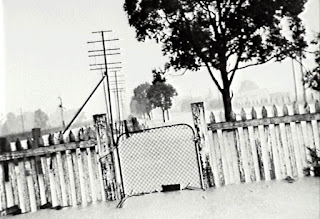
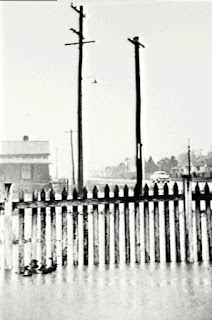
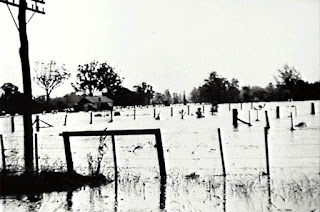
The Macarthur region experienced severe flooding this week and we are all looking forward to overdue sunshine. Floods are nothing new to Campbelltown. One of the worst was in 1961. Newspaper coverage was extensive and fortunately a number of photographs were taken to capture the extent of the inundation.
Locals Share The "Big Wet" was the headline from the Campbelltown-Ingleburn News that week, indicating that nowhere in the area escaped. The deluge started on the Saturday afternoon of November 18 and continued relentlessly through to the Sunday morning. The paper reported that "Residents awoke at dawn on Sunday morning to look out upon a sea of water". Traffic was driven to chaos as most of the roads around Campbelltown were closed. Residents in the low lying areas prepared to leave as the flood waters rose. The peak of the flood at Campbelltown was at 7.30am on that Sunday morning and downstream at Glenfield at 9am. Even Queen Street was under water and not trafficable until about 8am.
The severest flooding of homes in the municipality occurred at Macquarie Fields where Bunbury Curran Creek flooded adjacent areas. Police and rescuers there used rowing boats to visit the affected homes to ensure the occupants had left. This proved difficult however with the strong current.
The rain cleared up a little after Sunday and through to Monday. Then on the Tuesday morning just before 9am, a flash storm resulted in 160 points (40 millimetres) of rain in 20 minutes, and within 30 minutes caused flooding worse than on Sunday morning. The drainage from Sewer Lane (today's Dumaresq Street) blocked from excessive floodwater. Some of the places affected were Tripp's Garage and the Balalaika Cafe Library!
One of the areas heavily affected was Minto. Residents who has lived most or all of their life there thought it was the worst flooding in memory. The floor of the studio of well known sculptor Tom Bass was flooded and some models were affected.
The following photographs were taken at Minto from the Number 2 Railway Cottage.
Written by Andrew Allen
Source:
Campbelltown-Ingleburn News, 21 November 1961 p1