Thursday, 13 January 2022

Matilda's "Mountain View"

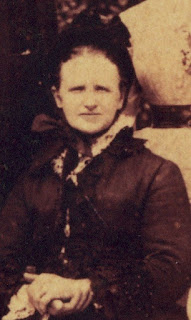
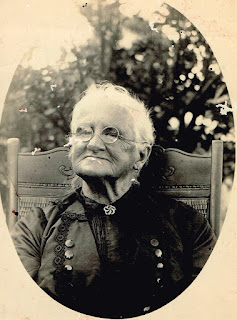
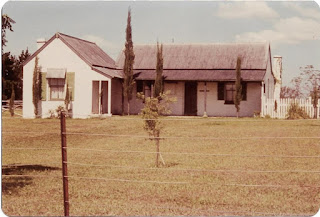
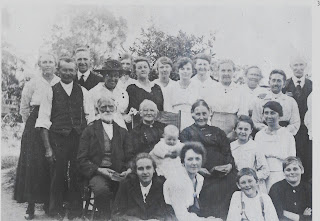
The library is always excited to receive donations of old photographs. Ken Denison visited before Christmas and kindly donated many photos from his collection of the Denison family that once lived in East Minto. The photographs show various generations of the Denison family, including the matriarch Matilda and the family home "Mountain View". Matilda led an amazing and long life. Some of her experiences and images from the collection follow below.

It was common in the early days for women to miss out on the glowing obituaries reserved for men. When Matilda Denison passed away in 1927, she became an exception to the normal. Matilda Clarke was born in Birmingham, England in 1840 and moved with her family to Australia three years later. The first of many set backs in her life occurred the following year when her mother passed away, leaving six children to the care of her husband. John Denison passed away in 1897 and tragically their two sons William and James drowned 13 weeks later after being washed off rocks at Botany. Matilda undoubtedly drew on her strong faith to get her through those difficult days.

Aged 17, Matilda attended the service held for the victims of the Dunbar after it was wrecked outside South Head in August 1857. She also saw the first sod cut for the first railway in the colony and witnessed the first train leave from Sydney to Parramatta. The last thing she heard over the new wireless was the first underground train leave Central for St James Station.

According to her great grandson Ken Denison, Matilda was extremely family orientated. In her will she stated that the property "Mountain View" was not to be sold, and to be used by the family for gatherings and holidays. Records show that Matilda bought the property in 1908 and at the time "Mountain View" was already built. She changed the name from possibly Eagleview to Mountain View.

Matilda Denison died on Sunday, 30 January 1927 at "Mountain View" aged 86 and was buried at Rookwood Cemetery. About 200 people attended the funeral- indication of the high regard her family and the community held for her.

Photographs below:

A younger Matilda Denison; Matilda Denison in her later years; "Mountain View"; Members of the Denison family in the 1920s.


Written by Andrew Allen

Monday, 20 December 2021

Rixon and Burrows

Most of us know the story of Frederick Fisher and the events that lead to his murder by George Worrell. The lives of the main characters involved such as Fisher, Worrell and Farley have been well documented. Some of the lesser known contributors to the story however have little information written about them. Two such people are the three young boys who found the blood stains on the fence- the two Rixon brothers and young Burrows.

On 25 October 1826, ten year old Robert Burrows and two of his half brothers Thomas and Henry Rixon, had been fishing in Bow Bowing Creek (can you imagine trying to catch fish in there now! Apparently a fish called a gudgeon was in abundant supply). They elected to take a short-cut back to Appin Road by crossing Fisher's horse paddock. The boys were about to negotiate the fence which separated the farms of Fisher and Worrell when they noticed blood on the fence. The uppermost rail had splashes of blood as big as a hand. The boys raced back to Campbelltown and raised the alarm. Their discovery eventually resulted in the discovery of the hastily buried body of Fred Fisher.

Robert Burrows was baptised on 6 October 1816 at St. Luke's Liverpool. He was the only son of Robert Burrows and Amelia Rixon. His father, Robert Burrows Senior, was a convict who arrived on the Earl Cornwallis in 1801. He married Amelia Rixon in 1816 at St. Luke's and tragically drowned at South Creek on Aspinall's farm at Windsor in 1820. Burrows was Amelia's third partner (she was recognised as married to James Rixon without officially marrying him).

Not much else is known of Robert Junior's life. He married Mary Smith in 1843 when he was aged 27 and died at his residence at Balmain in 1851, aged only 35.

Unlike Robert Burrows, the two Rixon boys involved in the discovery of blood stains, came from a large family. On the front page of the Sydney Gazette of 19 January 1806 it was reported that On the night of last Sunday Amelia Rixon, the wife of a private in the New South Wales Corps, was safely delivered of three infants, two of whom are living and have a very promising appearance, the third was sadley still born” .The triplets were the first to be born in the colony. The surviving triplets were James and Benjamin. Thomas and Henry were born in 1808 and 1810 respectively. This makes both of them considerably older than their half brother Robert Burrows when the blood stains were located.

Both Thomas and John later served as police constables and appear to have remained in the Campbelltown area. Thomas also worked as a farmer and miller. He died in Campbelltown in 1883 and is buried in St Peter's Cemetery. Henry died the following year. Both had large families and their descendants still live in the region.

One can only imagine how their grisly discovery in 1826 affected them for the rest of their lives. Regardless of how they felt, all three boys played a significant role in the story of one of the world's most famous tales of murder and its apparition.


Written by Andrew Allen

Wednesday, 24 November 2021

Farewell Alex

Campbelltown lost one of its treasures last week in Alex Goodsell. There wasn't much about Campbelltown that Alex didn't know. Born in Manly, Alexander George Goodsell OAM arrived in Campbelltown in 1932 as a young child and lived most of his 95 years here. 

It was as a young science teacher at Homebush Boy's High School that Alex was encouraged to become more involved in the humanities by school administrators. Taking this advice, he attended his first Campbelltown and Airds Historical Society meeting in 1956. He soon became secretary and then, following the death of founding President Ivor Thomas, took over as President of the society. His term lasted for forty years.

Alex was instrumental in saving many of the town's heritage buildings. He was like a Campbelltown version of environmental activist Jack Mundey. Alex also took photographs of heritage buildings that no longer exist. Examples of these include 'Woodbine' and Leumeah House- both demolished in the 1960s. This shows how ahead of his time he was. Over the years he observed how attitudes to historic buildings have changed. People now realise the importance of preserving them for tourism and local interest. What a shame he couldn't rescue more.

Alex was proud and very fond of 'Glenalvon'- the home of the Campbelltown and Airds Historical Society. The Alex Goodsell Rural Exhibition Centre was established there to showcase the area's vast collection of agricultural tools and machinery. It is well worth a visit.

My personal memories are of him explaining why he believed Fisher's Ghost appeared to John Farley at the intersection of Queen and Dumaresq Streets. He would explain with tremendous knowledge and passion the details of the corduroy bridge that once spanned a waterway that flowed near this site. 

Thank you for your immensely significant contribution to Campbelltown Alex. Hopefully future generations will take your advice: "If you ignore your history you do so at your own peril".


The "Stone Jug" was demolished in 1953. This photograph, the only known one of this building, was taken by Alex in 1952. (Goodsell Collection, Campbelltown and Airds Historical Society).


I am pictured on the extreme left next to Alex at the launch of my Grist Mills on the Tripp family. 


Written by Andrew Allen

Friday, 29 October 2021

The Gypsy's Warning

 In 2014, I wrote about the old windmill at Mt Gilead and mentioned that it was struck by lightning in the same storm that caused the clipper Dunbar to smash into rocks at South Head, killing all on board except for one. This was not the only story that connected the Dunbar storm to Campbelltown.

In Julie Crowley's revised third edition of Verlie Fowler's Glenalvon Campbelltown, NSW there is a section that relates to a fascinating story. One evening in 1857, Catherine Keighran, sitting on Glenalvon's verandah with her daughters, was suddenly approached by an elderly gypsy woman wanting to tell their fortunes. She grabbed the hand of Catherine's 22 year old daughter Rose and gave her the following prophecy:

"You will never see again the gentleman who put that sparkling diamond ring on your finger. He will be drowned at his own door."

A few months later on the night of Thursday 20 August 1857, the Dunbar was driven into the reef and began to break up immediately. The gypsy's warning had come true and Rose's young gentleman had been drowned. His identity is unknown.

Rose married four years later to William Cyprian Curtis, one of the first five students at the new University of Sydney. They had a large family.

I wonder who the gypsy was and if she continued to have success with other prophecies.


The front verandah at Glenalvon in 1925. It was here 68 years earlier that Rose had her encounter with the gypsy.

The wreck of the Dunbar (records.nsw.gov.au)

Written by Andrew Allen


Thursday, 21 October 2021

Changing Language and Attitudes

I find it fascinating to read how things were described in newspapers from yesteryear. The 20 December 1955 issue of the Campbelltown-Ingleburn News threw up some beauties. The heading "Gay Crowd at Railway Social" jumped off the page at me. Those unfamiliar with the changing use of the word "gay" might be excused for thinking this infers to a mardi gras type crowd that just so happen to have a fetish for trains! Reading through the article, I realised that the "gay" crowd were from the Campbelltown sub-branch of the Australian Railway Union. According to the article they held their...wait for it...Christmas meeting and smoko! These days of course, the word smoko is used very loosely for a quick break from work or for an actual short smoke break from the remaining few who still do have the occasional puff. I find it hilarious that the word was used back then in a serious newspaper article to describe a meeting for such a group.

There were other references scattered throughout the paper to demonstrate how far we have come, particularly with gender roles. Downes Department Store, once the go to for most of the town's commercial needs, were advertising their stock for Christmas. Two advertisements grabbed my attention. Firstly, "Mother would appreciate a Hoover for Christmas" suggested that the town's women folk would have all their wishes come true if they fulfil their role in life using the latest swanky vacuum cleaners. Men would be too busy with other jobs, supported by a similar Downes add on the next page claiming "Father would appreciate a Victa mower for Christmas"!

I wonder what researchers will think of our language and attitudes in 66 years from now!


An undated photo of Downes Department Store in Queen Street


Written by Andrew Allen


Source: Campbelltown- Ingleburn News 20 December 1955

Thursday, 7 October 2021

Lost Stables

They were living on borrowed time. Standing in a prime location for 105 years, the CBC Bank stables defied the developers longer than expected. Progress eventually prevailed and this icon from a past age was no longer. Thankfully, it was photographed just days before the demolition.

The development application that sounded the death knell for the stables was submitted by the land owners Janango Pty Ltd. In August 1986, Janango submitted an application to erect a single storey commercial building. The stables had been identified and listed in the Campbelltown Council's Historical Register as having historical significance. They also had a Heritage Order placed on them along with the bank building. It could not save them. A council inspection noted the poor condition of the building and they recommended the stables be demolished. Their favourable location no doubt was also considered. 

Attempts had been made in the lead up to their destruction to save the site. A proposal was put forward to have them as the centre-piece of a courtyard development. Its success would have meant a stay of execution for the iconic stables. Nothing came of this and the stables were demolished not long after they were last photographed in September 1986. 

Do you remember the old CBC Bank stables?


The stables photographed on 10 September 1986 by Brad Harris (Campbelltown City Library)


                     An undated photo from the A. Walker Collection (Campbelltown City Library)

Written by Andrew Allen


Source: 

ALLEN, Andrew 2018
More Than Bricks and Mortar: Remembering Campbelltown's Lost Buildings
Campbelltown: Campbelltown and Airds Historical Society
           

Wednesday, 22 September 2021

Mayhem in the Main Street

Driving down Queen Street today is an exercise in patience. The battle for the elusive parking spot, traffic lights and speed limits make the journey down Campbelltown's main thoroughfare a painstaking one. The result is very few accidents; something that was not always the case in years gone by. One of the first fatalities resulting from an accident in Queen Street was the death of Thomas Hyndes. On the evening of Sunday, 19 July 1846, Thomas Hyndes was riding with three companions down Queen Street. When he got to the courthouse (site of present courthouse) he started to ride at a furious pace and when he got to opposite the King's Arms (site of present First Nation Real Estate on corner of Queen and Cordeaux Streets) he was thrown from his horse and killed instantly.
Truck and trailer bogged in front of Wilkinson's plumbing business in Queen Street 1926-1932. (Campbelltown and Airds Historical Society)

On 1 August 1898, an accident occurred in Queen Street in the vicinity of W.W. Lee's store. A horse and sulky owned by Mrs Fowler was standing by, when young Austin Tripp rolled the wheel of a vehicle up the street. The horse took fright and bolted, striking another conveyance owned by Rev. J. Ashmead with considerable force. Miss Ashmead was thrown out of the vehicle but was not seriously injured. The sulky was badly damaged.

A fatal accident occurred in 1926 when James Carroll was driving a horse attached to a sulky along Queen Street when a shaft broke, causing the horse to bolt. The runaway horse and sulky crashed into a cart driven by Aby Adams driving in the same direction. A shaft from the sulky penetrated the rear of the car and went through the lungs of John Adams, the father of the driver. He was rushed to hospital but died soon after.
By the early 1920s, the main street was becoming a dangerous place to navigate. Cattle were still being driven down the street by drovers. A couple of accidents prompted the Council to change the stock route to surrounding streets. Two of these incidents happened in 1921, with one fatal. A young girl was struck in Queen Street by cattle and knocked over, injuring herself. Another accident was fatal. Chun Yueon was killed by a cow that charged at him on Menangle Road near the southern end of Queen Street. Although not in the main street, this accident resulted in the coroner recommending that Council have proper times and stock routes for droving cattle. This lead to a change from droving cattle down Queen Street to running them down surrounding streets, thus avoiding the busy main street. The route was changed a few years later after the Inspector of Nuisances was harrassed by drovers claiming the old stock route was to difficult to navigate. Accidents in Queen Street kept occurring up until 1947. Mary Loftus was desribed as being "hale and hearty" for her age, 75, when a tragic accident took her life. Stepping off the footpath in Queen Street on Christmas Eve at about 8pm, Mary was struck by a truck and fatally injured. She was taken to Camden Hospital where she died not long after. The driver was later cleared of manslaughter.


Written by Andrew Allen