Monday, 22 March 2021

Wedderburn Charcoal Pits

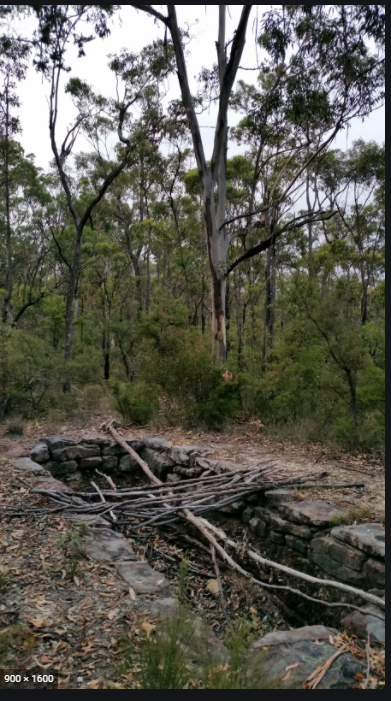
Did you know that charcoal was once used to run cars instead of petrol? During World War II, petrol rationing forced many people to find alternative methods of running vehicles. The rationing meant business people with trucks were particularly affected. Campbelltown did not escape this problem, so some Wedderburn orchardists set up a charcoal production business on the opposite side of the road from the school and across the creek. Four pits were dug in the bush. The pit method required a large pit to be dug in the ground and lined with bricks or sheet iron to prevent the charcoal becoming contaminated, and then a small amount of kindling wood was placed in the bottom for lighting purposes after the pit had been stacked with the timber to be carbonized. 

The orchadists used hardwood from the Wedderburn bush for the pits. Once produced, the charcoal was stored and transported in disused grain stacks, with a sack of charcoal weighing about 18 kg. The charcoal was used by those who had fitted a charcoal gas producing unit to their vehicle. The charcoal was placed in a box at the rear which in turn produced gas power to the vehicle. Their are however many stories of poor performances using charcoal, particularly a loss of power.

Pits like these would have been used across Sydney, but most would have since been lost. The pits at Wedderburn still exist owing to their remote location and the stone lining which has helped to keep them from caving in. Only three of the four pits exist.


The Hawkes family with their charcoal burning vehicle at Leumeah around 1941


Written by Andrew Allen


Sources:

HOLMES, Marie 2012

A Scapbook of History: Stories of the Macarthur District

Campbelltown: Campbelltown and Airds Historical Society


Wednesday, 10 March 2021

A Local Treasure

Edward John McBarron, born in 1918 at Albion Park, was a well-known Campbelltown figure for many years. As a Veterinary Science student he graduated from Sydney University in 1942. Whilst studying at University, he had been obliged to collect 100 botanical specimens, but continued to collect long after 100. His collection grew to over 15,000 specimens, now a vital part of the National Herbarium.
Eddie, as he was known, became an Inspector of stock at Holbrook and Albury before his appointment in 1953 as a Veterinary Research Officer at Glenfield Veterinary Research Station. This began his long association with the Campbelltown area.
Eddie published many papers and books throughout his life, ranging from veterinary papers on metabolic disorders in cattle to books on the botany and history of Campbelltown. 36 veterinary publications included subjects such as poisonous plants, water-borne bacteria and endangered species. Over 40 publications on local history and flora mainly concentrated on the Campbelltown area.
As a member of the Campbelltown and Airds Historical Society Eddie helped to label and restore exhibits in the Stables Museum at Glenalvon. He was made a Life Member of the society in 1995.
Eddie married Olive Gadd in 1946 and had four children, two boys and two girls. His other interests included the search for the perfect home brew, buying and tinkering with rarely seen makes of cars, and learning foreign languages, particularly French. 

Edward John McBarron (Richard Lawrance Collection 
Campbelltown City Library. Copyright Richard Lawrance)


He was nominated by seven organisations from a cross section of interests for an Order of Australia Medal, which was awarded in 1992 for his efforts in conservation, the environment and systematic botany.
Edward John McBarron passed away on 23rd August 1996 leaving a legacy of a wealth of information collected throughout his lifetime and compiled into readily available formats. We are pleased to hold at Campbelltown a number of Eddie’s publications which have greatly enhanced our knowledge of our local history.

Compiled by Claire Lynch from an adaptation of funeral eulogy given by David McBarron

Source
Grist Mills Vol. 9 No. 4 

Thursday, 4 March 2021

An Aerial View in 1956


This aerial photograph from 1956 demonstrates how much Campbelltown has grown in 65 years. The area shown covers from Kialba Road at the bottom of the picture to Hollylea and the Plough Inn at the top of the image. At the very bottom at the left of the aerial shot is "Kialba" and its surrounding trees. "Kialba" was a large federation-style home located at 29 Kialba Road. The home was built and occupied by Alfred Payten, an architect from the well-known Payten family. It is now vacant land and its palm trees still exist.

In 1956 Kialba Road joined Campbelltown Road. This can be seen in the photograph where it bends to the right and connects with Campbelltown Road. A little further north and Campbelltown Road crosses Bow Bowing Creek. On the banks of the creek at this spot stood the iconic Keighran's Mill. Built in 1855, it was also referred to as Payten's Mill. In later years it had displayed on it's wall an advertisement for Wolfe's Schnapps. The mill was dismantled in 1962. 

Heading further north along Campbelltown Road and on the left is the home "Woodbine". This fine old house could date as early as 1817 and was home to the Payten family from 1873. It was surrounded by magnificent trees such as kurrajongs, acacias, pines and cedars. "Woodbine" was demolished in the 1960s after the land was zoned industrial. What a shame! The site of the house is about where 7 Hollylea Road is today.

The right of the photo shows the growing suburb of Leumeah. The railway lines runs through the middle of the aerial photo between Leumeah and "Woodbine". In 1956 when this photograph was taken, Campbelltown Road was aligned differently. It followed the path of where today's Hollylea Road is located. The two-storey house "Hollylea" and adjacent Plough Inn can be seen on the old alignment of Campbelltown Road at the top of the photo. "Hollylea" was known as The Three Brothers Inn in the early days of the settlement and was owned by Nathaniel Boon.


Written by Andrew Allen


Sources:

ALLEN, Andrew 2018

More than Bricks and Mortar: Remembering Campbelltown's Lost Buildings

Campbelltown: Campbelltown and Airds Historical Society


Thursday, 18 February 2021

A Respected Cop


“He was a character, Slats. But he kept the town in order, one policeman. We had respect for him, I think that was it. We had respect. If we didn’t, we got a clip across the ears, or a boot up the backside.” These comments seem to reflect the town’s feelings toward a much-respected cop. A man who well and truly left his mark on Campbelltown.

Bernard Patrick Slattery, known affectionately as Bernie, joined the police force on 3 July 1939, at the age of 21. After initial training, he was posted to Sydney’s Clarence Street Police Station until 1945. Then transferred to Camden, he remained there for eleven years. At Camden he was promoted to Sergeant 3rd Class and then got sent to Grenfell for two years.

A rugby league match at Camden between fierce rivals Camden and Campbelltown threatened to erupt one year in the 1950s. Before the match, Bernard went to both dressing rooms and said we might just arrest someone today. There had never been an arrest at a football match in the area before. It ended up one of the cleanest football games anyone had seen.

In October 1960, Bernard transferred to the position of officer in charge of Campbelltown Police Station. Sergeant Slattery served 12 years in charge of the little station in Railway Street. He lived in the police sergeant’s residence down from the police station in the same street. In those days, the station was closed between midnight and 8am so the telephone had to be answered by the lock-up keeper.

Sergeant Slattery earned a reputation of being a fair and respected policemen. Young offenders, after receiving a stern lecture, then benefited from the Sergeant’s advice. He would say “I am not just a jailer waiting for you to put your foot wrong. I like to think I am here to protect life and property and that I can lead the community and encourage citizens to be law-abiding.” One story told by his son Michael concerned a certain Campbelltown youth who was in the habit of stealing bikes. Sergeant Slattery bought a second hand bike and lent it to the boy but asked him to look after it, including oiling it regularly. He wanted him to bring the bike in every second Saturday so he could inspect the boy’s work. After a while, he gave the bike to the lad permanently.

Bernard rose through the ranks from constable to sergeant, inspector and finally superintendent, where he oversaw a division incorporating Campbelltown, Fairfield and Liverpool. He was later sent to Broken Hill, Philip Street in the city and then Wollongong, before “returning home” as superintendent in charge of I division which covered Fairfield to Bargo. He considered the high spot of his career as the time when he was in charge of police arrangements in Sydney on the day that the Whitlam Government was sacked in 1975.

Following his retirement from the Police Force in 1978, Bernie became a member of the Campbelltown Hospital Board and director of the Campbelltown Catholic Club. He always held Campbelltown dear to his heart. Bernard Slattery died in 2002 aged 83. The cramped and inadequate Railway Street police station, was eventually demolished in 1988. The Police Sergeant’s house was demolished in 1970.


Written by Andrew Allen


Sources:

Campbelltown-Ingleburn News, 27 June 1978

Macarthur Advertiser, 15 June 2002

Interviews with Robyn Watson, Ted Sedgwick and Michael Slattery


Wednesday, 10 February 2021

Minto Mall begins

Surprisingly, Minto Mall was named, not by a corporate think tank, but by a local primary school boy. Prior to its grand opening on April 28 1981, developers launched a competition asking for suggestions to name the brand new shopping centre. The winning entrant was Mathew, a young local with his nicely alliterative entry.

14 Nov 1980
Arthur Jones Collection

At a cost of 13 Million dollars not only did the building itself employ 200 workers during its construction but an additional 300 would be employed in the shopping centre. Opening with Coles New World, Ansett Travel, Mr Whippy, bank and also Kmart boasting 13 Checkouts!

18 Feb 1981
Arthur Jones Collection

Coles Managing director, Mr Bevan Bradbury said they would “offer a form of shopping that has proved enormously popular.” - referring to the latest fashion for malls. He also proclaimed New World itself would have a 132 metres of refrigerated selling space.

Minto News April 1981
The advertising materials ushering in
this new form of shopping experience,
 proclaiming “Yes, right now you can step into
 1980’s style shopping”

For two weeks the mall offered tickets in various competitions. “Up for grabs” was a refrigerator, colour television and dishwasher. The winning ticket was presented by the “Multimedia” personality of Michael “Hollywood” John Howson and flamboyant Gold Logie award winning comedian, Jeanne Little who's catchcry of "Ohhhhh, Daaaahling was no doubt heard throughout Minto Mall. 


Minto News April 1981

Other promotions in the inaugural weeks included model train displays and free balloons for kids young and old.

According to the advertising there are
 spaces here for 950 cars in this one stop shop.
Photo by Ron Hutchings in the Minto News.

Wednesday, 27 January 2021

First Accident on the F5

The new section of the F5 freeway from Campbelltown to Yanderra opened on 15 December 1980. The new stretch was opened by Premier Neville Wran, with large queues of cars banked up for kilometres waiting for the opening. The new section reduced travel times greatly, but unfortunately accidents on the freeway still occur. Strangely however, the first accident on the freeway happened BEFORE the official opening. 

On the weekend before the opening, Sergeant Olivera and Constable Bailey were patrolling the new section at the request of the Department of Main Roads. The DMR had been concerned that people may have misused the freeway before its official opening. About 12 kilometres south of Campbelltown, a kangaroo appeared from the grass on the eastern side of the road directly in the path of the police car. Despite braking, the police car was unable to avoid hitting the kangaroo. It died instantly. Damage to the police car was minor and neither officer was injured.

Looking north from the bridge over construction of the F5 Freeway at Menangle Park in 1976. (Trevor Richardson Collection).


Written by Andrew Allen


Source: Campbelltown-Ingleburn News, 16 December 1980, p1

Wednesday, 20 January 2021

The night they blew the safe!

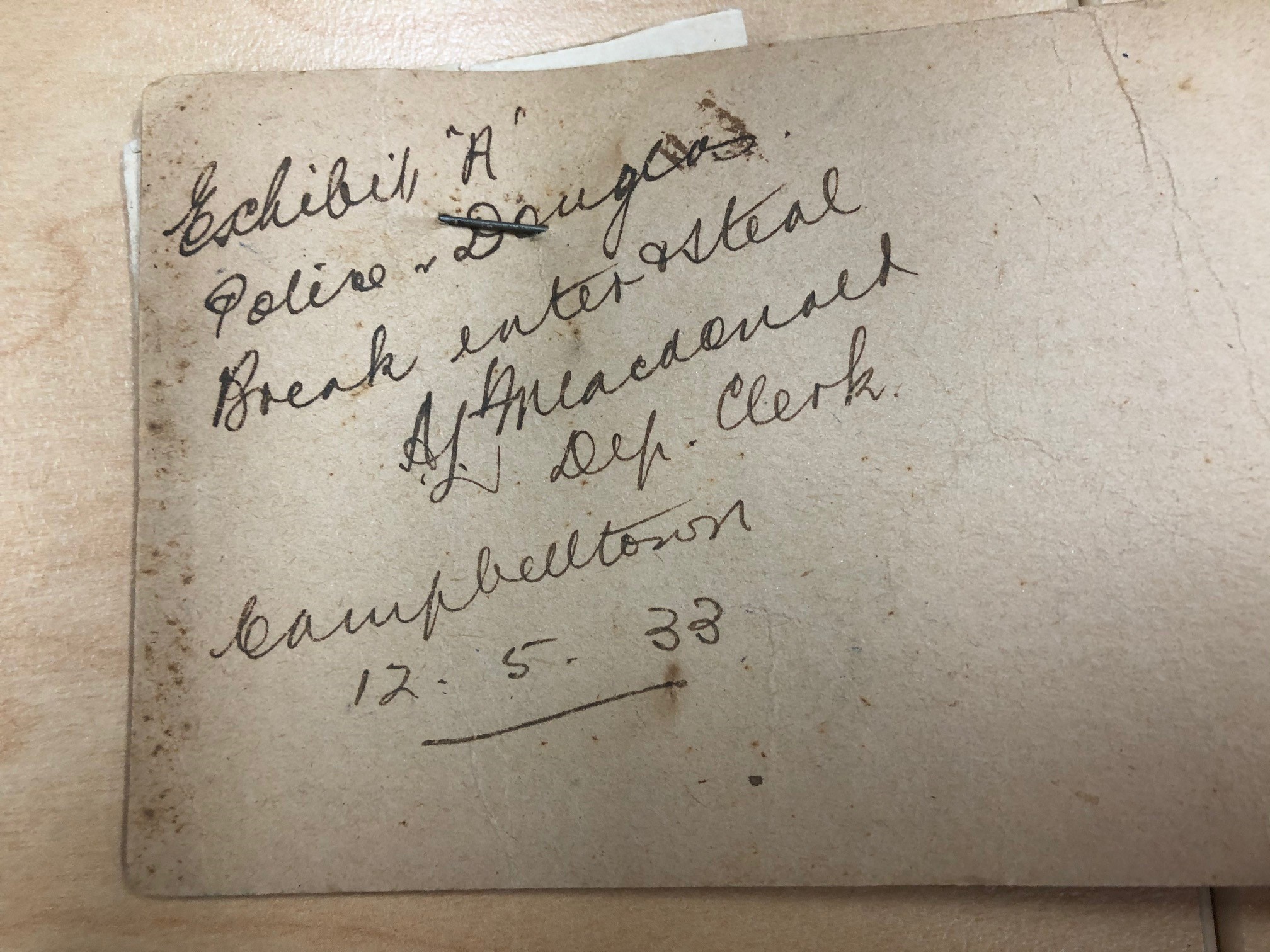
I recently opened a pamphlet file which contained a very old cheque book. My curiosity was piqued by the little note on the front of it – see photo below. 

The note on the front of the cheque book

Inside the cheque book - Police v Douglas


This led to an interesting tale of theft and forgery!
During the night of the 19th and 20th April 1933, Ingleburn Council premises were broken into. The safe was blown, and a number of items stolen. These included a pistol and cartridges, postage stamps, cash, some loose cheques, and a cheque book. Constable Best of Campbelltown attended the Ingleburn Council Chambers at 10.30 am on the 20th April, where he saw that the safe had been blown open, with the safe door off its hinges. There were books and papers strewn about, plus a quantity of putty (explosive) in a paper towel. Most importantly was a paper match case on the floor near the safe. The side window had been forced open.
Shockingly, another go was had at the Council Chambers on the 28th April, just 9 days after the first robbery. Not as competent as the first attempt, the robbers left a large amount of putty all over the Town Clerk’s office, to his considerable annoyance, and only escaped with a few pounds.

Ingleburn Council Chambers as they were in 1933

In the Campbelltown Police Court on the 19th May Mr John Charles Douglas was charged with breaking and entering the Ingleburn Council Chambers. Douglas had been questioned by Detective Surridge of the Parramatta Police. Douglas tried to explain away the cheque book he had in his possession by stating it had been given to him by another man, who, not surprisingly, was unable to be located. Douglas had passed two cheques on Gowing Bros and Hordern Bros, after forging the name of H.J. Daley on them.

Cheques in the stolen cheque book


Detective Surridge showed Douglas a cardboard match case bearing the words “Boomerang” 53 Market Street, Sydney – the same match case that had been left behind at the robbery. Douglas admitted to having one ‘similar’.
Douglas was remanded to stand trial at the Parramatta Quarter Sessions on the 6th June, which he did. He was charged with breaking and entering, and was convicted on an alternative charge of receiving. He was sentenced to 12 months hard labour.
The Council Chambers must have been seen as an easy target, as they were broken into yet again on the 21st June. The safe door withstood the charges, and nothing of value was taken. Bryan Chrystal recalls this incident as follows - "I think he (Harley Daley) got the job of Town Clerk in the 30s. This was right in the middle of the depression. Part of his job was handing out the dole and also if they did any relief work. They had a big strong room in the middle of the Council offices. This particular night, apparently they all knew that the money had come in and he had put it away to pay out the next day. These two characters must have come in and put gelignite on the door of the safe and they detonated it. They didn’t get the money because the building fell down all around the strong room. It made a real mess of the Council Chambers. He always told that story."

Written by Claire Lynch
Sources 
Trove
"Campbelltown Recollections"
 https://www.campbelltown.nsw.gov.au/ServicesandFacilities/Libraries/LocalStudies/CampbelltownRecollectionsStoriesFromOurPast