Friday, 23 October 2020

Glenfield Veterinary Research Station

 In 1923 the New South Wales Department of Agriculture opened its very first veterinary research station on a small property at Macquarie Fields. The Glenfield Veterinary Research station would make a remarkable contribution to veterinary science and agriculture for almost 70 years.

The Research Station was established in recognition of the economic cost of disease in livestock and the need for a facility to conduct research centred on problems of importance to the cattle, sheep, poultry and pig industries. Perhaps most significantly, techniques for the artificial insemination of cattle were pioneered there.

Approval for the establishment of the veterinary institute was given in 1913, but the outbreak of WWI and the shortage of funds meant that implementation was delayed until 1916 when 45 hectares was purchased from the Ross Brothers’ Macquarie Fields property. On June 1, 1919 Dr Sydney Dodd was appointed Consulting Veterinary Pathologist and took charge of plans for the buildings and equipment necessary for the Station.

At the time of the buildings being constructed in 1920, Glenfield was a small village on the east side of the railway line. There was a railway station, some houses and a primary school. Farming was the main activity in the district and the Veterinary Station was the only development to the west of the railway.

Staff of the Glenfield Veterinary Research Station, 1923 (Photograph donated by Col Clissold)

When the buildings were complete, Dr H. R. Seddon was appointed pathologist and the Glenfield Research Station was officially opened on November 2, 1923. The work of the station was not confined to animal health problems, research was carried out on animal husbandry and nutrition, drought feeding of sheep, artificial insemination of cattle and the control of noxious animals. Glenfield was also responsible for the development of a highly virulent strain of myxoma virus, (the “Glenfield Strain”), which proved invaluable to rabbit control throughout the continent. Glenfield will forever be synonymous with being the first to introduce the Myxomatosis virus to Australia for experimental purposes. 

Glenfield Veterinary Research Station
The Farmer and Settler (Sydney 1906-1955) 4 Sept 1925

In the early 1980s there were approaching problems at Glenfield from urbanisation and the need for improved laboratory facilities, it was decided to move the Station to land at Camden purchased by the NSW Government that had once been part of the Camden Park Estate, the site of early Agricultural development in Australia by John Macarthur and his family. Staff, equipment and livestock were transferred to the new Elizabeth Macarthur Agricultural Institute between 1989 and 1990.

Written by Samantha Stevenson

References 
Grist mills Vol 22 No 1
The first 50 years – Glenfield Veterinary research station
50 years in animal research: Veterinary research station Glenfield 1923-1973
Glenfield Veterinary Research Station by P.J. Mylrea & D.W. Dredge

Thursday, 8 October 2020

Recognition for Norm


The Campbelltown and Airds Historical Society recently conferred upon Norm Campbell an Honorary life membership to recognize the many years of commitment to our community. Anyone who is interested in the history of Campbelltown would likely know of this kind hearted man with an infectious energy. For those who don’t, we would like to let you know a little about his life.

Norm was born in Lithgow Street Private Hospital in 1923. As a child he lived in Stanwell House, one of the colonial buildings in Queen Street, until the government purchased the strip of Georgian houses and took on the prohibitively expensive task of restoring them.

It was a childhood lived in the shadow of the Great Depression. His mother had been adopted by George and Margaret Chinnocks who could not have children of their own. George and Margaret also looked after children of the state who were very happy to live with them.

“Grandfather Chinnocks” was very fond of horses and where there might be family portraits there were photos of thoroughbreds. There were very few cars around then everyone owned a sulky and horse for their transport. There were a number of wild horses in Glenfield if you wanted a horse you would go there, grab one and break it in. 

Norm remembers leaving for High School at 7:30am every morning by steam train with his friend Greg Percival, among others.  It was a long day having to change trains, swapping between steam and electric having to be shunted from Granville to Parramatta and getting home after 5:00 pm.

Norm did not see war service, being rejected for medical reasons. He remembers those bleak times on the home front. The young men who came back wounded; the soldiers who did not come back at all. The town itself had rationing and coupons. Campbelltown had a lot of soldiers in those times coming through with troops camped in the showground and the train taking soldiers to and from leave.

After his mother passed away Norm worked as a shopkeeper in the general store which also happened to be the family home.

During his working life Norm had many varied jobs. He gained work as a movie projectionist in various areas around Sydney before Fred Eves, who had given him his start delivering flyers for him, invited him back as projectionist for the fabled Macquarie Cinema. The introduction of television in the 50’s curtailed the cinema’s activities but there was a silver lining.

Norm began doing stints as a news correspondent for ABC radio, reporting on local events. It was usually 6:30am but it had a large following. Later on he would buy a camera and delivered filmed news reports for Channel 2 and 7, even filming sequences for the Mavis Branson show.

During the sixties, Norm was hired by Jim Vernon to be a photographer for the Campbelltown Ingleburn news, Camden news, the Picton Post and Macarthur Advertiser

During that time there was only one scientific detective for a large area and so he and the police mutually agreed that he should take scientific photos for our area. Norm received criticism for doing this type of work but those photos were to prove the truth of many events. An illustration of that was the crash of a light airplane. One of Norm’s photos showed a twenty cent coin lodged in the rudder controls causing the accident.

But not every day in the newspaper business gained praise. When the newspapers started using computers, Norm was interested in the way they worked. He was banned when he “wiped out” an amount of the day’s work.

At the beginning of the 1950’s Norm had also joined the local fire brigade, becoming Captain in 1968 at one of the busiest and wide ranging of districts. He recalls fondly a fire engine, which could pump 250 gallons of water a minute remaining in use at the station from 1929 until 1964, being unsurpassed in quality for many a year after that.

Norm recalls that many strange things have happened in Campbelltown, luckily more good than bad.

“Retiring” in 1988, Norm Campbell has kept an interest in many pursuits and been so generous in providing Campbelltown Library with so many photos and recollections of Campbelltown’s past over the years. We will be forever indebted to him.

Written by Michael Sullivan

Monday, 28 September 2020

The suburb with the misspelt name

Englorie Park House sits at the centre of the tiny suburb of Englorie Park. The land on which it sits has been home to many interesting people. It straddles two original land grants – one made to First Fleeter William Eggleton, and the other to Second Fleeter David Nowland.
Eventually the grants became one farm owned by merchant farmer Samuel Terry, who became known as the “Botany Bay Rothschild.” The property stayed in the Terry family after Samuel Terry’s death in 1838, via his grandson Samuel Terry Hughes, then to his stepdaughter Esther Hughes and then to William Nunn Pattrick, grandson of Esther Hughes. Pattrick (who had 12 children, of whom 6 sons served in WWI, three killed in action, 2 wounded), sold the property to Alfred Leath Park. Alfred built “Parkholme” – described as one of the “prettiest villas in the vicinity of Campbelltown, or indeed the colony”. Park was well known in coursing circles in the colony and his greyhounds were his pride and joy.  In about 1892, the property was sold to Henry Edward Vaughan, who was elected as an Alderman the same year, and as Mayor of Campbelltown the following year. He only served as mayor for one year. He leased Parkholme out when he subsequently moved away and after his death in 1901 it was purchased by Frederick Merewether. Frederick’s brother Herbert built the historic home Raith around the same time. The Merewethers were descendants of a pioneering family from the Hunter Valley.
In 1913 the property changed hands again. It was sold to Charles Burcher.  Born to blacksmith father Steven and mother Jane in Liverpool, on April 4th, 1837, Charles married Margaret Wilhelmina Smith in 1873, but she would tragically die in 1874, and their first and only child, daughter Jane, died in 1875. 

(Photo: Pastoral Review 16.12.1916) 

Burcher was highly respected in pastoral circles, and had been the owner of Euglo Station near Condobolin, and the adjoining Eugalong Station. Consequently, having retired to Campbelltown he changed the name “Parkholme” to “Euglorie Park”. Newspapers of the day frequently misspelt the name as “Englorie”, and this name would eventually stick. Burcher only lived at Euglorie Park for 3 years, before he died in 1916. He is buried in St Peter’s Cemetery, and clearly on his headstone is written “Charles Burcher who died at Euglorie, Campbelltown”. And so, Englorie Park really should be named "Euglorie Park". 

Burcher's headstone at St Peter's Campbelltown

Written by Claire Lynch
Sources
Trove
Ancestry
Grist Mills, Vol.4, No.1
http://www.cahs.com.au/parkholme.html

Thursday, 17 September 2020

Highway Hold ups

Travelling along Appin Road has long been a hazardous trip. If you were doing it in 1866 there were even more reasons to be filled with trepidation. My research has revealed at least three terrifying hold-ups between Campbelltown and Wollongong during this year, leaving the community shaken.

In early April 1866 one late evening, two armed men stopped the mail coach at Loddon River just outside of Appin on the Wollongong side. They robbed the coach coming from Campbelltown to Wollongong of its mail bags and £5 from the only passenger. They later stopped the mail coach from Wollongong to Campbelltown, known as the up mail, and robbed the passengers of various sums of money, but did not take the mail bags.

It is believed the same bushrangers robbed again about a week later. At about 3am and four miles (7kms) from Appin, the bushrangers stopped the horses, and ordered the the coachman to bail up. The coachman and contractor was James Waterworth, and he was accompanied by the driver, a man from Wollongong and two youths returning either to home or school. The bandits tied everyone up, searched and robbed them. They also undid and rifled the mail bags, opening the letters, and helping themselves to whatever they liked. After leaving the letters scattered about the road, one of them cracked the whip and they drove off, leaving the poor passengers tied up. They eventually untied themselves and raised the alarm.

A few days later a girl on a farm on the Macquarie Fields Estate, was returning from school, when she picked up a parcel which turned out to contain 36 cheques, amounting to £360, and was a portion of the proceeds of the robbery. The cheques were handed over to the police and later a man from Appin was apprehended by the police.

James Waterworth was the coachman on Appin Road for many years. He died in his nineties in Campbelltown in 1920 after a lifetime of amazing stories of bushrangers and robberies. He was held up by bushrangers on three separate occasions. Before the robbery described above, James was held up once with a sickly man as his passenger. He was coming back from Wollongong with £300 and when the bushrangers stuck up the coach, James picked the little man up and carried him to a nearby shed. "You surely wouldn't harm this poor sick fellow" he said, and the bushrangers let him go.

Joshua Bray lived at Denfield on the Appin Road. In 1866 he wrote "They are very much excited about here, the mail was robbed ten days ago...The night before last they stopped it about a quarter of a mile from this house- the coachman and the passengers came about 4 o'clock in the morning to tell us. These robberies take place in the night...they were hiding all their jewellery. Papa has loaded his pistol". Bray describes this robbery as a quarter of a mile from Denfield or about 400 meters in today's measurements. This would rule out the robbery where they tied the victims up as it was seven kilometeres from Appin and therefore too far from Denfield, however it could have been the one where Waterworth carried his sickly man to safety.

The bushrangers are long gone but the same narrow and winding Appin Road continues to move thousands of people between Campbelltown and Wollongong every day.


 James Waterworth pictured in 1902 driving the same coach that travelled from Campbelltown to Wollongong via Appin


Written by Andrew Allen


Sources:

Empire, 16 April 1866, p4

Sydney Morning Herald, 14 April 1866

NSW Police Gazette and Weekly Record of Crime, 4 April 1866, p118


Tuesday, 8 September 2020

The Old Police Station


The Campbelltown Police Station was once situated in Railway Street. Dates for its construction vary from 1880, the late 1880s and 1890. It replaced an earlier station around the corner in Queen Street near the Courthouse.

The police station was built in typical late nineteenth century style for police stations. It had cast iron brackets decorating its ten verandah columns. To the north of the station were the cell blocks and stables. These cell blocks were linked to the courthouse in Queen Street by a tunnel. A police sergeant's residence was situated next to the station until it was demolished in 1970.

The station operated until August 1985, when it became far too inadequate for Campbelltown's growing population. A fibro extension to ease the congestion did little to fix the problem. 

The old station was eventually demolished in 1988 and it was controversial. The Attorney General's Department owned the building but regarded the station as having no real historical significance. The National Trust however recommended that it be retained. Members of the public were vocal about its pending demolition including Deputy Mayor John Hennessey, who claimed "this is nothing short of public vandalism". A new court complex now stands on the site. A more modern and much larger station was built in Queen Street.


Written by Andrew Allen


Sources:

ALLEN, Andrew 2018

More Than Bricks and Mortar: Remembering Campbelltown's Lost Buildings

Campbelltown: Campbelltown and Airds Historical Society


Macarthur Chronicle, 17 November 1987, p17

Friday, 21 August 2020

New Rotolactor Photographs

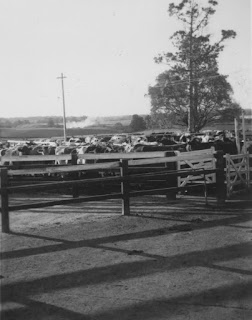
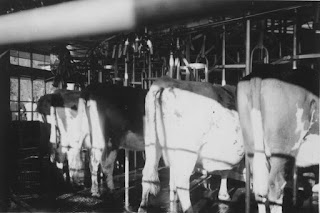
The library recently received a donation of photographs of the Menangle Rotolactor during its heyday. We are grateful to Lyn Smith for sharing her wonderful images with us. Below is a sample of some of the collection we received. The photographs were taken in 1956. The complete donation is being processed and added to Our Past in Pictures photographic database found on the local studies page on the library's website.


Cattle yards at the Menangle Rotolactor

The rotolactor in 1956

Cows being milked at the rotolactor


Written by Andrew Allen


Tuesday, 11 August 2020

Fined

50 years ago today, this story from the Campbelltown-Ingleburn News:

An Ingleburn man was convicted at Campbelltown Courthouse and fined for negligent driving. Proceeding along Atchison Road, Macquarie Fields the driver decided to overtake the car ahead.
Unfortunately, in doing so he forced a police car, approaching from the opposite direction, to brake suddenly and swerve completely off the road to avoid collision.
According to the accused, he took the course of action because the car in front had braked suddenly.

The driver was fined $100.

The incident was dramatic to imagine but I wondered too about the fine payment without the convenience of eftpos. Back then there were no $100 dollar notes. And in 1970 there were no fifties either! After decimalisation, $50's were only deemed warranted after enough inflation had come to pass and weren't introduced until 1973. The only suitable choices after $20's, if he were flush enough, were these Campbelltown related notes.

Caroline Chisholm

John Macarthur

Or perhaps he wrote them a cheque...whatever they might be.


Sourced from the Campbelltown Macarthur Advertiser, 11 August 1970

by Michael Sullivan