Wednesday, 25 March 2020

Bessie Grandemange

With the long overdue coverage and interest recently in women's sports, I thought it was timely to bring to your attention an athletics star from the early part of last century. Her name was Bessie Grandemange and she had a connection to Ingleburn.

Bessie Grandemange was a champion of women's athletics in Australia from 1915 to 1922. Her father and brothers were also successful athletes, but Bessie starred with a series of world records from 100 yards to the Triple Jump. She remained undefeated in scratch races throughout her career in Australia.

Bessie first displayed her immense talent in a ladies race handicap at Canterbury in 1915 at age 16. She ran her 97 yards in 11.8 seconds, beating some of the more fancied runners. This was the start of her excellence over the next seven years.

Bessie is pictured here in 1922 

Bessie's coach and manager was George Craft of Ingleburn. George was a huge supporter and admirer of her talents and regularly boasted about his young athlete. George Craft was a well known sporting man and poultry breeder in Ingleburn. He bred ducks and often judged them at the Royal Easter Show. Since the outbreak of the First World War he had been the secretary for most patriotic events and functions in Ingleburn. One event was a sports meeting at Ingleburn to assist the War Chest Fund. This was held on 22 September 1917. It was undoubtedly George's influence that saw the now famous athlete compete at the meeting. The highlight of Bessie's performances was an Australian record for the hop, step and jump. She cleared 33ft 10in (10.3124 metres) which George testified to the correctness of.

After the war and the Spanish Flu outbreak, Bessie continued to compete. She went on an unbeaten streak, that included a challenge in the press by Ruby Baddock that Bessie accepted. Around 1922, the athletics scene for women in Sydney had declined and there were fewer opportunities for Bessie to appear in public. She married a man named Arthur Callard and they went to Britain to live. In 1925 she returned to competition in the British women's amateur 100 yards championships. She won her heat but could not run a place in the final (her former professional status seemed to have been cleared). This was followed by a run in the British Games at Stamford Bridge. There is no record of Bessie Grandemange ever racing again.


The story of Bessie Grandemange then becomes a mystery. She separated from her husband and child and it was rumoured that she emigrated to New Zealand, possibly dying in the Napier earthquakes of 1931.

One interesting anecdote- on the evening of the War Chest sports day at Ingleburn, George Craft was charged with selling liquor without a licence. The charge was eventually dismissed.

Thank you to Graham Thomas and John Crossingham for much of this information.


Written by Andrew Allen


Sources:

Track and Field Athletics Australia by Graham Thomas

Cumberland Argus and Fruitgrowers Advocate, 20 October 1917, page 11

Referee, 3 October 1917, page 10


Thursday, 19 March 2020

Remembering the Great Depression

The coronavirus crisis is serious threat to the health of many people across the world. The virus is also a potential catastrophic threat to the financial markets across the globe. Many predict it be the biggest financial threat since the Great Depression that started in 1929 and lasted to around 1933.

One of my predecessors, Lorna Humphreys, interviewed a number of elderly Campbelltown residents in the 1970s. A question she often asked her interviewees centered around what Campbelltown was like in the Great Depression. I thought I would include some snippets of these interviews that talked about those Depression years.


       We didn’t do too bad in the depression at all. One lad came in here a while back and wanted to know we had suffered and that. I said we didn’t suffer, our relations helped us. – Florence Allen

        
        It was depression time. We advertised for a sawyer and there were about 10 or 12 men standing at the gate in the morning. In those times you asked them to show you what they could do. This man was a great big handsome fellow, and he just had a pair of sandshoes on, he didn’t own a pair of shoes. Anyway he got the job. – Rita Brunero


Did you have many nights when there was hardly anyone there (Macquarie Cinema)?
          
        Yes, but if there were only two there we would still show it. Then there were the days of the depression. The poor devils would be lined up outside the theatre. Nobody had any money and they would ask if they could come into the pictures. They would be filthy and walking the streets. I had a special place down the front.
I never heard of people going hungry or being put out of their homes or anything. But the hordes that used to come through and would ask for food.
      We used to put them in the front of the theatre. It was hard for us. We used to run dances and do other things. – Fred Eves

          
What was the depression like here in Ingleburn? Did it affect people very much do you think?
          
       Well it didn’t affect father, he kept his job right through. And we weren’t very conscious of it in a way ‘cause you’re only kids you know, a lot of things go over your head. But, I can remember a lot of people saying, you know, how hard up they were, and that sort of thing. They used to go into the city on Fridays for two and sixpence, return for two and sixpence,  and they’d go to the Town Hall and you’d pay threepence I think it was to go in, and you’d sit down and sing.
          
Did they have dole queues in Ingleburn or did they have to go somewhere else?
      
      Ah, they had men working on the roads, solicitors and all kinds of chaps they had, I remember they cleared this, when we first came here you couldn’t see down the Cumberland Road, now I can see right the way down to the pines down there, but before you couldn’t because it was only just a dirt track, sort of three ruts, the horse goes in and the two wheels down there. Well then during the depression they had these chaps working, and they cleared the road, they opened up all this here, it used to be all bush from here to the railway, and right back. We had these chaps, they cleared the roads, just cut down the scrub and stuff. I remember the chaps working, it sort of didn’t worry us. – Margaret Firth


When you lived in Campbelltown during the depression years, how did people pay you for delivering their babies?
          
       They didn’t pay me. Do you know Milgate Lane? Somebody found out that I was on a case down there and told me that I would never get paid. Women had funny husbands in those days. They had to hide their money. – Emily Jane Kisbee


How did the Depression affect around here in Campbelltown? Do you remember?
         
         Well later on when we came back it was still bad. People, two or three a day, would come to the house for food. Men mostly. Well the women weren’t used to working. See the women weren’t used to having jobs. There were no jobs for them. I remember Marie trying to get a job and she put an ad in the paper for a lady jackeroo. – Angela Lysaght


What do you remember about the depression years in Campbelltown? You would have been old enough to have been aware that there was one.

        It was during the depression years that we moved to Campbelltown. The reason for my father leaving the farm was because he became ill. That was around 1923. I don’t know why it was so hard to get labour. He couldn’t get labour on the farm. He would even take people in off the roads. There were a lot of swaggie type people in those days. They would take the job and they had their own room on the farm and you would get up the next morning and they would be gone. It became such a problem to employ anybody. He decided that he would become one of the employable instead of being a boss.
          
      He worked for my uncle in the butcher’s shop part of the time. During the depression years we were lucky because we owned two or three houses. We had a couple in Picton and we had a couple here so we had rent coming in from those. We were lucky we had railway people who were not out of work and could pay the rent.
          
You were at school, but do you remember things getting worse in the depression years? Were there scruffy children and hungry children?
         
       I think there some poorly dressed children. I don’t know that anyone really wanted for food. There was a coupon system.

I haven’t come across anyone yet who lived in Campbelltown and was terribly aware of the depression; it seemed to have almost passed them by.

        Maybe it did, because in those days it was largely a farming community and they grew what they needed to eat. – Leila Spearing


How about during the depression, I have been told that people camped out under the bridge at Menangle along the river.

      Yes, I used to walk to school every day along the river to school and they would be there.

It has been very hard to find out anything much about the depression years in this area.

       The locals seemed to manage all right. They grew their own food. I can remember in the war years we were growing our own vegetables. I was a child in the depression and I can remember that well. I can remember the banks closing. I was thinking the other day about the building society and people were panicking but that was what happened in the depression. People rushed to the banks to get their money and they closed the banks. – George Taber


No-one seems to have mentioned how the depression affected Campbelltown.

         I can remember when Leumeah opened up as a residential area and people could buy a block of land for around £5 and put up anything. It was a real shanty town. It was quite an area with one room shacks.

 How long did the shanties stay?

          For many years, Leumeah was a real shanty town.

 What about the other side of the railway line, the other side of Broughton Street?

       Yes, there were a couple of old houses the other side of Broughton Street near the old Milk Depot. There were some further opposite the railway which they called Struggletown. – Miss E. Triglone


Written by Andrew Allen

Thursday, 12 March 2020

Brother Bill


The Campbelltown community was in shock at the death of Bill Coogan in 1962. Bill was known as Brother Bill to the towns people from the way he addressed all and sundry. He was a cheery butcher (aren't all butchers) who had a shop near the corner of Queen and Railway Streets and adjacent to Lack's Hotel, known as Coogan's Butchery. His main contribution to the town however was as an alderman on Campbelltown Council between 1956 and 1962.

William Coogan was born in Campbelltown in 1908. The Coogan house was at the bottom of Milgate Lane, close to the Railway line where Bill's father Robert worked as a railway yard attendant and fuelman for locomotives. Bill began his working life as a drover before working for Tildesley Brothers butchers of Campbelltown. This shop was about opposite the Old Post Office that still stands in Queen Street. He later opened a butchery business at The Oaks before opening his Queen Street business in 1946.

As an alderman, Bill was noted for his forthright opinions. He was always fighting for faster planning of the area and believed the Cumberland County Council was hindering development of the area. He would sit in at as many committee meetings as he could so he could add to his knowledge of Council affairs. He was also heavily involved with the Campbelltown Kangaroos Rugby League Club and was a lover of horses.

The genial and humorous Brother Bill collapsed and died while attending a show at Bathurst on May 5 1962. He died the next morning. He was only 54. Two minutes silence preceded the football that weekend in honour of one of the Kangaroo's staunchest supporters.

Coogan Place is named for Bill Coogan.


Written by Andrew Allen


Sources:

Campbelltown-Ingleburn News May 8 1962

McBarron, Eddie J. et al 1985
Campbelltown 1930-1940 Dumaresq Street and Environs
Campbelltown: Campbelltown City Council


Tuesday, 3 March 2020

In Memory of Violet

Occasionally in my research I stumble upon a story that tugs at the heartstrings. One such story was an accident that occurred at the St Andrews farm at Minto almost one hundred years ago.

On the afternoon of 10 May 1923, Phillip Gray was cutting chaff on the farm at St Andrews, assisted by his two sons. The chaff cutter was a horse-driven machine, and whilst engaged in the work five-year old Violet Gray walked into the shed without being seen by her father. Phillip was busy working the chaff cutter at the time. Violet reached across for a bag near the chaff cutter. Her frock was caught in the driving-wheel of the machine, and she was hurled around several times before her father was able to stop the machine. Poor Violet's head was injured too severely to be saved by the doctor and she died a few minutes after his arrival.

The Gray's had recently moved from near Robertson in the Southern Highlands. Violet was born at Kangaloon near Robertson in 1917. She was the second youngest of nine children born to Phillip and Ellie (nee Papworth). Phillip died in Iolanthe Street, Campbelltown in 1932 and Ellie died in 1964. All three are buried in St Peter's Cemetery in Campbelltown.


Violet's grave in St Peter's Anglican Cemetery. The dates for Violet are incorrect. She was born in 1917 and died in 1923. Her father Phillip died in 1932 and not 1930 and he was born in 1878 and not 1874.

 St Andrews Farm in the 1960s- scene of Violet Gray's accident in 1923. (Thomson Collection)


Written by Andrew Allen

Source:

Sydney Morning Herald, 11 May 1923, p12

Campbelltown Federation Register 1900-1920, 2008
Campbelltown District Family History Society Inc.


Wednesday, 26 February 2020

Archaeology at Leppington House

Some years ago I wrote a post about the history of Leppington House. This early building, situated in the north west corner of the Campbelltown Local Government Area, was built by William Cordeaux and was lived in as early as 1823.

Last Monday I visited the site of Leppington House where an archaeological survey is being carried out by Eco Logical Australia Pty Ltd. I met with the Principal Heritage Consultant Karyn McLeod who explained the background of the project, what has been discovered and what plans there are for the site. The visit was most interesting and I learnt much, including some previous misconceptions about the history of Leppington House.

Apart from the Cordeaux occupation, the building was used primarily as a dairy farm and cattle grazing throughout its history. Another misconception was that a carriageway was constructed from Camden Valley Way to the property. No evidence could be found of this. Also, there was no archaeological evidence of a fire destroying the house. It had almost certainly been demolished some time after 1956, almost certainly after a period of being unoccupied. Aerial photographs will be checked in the near future which will hopefully provide a more accurate date of demolition.

The house is a double storey central core with two single storey wings, while it was likely to have been a comfortable family home it is definitely not a grand gentleman's villa. The building was constructed of brick and not stone as previously suggested.

The excavation so far has not unearthed a lot of artefacts. Some of what has been found, I have photographed below. These include coins, glass and building materials.

The Leppington House Park is located within the Willowdale development area, Leppington. The study area proposes to conserve and feature the archaeological remains within a publicly accessible park.


Written by Andrew Allen


Sources:

Karyn McLeod
Principal Heritage Consultant
Eco Logical Australia Pty Ltd

Eco Logical Australia 2018. Willowdale Archaeological Assessment  and Research Design. Prepared for Stockland.

Wednesday, 12 February 2020

The Murrays of Minto

Charles Murray was born in Ulladulla, and married his wife Catherine in 1895. They had a son, Claude Charles and a daughter Gladys Mary.

Charles and Catherine on their wedding day.
Photo - Ancestry 
 In 1901, the Murrays leased out their farm Avondale, at Yatte Yattah, and Catherine took on a mortgage of several portions of Campbellfield, including Dr Redfern’s homestead. The home was re-named Buena Vista, and the family set up a dairy farm. In an article about Minto, J. Hall remembers ‘Mr Murray (Claude’s father), who only boasted one can of milk centred in the body of his spring cart on which he sat, and in rain or heat held an umbrella up, as his old creamy pony jogged along from the Old Redfern home on the hill to the railway station’. Charles passed away in 1912.
Claude went on to become the mayor of Ingleburn from 1934 to 1939, then again in 1948. The farm had grown into a successful dairy, and the Ayrshire cattle they bred were Royal Show winners.  It was reported in the newspaper that Buena Vista Playmate produced 4501b. of butter-fat in 273 days as a mature cow in 1936!
Campbellfield (aka Buena Vista) 1950
Photo - CAHS
The property passed to Claude Charles after the death of his mother in 1958. Claude’s son Jack worked on the farm and also became the local milk carrier, picking up milk cans from the surrounding dairy farms. His friend Bryan Chrystal recalls helping him on his truck, opening the dairy gates for Jack, and helping to unload the empty milk cans and stack the full ones. Most of the smaller dairies would have about six cans of milk. A far cry from the days when Jack’s grandfather Charles would take his one can of milk in a spring cart to the railway station!
The property was sold after 1958, and is now the site of the Minto Marketplace.

Written by Claire Lynch

 Sources
Early Memories of Minto by D. Hall
Grist Mills Vol.4 No. 4 “Minto” by Joan Murphy
Campbellfield, Guernsey Avenue, Minto : a heritage study

Friday, 31 January 2020

Can you help us?

There are sadly many photographs in our collection that are unidentified. Some of these include images from our recently purchased Fairfax Collection. A couple of years ago Campbelltown Library purchased about 250 of these vintage photographs for our collection.

In 2013 Fairfax Media sent the two million photograph archive of the Sydney Morning Herald newspaper to a company in Arkansas to be digitised. The scanning company was disbanded prior to completing the scanning, and the work was eventually managed by a court receiver. Part of the deal Fairfax made was to trade the vintage prints for the scanning services. From the turmoil in the scanning company, the archive eventually became bank owned by a regional Arkansas bank with no interest in holding these photographs. After much discussion and negotiation, Duncan Miller Gallery in Santa Monica, California bought the entire collection, with the goal and purpose of repatriating many photos back to Australia.

The library is hoping to have the unidentified people or buildings in some of these photographs in this collection identified. The following images are ones we need your help with:

Who are the children in this June 1968 photo at Campbelltown Swimming Pool?


Who are the children on the tricycles in April 1969?


Where is this Campbelltown Street?


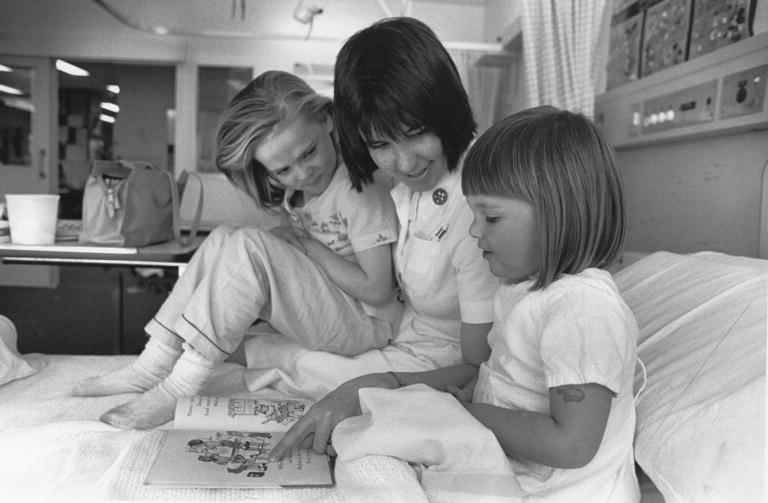
Who are the two children with Sister Brennan at Campbelltown Hospital in 1987?


Where in Campbelltown is this building?


Written by Andrew Allen