Wednesday, 26 February 2020

Archaeology at Leppington House

Some years ago I wrote a post about the history of Leppington House. This early building, situated in the north west corner of the Campbelltown Local Government Area, was built by William Cordeaux and was lived in as early as 1823.

Last Monday I visited the site of Leppington House where an archaeological survey is being carried out by Eco Logical Australia Pty Ltd. I met with the Principal Heritage Consultant Karyn McLeod who explained the background of the project, what has been discovered and what plans there are for the site. The visit was most interesting and I learnt much, including some previous misconceptions about the history of Leppington House.

Apart from the Cordeaux occupation, the building was used primarily as a dairy farm and cattle grazing throughout its history. Another misconception was that a carriageway was constructed from Camden Valley Way to the property. No evidence could be found of this. Also, there was no archaeological evidence of a fire destroying the house. It had almost certainly been demolished some time after 1956, almost certainly after a period of being unoccupied. Aerial photographs will be checked in the near future which will hopefully provide a more accurate date of demolition.

The house is a double storey central core with two single storey wings, while it was likely to have been a comfortable family home it is definitely not a grand gentleman's villa. The building was constructed of brick and not stone as previously suggested.

The excavation so far has not unearthed a lot of artefacts. Some of what has been found, I have photographed below. These include coins, glass and building materials.

The Leppington House Park is located within the Willowdale development area, Leppington. The study area proposes to conserve and feature the archaeological remains within a publicly accessible park.


Written by Andrew Allen


Sources:

Karyn McLeod
Principal Heritage Consultant
Eco Logical Australia Pty Ltd

Eco Logical Australia 2018. Willowdale Archaeological Assessment  and Research Design. Prepared for Stockland.

Wednesday, 12 February 2020

The Murrays of Minto

Charles Murray was born in Ulladulla, and married his wife Catherine in 1895. They had a son, Claude Charles and a daughter Gladys Mary.

Charles and Catherine on their wedding day.
Photo - Ancestry 
 In 1901, the Murrays leased out their farm Avondale, at Yatte Yattah, and Catherine took on a mortgage of several portions of Campbellfield, including Dr Redfern’s homestead. The home was re-named Buena Vista, and the family set up a dairy farm. In an article about Minto, J. Hall remembers ‘Mr Murray (Claude’s father), who only boasted one can of milk centred in the body of his spring cart on which he sat, and in rain or heat held an umbrella up, as his old creamy pony jogged along from the Old Redfern home on the hill to the railway station’. Charles passed away in 1912.
Claude went on to become the mayor of Ingleburn from 1934 to 1939, then again in 1948. The farm had grown into a successful dairy, and the Ayrshire cattle they bred were Royal Show winners.  It was reported in the newspaper that Buena Vista Playmate produced 4501b. of butter-fat in 273 days as a mature cow in 1936!
Campbellfield (aka Buena Vista) 1950
Photo - CAHS
The property passed to Claude Charles after the death of his mother in 1958. Claude’s son Jack worked on the farm and also became the local milk carrier, picking up milk cans from the surrounding dairy farms. His friend Bryan Chrystal recalls helping him on his truck, opening the dairy gates for Jack, and helping to unload the empty milk cans and stack the full ones. Most of the smaller dairies would have about six cans of milk. A far cry from the days when Jack’s grandfather Charles would take his one can of milk in a spring cart to the railway station!
The property was sold after 1958, and is now the site of the Minto Marketplace.

Written by Claire Lynch

 Sources
Early Memories of Minto by D. Hall
Grist Mills Vol.4 No. 4 “Minto” by Joan Murphy
Campbellfield, Guernsey Avenue, Minto : a heritage study

Friday, 31 January 2020

Can you help us?

There are sadly many photographs in our collection that are unidentified. Some of these include images from our recently purchased Fairfax Collection. A couple of years ago Campbelltown Library purchased about 250 of these vintage photographs for our collection.

In 2013 Fairfax Media sent the two million photograph archive of the Sydney Morning Herald newspaper to a company in Arkansas to be digitised. The scanning company was disbanded prior to completing the scanning, and the work was eventually managed by a court receiver. Part of the deal Fairfax made was to trade the vintage prints for the scanning services. From the turmoil in the scanning company, the archive eventually became bank owned by a regional Arkansas bank with no interest in holding these photographs. After much discussion and negotiation, Duncan Miller Gallery in Santa Monica, California bought the entire collection, with the goal and purpose of repatriating many photos back to Australia.

The library is hoping to have the unidentified people or buildings in some of these photographs in this collection identified. The following images are ones we need your help with:

Who are the children in this June 1968 photo at Campbelltown Swimming Pool?


Who are the children on the tricycles in April 1969?


Where is this Campbelltown Street?


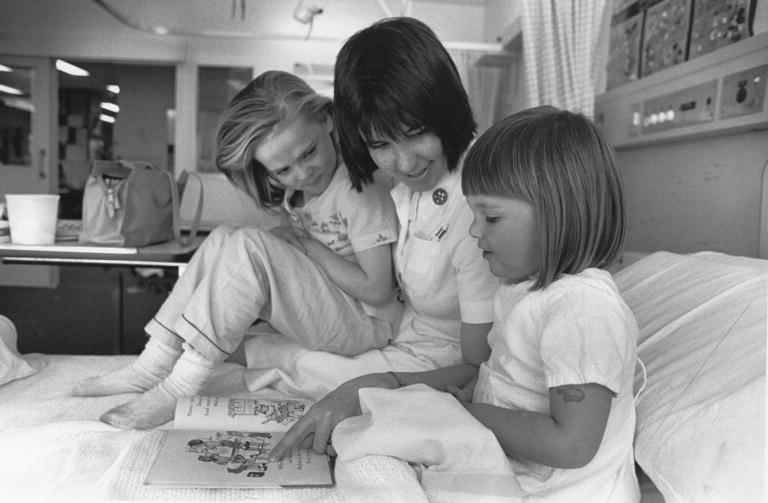
Who are the two children with Sister Brennan at Campbelltown Hospital in 1987?


Where in Campbelltown is this building?


Written by Andrew Allen


Friday, 24 January 2020

The Bookworm

Ronald Winton was born in Campbelltown in 1913. He was the youngest of three boys to Bob and Lily who owned a shop in Railway Street. As a boy he was nicknamed Johnny Head-In-Air by his brothers after a character in a comic picture book.

Ron was born with a congenital deformity of the foot, making walking for him as a child very difficult. After surgery to straighten the foot at the age of three or four, he could walk reasonably well, but not jump, run, hop and play games naturally easy like his mates. One thing Ron turned to was reading. He grew to love the small library that was once at the back of the old town hall in Queen Street. The library was run by Ted Bamford with the assistance of Mr Gamble. In his autobiography titled 'Johnny Head-In-Air', Ron wrote how the library seemed to receive little attention from the council or citizens and as a result, most of its books were old-fashioned and outdated in style and content. Still, he derived much pleasure from reading them.

Ron grew particularly fond of William Shakespeare's works. He developed a fascination for anything the bard wrote, regularly borrowing numerous old-fashioned volumes and lugging them home to Railway Street- deformed foot and all. His love of all things Shakespeare continued for the rest of his life. Similarly, his affection for the small musty library and Ted Bamford's kindness towards him also stayed with him for the rest of his days.

Ron Winton became a qualified doctor and served in the Second World War. He was awarded an OAM in 1997 and in 1977 was awarded the Gold Medal of the Federal Council of the Australian Medical Association. After leaving Campbelltown early in his life and going on to achieve many notable achievements, Ron never forgot Campbelltown and that tiny old library at the back of the old town hall. He died in 2004 aged 90.

Ron Winton is standing second from the left in the third row. (King Collection)

The small library was located where the window on the far right is. You can just make out the word library on the window. This was taken in 1892.


Written by Andrew Allen


Wednesday, 15 January 2020

It's all in a name - The Forbes Hotel.

In 1816 Daniel Cooper was sent to NSW after being convicted of stealing. Soon after arriving he was granted a conditional pardon, and by 1821 an absolute pardon. He was engaged in a number of ventures and became a highly successful businessman. Daniel’s involvement in the Macarthur area was firstly as the builder and owner of the Forbes Hotel in Campbelltown (opposite Mawson Park), with his license dated 9th July 1830. He is recorded as being the first land developer in Campbelltown area.
So why did Daniel Cooper name his hotel “The Forbes Hotel”? According to several sources it was named for Chief Justice Francis Forbes.

Chief Justice Francis Forbes
Francis Forbes arrived in Sydney in 1824 having been appointed Chief Justice of the Supreme Court in NSW. Daniel Cooper would have come into contact with Justice Forbes when he presided over the infamous 1827 Fisher murder trial, at which Daniel Cooper was called as a witness. Then in 1828 the First Court of Quarter Sessions was held in Campbelltown in 1828 – it’s reported that this was presided over by Justice Forbes.
Justice Forbes became instrumental in instituting trial by common jury of twelve inhabitants, who had come to the colony as free men or had been born in it, for the first time in Australia. Daniel Cooper took an active part in the campaign to have emancipists accepted for service on juries; when it was won in 1829 he was one of the first to serve. Justice Forbes supported this campaign.
Shortly after this Daniel Cooper built and named his hotel in Campbelltown the Forbes. I would imagine that Daniel, an emancipist and self-made man, would have appreciated the support of Justice Forbes.

Berry's Forbes Hotel, 1894 (Sedgwick Collection, CAHS)
Berry was the proprietor in the early 1890s. 

Written by Claire Lynch
Sources
“Sir Francis Forbes : the first Chief Justice of the Supreme Court of N.S.W.” by C.H.Currey
camdenhistory.org.au
Australian Dictionary of Biography

Wednesday, 8 January 2020

God's Little Acre

The small cemetery at the St Mary The Virgin Anglican Church at Denham Court, regularly referred to as God's Little Acre, dates back to the 1830s. The first interments were Richard and Christiana Brooks and were made several years before the graveyard existed. The chapel was erected over their graves in a vault under the sanctuary. Determining what burials occurred soon after becomes complicated as some burials were recorded by other parishes. The records of St Luke's at Liverpool show that a William Roberts was buried there in 1837. This appears to be the burial that follows the Brooks burials. Another early burial from the St Luke's Register is that of baby William Hush aged 7 weeks and buried in 1838. The first burial at St Mary's recorded in the Church's own burial register was that of a free settler, Mary Goodall. She was aged 75 and buried on 2nd April, 1845. She was buried only a couple of days after the cemetery was consecrated by Bishop Broughton on his way home from the Maneroo.

There appears to be confusion over the oldest monument in the cemetery. The State Heritage Inventory lists the oldest monument as George Cesley's in 1837, however other sources claim that Joseph Giles' monument dating to 1848 is the oldest. I'm planning another visit to the cemetery shortly, so I will give an update of my findings on this blog!

Pictured above is an early grave with a headstone for Mary Maxwell Atkinson who died in 1860 (Campbelltown and Airds Historical Society)


The original burial register contains 258 registrations, however research indicates that this is well short of the actual burials in the cemetery. This was probably because there were a large number of burials carried out when the cemetery didn't have a permanent clergyman. Some of the missing names may have been recorded in another parish.

Some years ago I was approached by the family of a well known Ingleburn identity named "Digger" Black. He passed away in the 1950s and was buried in the cemetery, but the location of his grave has been lost. Although a reasonably recent burial, the site of "Digger's" grave was not recorded, leading to much frustration and heartbreak for his family.

Another mystery is that of a child's grave surrounded by an iron fence with the initials "W.C.F." inscribed on a small headstone. Mysteriously, the cemetery or church records have no details of a person matching those initials. There is a person who once regularly put flowers on this grave and it is not known if they did it through kindness or if they knew the person.

During the 1930s a young girl and a State ward died and was bound for a pauper's grave. She was saved from this fate by a generous and caring family named Gavin who allowed her to be interred in a section of their family plot.

As well as local pioneers, the cemetery contains the remains of notable people such as "Gentleman" Jack Crawford, one of Australia's greatest tennis players. He is buried with his wife, the former Marjorie Cox, who also played tennis at a high level.

A visit to this little place of serenity is highly recommended. There are many various monument types and styles, with each telling a story in some way of that person's life.

St Mary the Virgin Church with some of the headstones from the cemetery in the foreground (Trevor Richardson Collection).


Written by Andrew Allen


Sources:

The Anglican Parish of Denham Court and Rossmore Commemorative Booklet of St Mary the Virgin Denham Court with an overview of the Parish 1977

LIDDIARD, A 1993
The Story of St Mary the Virgin Anglican Church, Denham Court NSW


Friday, 13 December 2019

Switching On

When the question of whether or not Campbelltown should get electric lighting back in 1921, the town was almost split down the middle. Campbelltown Council held a referendum to gauge support. There were 80 votes in favour and 65 against. Many people were a bit afraid of this "new-fangled business". Three years later however, electricity was turned on for the first time, lighting up the town like a Christmas tree.

The honour of flicking the switch fell to Mrs Hannaford- wife of Mayor Charles Hannaford. This occurred on the evening of 23 January 1924 at the power station in Cordeaux Street. An excited crowd of 1000 people gathered to look at the illumination of hotels and shops in Queen Street. A number of business houses that included The Club, Federal and Royal Hotels, Reeves Emporium and the Railway Station, were decorated with dazzling lights and flags.  The mayor's house, named Miramichi, situated next to the court house, was also decorated with rows of coloured lights.

The Electric Power Plant and Power Station was the first of this particular type in New South Wales to produce energy on the alternating current system and fed by crude oil. It was a source of loud noise and could be heard all over town when it was started. It therefore ran only at certain times of the day and night.

The Electricity Power Station in Cordeaux Street (Campbelltown and Airds Historical Society)


The two diesel-powered generators installed in the power station had less than one hour's down-time in four years, but they soon became obsolete and in 1929 Campbelltown was connected to the Railways Department electricity supply system. The electricity station was located about where the front yard of the Catholic Presbytery is today. A cement slab remained for many years until the new presbytery was built on the site. It's likely that remains of concrete pylons to the immediate left of the presbytery's front door are connected to the electricity station. It was demolished in 1931.

Ingleburn eventually got electricity in 1930 and loans raised were able to extend it to Macquarie Fields, Glenfield and Denham Court in 1936.


Written by Andrew Allen


Sources:

ALLEN, Andrew 2018
More Than Bricks and Mortar
Campbelltown and Airds Historical Society

HOLMES, Marie
Charles Newton Hannaford
In Grist Mills: Journal of the Campbelltown and Airds Historical Society
Vol. 27, No. 3, November 2014

LOW, R.A
Switched On In The West