Thursday, 27 April 2017

A Brave Soldier


One of Campbelltown's bravest soldiers was Walter John Hagan. He was born in Campbelltown on the 14th of February 1892. At the age of 23, he decided to enlist in the AIF in January 1916.

Walter left Sydney Harbour on the Beltana on the 13th of May 1916 and arrived in England in July. After further training, he proceeded to the frontlines in France as a runner with the 36th Battalion. In 1917, his unit was moved to the Ypres Sector in Belgium, where they took part in their first major operation, the Battle of Messines on the 7th of June. Following on from this success, they then participated in the Third Battle of Ypres, fighting in the mud around Passchendaele Ridge on the 12th of October. The following day Walter was reported missing in action.

Back in Campbelltown the Hagans awaited for news of Walter for about 6 months. When the bad news eventually reached them of Walter's fate, they were naturally devastated. A Court of Enquiry concluded that Walter was killed in action on 12th of October 1917 at Passchendaele Ridge. A Captain Goldrick gave his report: We were in action at Passchendaele on the 12/10/17 near the Cemetery. Hagan was my Runner. I had just asked him to take a message and he replied "Very Good, Sir", when he fell shot by a machine gun bullet.

No trace of Walter's resting place could be found and the whereabouts of his body is still unknown. He was posthumously awarded the Military Medal for "magnificent conduct". His name is recorded on the Menin Gate memorial in Belgium. Walter's brother William also served in the Great War and survived.


Written by Andrew Allen


Source:

HOKIN, Lauren
ANZACs of Macarthur: The Men and Women who served in The First World War
Campbelltown: Veteran's Recreation Centre

Thursday, 20 April 2017

"Having a voice" - Heritage Festival 2017 (20th April - 18th May)

Every year Campbelltown Library takes part in the National Trust's Heritage Festival. This year's theme is "Having a voice", and we have interviewed a number of people who have fought for change in our community. In a 25 minute video running continuously throughout the event we hear from such change makers as mammalogist Dr Robert Close, Pacific Awards Night co-ordinator Mal Fruean, mental health campaigner Sandra McDonald, former newspaper editor Jeff McGill and aboriginal elder Uncle Ivan Wellington.
Also represented in our display are those who are sadly no longer with us, but whose voices were heard in the past and made a difference to our community. Among these are
  • John Hennessey, who gave evidence at the Royal Commission into Institutional Responses to Child Sexual Abuse about his experiences at the Christian Brothers Boys Town.
  • Long serving alderman and Mayor Clive Tregear and his community spirited wife Genevieve Tregear.
  • Lorraine Cibilic, who spoke out for people with medically acquired AIDS.
  • Local businessman and philanthropist Ron Moore.
  • Legendary local physician Dr Ivor Thomas who delivered the majority of babies in Campbelltown during the '40s.

 Also given a voice are locals from all walks of life who were asked the questions "What do you love about Campbelltown" and "if you could change one thing about our city, what would it be?"
See for yourself their responses and our whole display from Thursday 20th April to Thursday 18th May.

Tuesday, 11 April 2017

Behind every great man....Genevieve Tregear's story

Much is written of Mayor Clive Tregear, but not so much about his wife Genevieve. A local Ingleburn girl, Genevieve was loved by her community and worked tirelessly for it.
Born to parents Oliver and Belinda Kayess in 1918, Genevieve spent her early life in Ingleburn, before meeting Clive Tregear. Clive had been transferred to Ingleburn Army Camp, after serving in Darwin during the Japanese attacks. They became engaged in 1941, and married in 1942.
In 1946, what should have been a joyous occasion for any young couple became a tragedy. On May 6th, Genevieve and Clive became parents to twin girls, who only survived for four days. Named Virginia Sue and Christine Cheryl, they were buried at Rookwood on May 14th. Sadly, the Tregears would not have any more children.
A couple of years later Genevieve opened a haberdashery business at 2 Ingleburn Road, Ingleburn. This business would remain open for 28 years. Later, Genevieve would also become a partner in Ingleburn Travel Service.
Genevieve helped to establish the Ingleburn Baby Health Centre. It opened in 1951, and Genevieve maintained a special relationship with it, bringing her in touch with many local families.
In 1956 Clive stood for council and became an alderman. With Genevieve by his side Clive then became Mayor in 1964. Genevieve was Lady Mayoress for the next 8 years. She welcomed newcomers to Campbelltown and Ingleburn, particularly those from overseas. She loved to help them adjust to their new lives.
 
Genevieve on her last day in the haberdashery shop - (Campbelltown Ingleburn News)
 
Genevieve was a founding member of the Quota Club of Campbelltown, and in 1976 was elected Lieutenant Governor of the 35th District of Quota International. In 1977, Genevieve closed the doors of her business at Ingleburn, and the same year was appointed to District Governor of the 35th District. Also active in many other organisations such as St Barnabas Church Ingleburn, Ingleburn Girl Guides, Ingleburn CWA, Ingleburn View Club and Ingleburn Ladies Bowling Club, Genevieve was always busy helping others.
She was described as "a most sincere and gracious person, always happy and bright, never complaining, always busy, mostly working for organisations concerned with helping mankind." She was sometimes affectionately known as "Mrs Ingleburn".
On 29th May 1995, Genevieve passed away, having suffered a stroke 4 days earlier. The community was devastated, as Genevieve had been so active amongst them. She was buried at Forest Lawn Cemetery at Leppington.
The following year Genevieve was honoured with a posthumous Australia Day Award for Citizen of the Year. A plaque in her memory is installed in Hallinan Park, Ingleburn.
Clive Tregear survived his beloved wife by six years. Ingleburn Centrelink staff would see him every day in Hallinan Park cleaning up rubbish, to keep the park tidy for Genevieve's memorial.

Genevieve's plaque in Hallinan Park.


Written by Claire Lynch
Sources -
Campbelltown Ingleburn News
Trove
NSW BDM

Tuesday, 4 April 2017

Campbell Town to Campbelltown

Our local studies section was recently asked when Campbelltown changed from being known as Campbell Town to Campbelltown. The answer is not a straightforward one. All of the library's resources were consulted for an official date but with no success. The only way to get close to the answer came from a search on Trove. Using a variety of search terms used in newspaper articles from the early days, and ignoring the many references to the town in Tasmania by the same name, we were able to get a general idea of when the spelling of our town changed.

The first reference to the Campbelltown spelling that we could find was in 1830. Prior to this both Campbell Town and Campbell-town were used.  Throughout the 1830s all three versions: the 2 worded name, the hyphenated name and today's spelling were used as much as one another. By the late 1830s and into the 1840s, Campbell Town was becoming a more infrequent way of spelling. It gradually became more infrequent through the 1850s to the 1870s, with only the very occasional spelling this way. By the 1880s it had all but disappeared.

There doesn't appear to be any official announcement or ruling on the change of spelling. Rather, the Campbelltown form of spelling appears to be simply the result of a morph from one version to the next or a corruption of the original two worded version.


An 1829 article from the Sydney Gazette


Written by Andrew Allen


Tuesday, 28 March 2017

Eschol Park House


Eschol Park House c 1870 (Campbelltown and Airds Historical Society)

Eschol Park House has a long and colourful history. From vineyards to ghosts to lost Nazi gold bullion, the place has long been a source of fascination. It was built on a grant acquired by Mark Millington in 1816. A small cottage was originally built on the site and can still be seen from the Queen Victoria Ballroom in the main house. The main house was built about 1820 by Thomas Clarkson and then changed ownership regularly throughout its history. The house is a mixture of styles and was added to, in stages. It was built using the ashlar method which is apparent on other houses built by Thomas Clarkson.

A flourishing vineyard was established on the property in the 1850s when William Fowler took over the large landholding.  He called it Eschol Park from the biblical reference to the 'promised lands of Eschol', a place of vineyards. Fowler built the two storey cellar into the hillside south of the house which still stands. He won numerous prizes for his wine.

Tragedy struck the Fowlers one night in the mid 1800s. Young Amelia Fowler, the granddaughter of William, was waiting for her boyfriend to come and get her in a horse drawn carriage to take them to a ball. In her haste she ran down the stairs, catching her foot in the hoops of her dress and fell down the steps, breaking her neck. It is Amelia's ghost that is said to haunt the building. A direct descendant of the Fowler family was attending a family gathering one night. Members of the family were waiting for her to come down the stairs at the end of the evening. However at the top of the stairs she froze to the spot and went into a dazed state. She said later she had gone through an instantaneous regression to the day of her forebearer's death, and could see the footman waiting at the bottom of the stairs to carry her to the carriage.

In 1876 William Fowler sold all of his land to Spencer Milgate. Milgate sold the property two years later to a Dutch photographer who lived there until the end of the century. The property's vineyards were wiped out in the 1890s with the coming of the phylloxera disease. The surrounding land remained as rural hills for many years until the mid 1970s when the suburb of Eschol Park was developed.

During the Second World War, the estate was used as a detention camp to house German Embassy staff. A fortune in Nazi gold bullion was believed to have been buried in the grounds of the property by the embassy staff.  Despite every square metre of the property being turned over, including the immediate grounds and the internal walls, no trace of the bullion has ever surfaced. Perhaps someone will dig it up from a backyard in the neighboring suburbs one day.

In 1991 a Croatian family named Masina purchased Eschol Park House and turned it into a fine wedding reception venue. Historically friendly additions were made to the property. The building, surrounds and driveway have been classified by the National Trust.


The house taken in 1999


Update

Evidence reveals Amelia Fowler was not killed by falling down stairs at Eschol Park House. She died at at a Queensland property known as 'Inkerman Downs' Station.


Written by Andrew Allen

Wednesday, 22 March 2017

Sir Henry's Visit

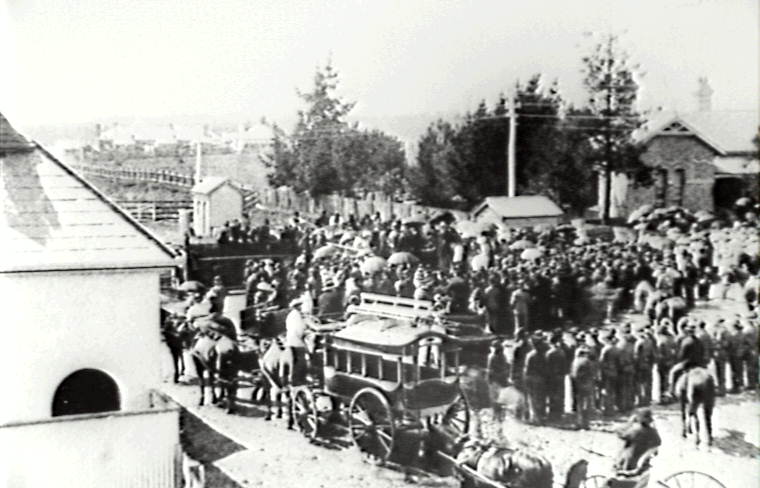
Campbelltown was buzzing with excitement on the day Sir Henry and Lady Parkes paid the town a visit. It was 1891 and Parkes was the Premier of New South Wales at the time. A huge crowd turned out to greet them at the railway station and listen to his speech made nearby. He was a huge figure in the colony and heavily involved in his attempts to federate the colonies. Despite his poor physical health after a recent accident involving a cab, he was still a formidable opponent in Parliament.


The reason for Sir Henry's visit was the Encampment of the Volunteer Forces for which Campbelltown was selected to host in 1891. This was a training camp for military volunteers and was a major coup for the town. A report in the Freeman's Journal described the arrangement of the camp "The Cavalry occupied the Rev. Mr. Alkins' paddock, on the eastern side of the Anglican Church, the Mounted Infantry were placed in a paddock adjoining St. Patrick's Inn, and the First and Third Regiments on the eastern side of Mr. Joseph Rudd's residence, and the remainder of the Infantry were located on the old racecourse."


The week following Parkes' visit was virtually a holiday for the townspeople. The streets from the railway station to the camp were spanned by triumphal arches, covered with fernery and bunting. The event even lead to improvements being made to the railway line. Men had to work day and night, in order to complete the duplication of the line as far as Campbelltown. Hundreds of navies were employed at ballasting, plate laying and bridge-making. Platform accommodation was also increased.


Henry's speech near the railway station, particularly his comments regarding federation, attracted loud cheers. He also entertained the strongest belief in the volunteer movement. At the conclusion of the address cheers were given for Sir Henry and Lady Parkes, the Governor and the Queen. School children then sang "God Save the Queen". After a luncheon at the headquarters mess, the visitors were shown over the camp, and returned to town by the half-past 4 train.


This is a photograph of Sir Henry Parkes' visit taken during his speech. Although very blurry, you can make out Henry's recognizable figure just to the left of the small shed on the right. (patience is required!)


Written by Andrew Allen


Source:


Freeman's Journal 11 April, 1891


Australian Star 30 March 1891

Monday, 13 March 2017

Confusion Reigns


Spare a thought for the residents who lived in the above East Campbelltown streets in 1970. At one end of the street the name is spelt Paterson Street and at the other end Patterson Street? Same with the other street. Is it Mereil Street or Meriel Street? It seems we had one confused signwriter back then and a lot of confused locals!

For the record, Paterson Street was named after the famous poet Banjo Paterson and the correct spelling is with one t. Mereil Street is the correct spelling for the other. The unusually named street was invented by joining the first names of Neil McLean and his wife, Merle. Neil McLean was the name of the developer of Campbelltown's first estate named St Elmo. Work on the estate began in 1949 and was located around Broughton and Lindesay Streets. It was nicknamed "Snob's Hill" by local residents as the homes were large and brick with sweeping views. Mereil and Paterson Streets were part of St Elmo Estate.

The next issue of the Campbelltown and Airds Historical Society journal "Grist Mills" will be launched this Saturday March 18 at 'Glenalvon'. Written by Julie Crowley and titled "Living on the St Elmo Estates: The Story of One Man's Trust", it looks at what life was like on the estate through the experiences of those who lived there. Copies will be available from 'Glenalvon' after the launch.


Written by Andrew Allen


Sources:

McGill, Jeff et al 1995
Campbelltown's Streets and Suburbs: How and why they got their names
Campbelltown: Campbelltown and Airds Historical Society

Campbelltown Ingleburn News, July 7, 1970