Friday, 25 September 2015

Saving Souls


A small pamphlet recently unearthed (see below) announces the “United Tent Mission” - opening in Campbelltown on the 15th August 1915 and continuing until the 24th August 1915. The evangelist Mr J.T. Furnass would feature in the Mission Tent which was to be erected in “The Reserve” Queen Street – what we now know as Mawson Park.
John Thomas Furnass, a native of Yorkshire, had arrived recently from England, where he also conducted missions as an evangelist. He was connected with the London Evangelization Society whose aim was to send suitable preachers to conduct special evangelistic services in churches or halls wherever the Society was asked. The Australian organisation was built upon the very successful precedent of its London counterpart.

From 1915 until his passing in 1940, J.T. Furnass held missions in tents, halls and churches all over New South Wales, up and down the South Coast, in the Southern Highlands, in the suburbs of Sydney, North to Cessnock and beyond, and out west. And so he found himself in a tent in Campbelltown for 10 days in August 1915. Newspaper reports of his missions indicate his success at bringing souls to the Lord.
His obituary referred to him as “the big man with the big voice”.  He died as he lived, called to God whilst preaching the Gospel.


Written by Claire Lynch
Sources - Trove

Friday, 18 September 2015

Happy 40th Birthday Glenquarie Library!


The Glenquarie Shopping Centre (Stage 1) was officially opened on September 29th, 1975. Built at a cost of $2.75 million, the centre was financed and developed by Campbelltown City Council, the first time a local government had entered into such a venture.  The centre contained 28 shops and banks, the largest of which was the Coles New World Supermarket.
One of the stores contained the first Glenquarie Library in a shopfront. This was described as the cheapest “shop” in the Glenquarie centre, being free to all residents and ratepayers.(see picture below).
Eight years later, on September 3rd 1983, Stage 2 was opened, which included the new ‘stand-alone’ Library and Neighbourhood Centre, as well as doubling the floor space of the shopping centre and increasing the number of shops to 56.
From small beginnings in 1975, Glenquarie Library has grown from 2 staff and just under 2,000 items, to 5 staff and approximately 24,000 items in 2015.


 Written by Claire Lynch
Sources - Local Studies Pamphlet Files


Thursday, 10 September 2015

The Murder of Ellen Hyndes

On the afternoon of Friday January 22, 1847 a man by the name of James Fitzgerald was walking towards a house on the Campbellfields Estate at Minto when he noticed a number of cattle gathered round in the scrub with their attention focused on something on the ground. Thinking that it might be the saddle and bridle that he came to look for he suddenly realised to his horror that it was the body of a young woman. The woman was lying on her back with the face and upper part of the body smeared over with clotted blood, which had recently flowed from a long and deep gash across the throat. He recognised the woman as 20 year old Ellen Hyndes.

Ellen had been married to a man by the name of Thomas Hyndes. He was killed the year before at the age of 33 when he fell from his horse. Although the devastation of her loss of her beloved husband and father of her two children was obvious to the locals, it didn't stop one particular admirer from making advances to the young widow.

John Kean was a ticket-of-leave man living in the same neighbourhood as Ellen Hyndes. Kean had become a frequent visitor to Ellen's house ever since the death of Thomas six months previous. After much persistence, Kean obtained her consent to become his wife, in return he would have to buy her some furniture and put it in her house. For reasons unknown she later refused to have the marriage solemnised, and returned his furniture to him which he sold off. Some time later they reconciled and he repurchased some of the furniture and returned it to her in the belief that she would accept his proposal. She expressed no interest this time which greatly upset Kean.

By coincidence a Constable McAlister was at Campbellfields with a warrant for John Kean for horse stealing, when Fitzgerald made his gruesome discovery. Whilst at the house of a man named Thomas Sharpe, he heard the voice of James Fitzgerald call out from the bush. He went over to investigate and an examination of the scene was carried out. The body lay about a half a mile from her house.

Later that day John Kean made his way to Reeve's Public House at Narellan with intentions to leave the district the next day. He knew the police would be on his trail. Constable Charles Bamford of Campbelltown made a statement "I had information that he (Kean) had been charged with horsestealing and murder; I went on Saturday morning, the 23rd, to Reeve's public house at Narellan; Kean was sitting under the verandah, the moment he saw me he ran through the house into the bush."  After running about a mile, Kean was apprehended and brought to the watch house at Campbelltown.

John Kean made a confession to the murder of Ellen Hyndes on the 29th of January. He declared:

 I murdered the woman and wish to suffer for it. I came to Campbelltown on Thursday, and went to James Hogan's house in which his mother resides. I arrived there about two or three in the afternoon. We began talking about Ellen Hyndes, and about a brother of his named Michael Hogan marrying her. We talked about nothing else that evening. I remained there that night, and next morning pretty early James Hogan and I left the house together, taking different roads, and we both met in the bush, not far from Ellen Hyndes house, and after waiting some time we saw her coming towards us. James Hogan first took hold of the woman and threw her down, and tore her shawl ; she got up and ran away, and I got hold of her and threw her down again, and James Hogan then gave me the razor that he had purposely brought to kill the woman; I then cut her throat. The night previous we had arranged how we were to murder her—that one was to hold the woman, while the other cut her throat. The reason for Hogan joining with me to murder the woman was, that he did not wish his brother to marry her. After we had murdered her we both returned by different roads to Hogan's house; I got to the house first, and he about ten minutes after; this was about 11 a.m.; after I had cut her throat with only one cut of the razor, I gave the razor back to Hogan; no blood came on my clothes; the mother of Hogan came into Campbelltown that day, and on her return, said there was a report about my stealing a horse; I then left the house and went over to Reeves's public house on the Cowpasture road, and remained there until the next day, when I was taken and brought into Campbelltown by constable Charles Bamford; no one knew of the murder but our two selves; Mrs. Hogan did not know of it, and Michael Hogan was not at home; I was aggravated to the deed by the jeering of the ogans (sic) and others.

James Hogan was initially taken into custody on the suspicion that he aided and abetted in the murder. He was later cleared of any involvement as the only evidence against him came from the confession of John Kean. He was later put on trial for misleading the police. The charge was proven and he lost his ticket of leave.

During Kean's trial it was brought up that he became jealous when he received word that Ellen was about to marry a man by the name of John Cremer. This was the real reason behind her refusal to marry John Kean.

A number of witnesses were called up at the trial and each gave damning evidence against Kean. One stated that he had heard Kean make several threats as to what he would do to Ellen if she did not marry him. One such threat was that before he was humbugged any longer by her, "he would go on the Sydney gallows". Another witness claimed that Kean came to her shop the day before to buy a knife and a handkerchief- the same patterned handkerchief that was at the scene of the murder and presented in court.

John Kean made no other defence other than the assertion of his innocence, declaring that the confession attributed to him was made while he was in a state of excitement from drink, so that he did not remember anything about it.

The jury, after having retired for a few minutes, found a verdict of guilty. The judge addressed the prisoner "solemnly as to the heinous nature of the crime which he had been proved, beyond all manner of doubt, to have committed."

John Kean was executed at Darlinghurst Gaol on April 30. He was reported to be penitent, and his conduct and demeanour uniformly pious. Since his confinement he became very corpulent. His appetite never failed him right up to the day before his execution.

Ellen Hyndes was buried in the same grave as her husband at St John's Catholic Cemetery, Campbelltown. The grave can be seen in the photograph below.


Written by Andrew Allen


Friday, 4 September 2015

Queen Street in the Late 1960s


Time for a walk down memory lane. This photograph would've been taken from the roof of the old Macquarie Cinema on the corner of Queen and Browne Streets looking south west. Those of you living in Campbelltown in the late 1960s would remember this part of Queen Street back then. (Click on the image for a larger version)

In the foreground on the left is Mawson Park with the Club Hotel also on the left on the corner of Queen and Cordeaux Streets. On the other side of Queen Street starting from the right is Ted McPherson's butcher shop which was at 151 Queen Street. Moving left and next to the butcher is Richie Hand's barber shop. Next to that is a milk bar owned by Con and Peter Papapandos and formerly operated by Grallelis'. Then we have a group of 2 storey buildings. The first on the left belonged to Ryall, Smith & Co, accountants, typing, duplicating and photocopying. It was upstairs and above Carolyn's Frock Salon. G E Eves, photographer was next at 157 Queen Street and this was also upstairs. Geoff Eves took this photograph and took many street scenes around this period. He still lives in Campbelltown. Moving left we had William B. Leckie, Chemist, at 159 Queen Street.

Moving further to the left, a vacant block of land sits beside two large buildings. On the right is the Bank of NSW, previously the Balalaika Cafe. On the other side of the vacant block is the Commercial Bank of Australia, later Bank of NSW and then Westpac. On the first floor was M R Newton, solicitor and J M Daly, surveyor. This site used to be occupied by Reeve's Emporium. Patrick Street is on the other side of this building.

Just out of the picture to the left is Lack's Hotel which was on the corner of Queen and Railway Streets.

Do you remember these businesses? We'd love you to share your memories with us!


Written by Andrew Allen


Source:

Campbelltown Ingleburn News, September 30, 1969

Saturday, 29 August 2015

St Peter's Cemetery Stonemason

Few of us today have the luxury of living close to work. Most of us waste long hours on clogged freeways endlessly staring at bumper stickers or tail lights. For one lucky Campbelltown identity however, work was literally just across the road.

Eugene Glyde Wells, better known as Hughie, was born in Shoreham in Sussex, England in 1886. At an early stage in his life he lived on The Isle of Wight where he was apprenticed as a stonemason. He moved to South Africa and later came to Australia. Hughie was a monumental mason in Campbelltown after arriving here about 1940.


Hughie and his wife Ethel lived and worked in a house in Broughton Street directly opposite St Peter's Church of England Cemetery. He was responsible for making headstones for the cemetery during his time living in Broughton Street. The house was demolished not long after the photo seen above was taken in 1977. The Scout Hall now stands on the site.

Not much is known about Hughie. A local resident remembers him staggering out of Lack's Hotel and getting into his little ute and wobbling his way down Queen Street before turning into Broughton Street. His son Frank, who lived in nearby Warby Street, worked with him at the stonemason's yard. Hughie died in Campbelltown in 1973.


             Hughie and Ethel's headstone in St Peter's Cemetery


Written by Andrew Allen

Friday, 28 August 2015

The Perfectionist Architect

Geoffrey Hamilton Gore's obituary described him as having a 'reputation as being an honest and articulate architect, a perfectionist in his profession.' He led an eventful and interesting life but it was through his prowess as an architect that his legacy will live on.

Geoffrey was born in December 1899 at Paddington and moved to Campbelltown in 1910 when he was 11. The family moved to a house in Sturt Street called "Rossmoyne". He attended Campbelltown Primary School. Most of young Jeffrey's spare time was taken up with going shooting with his father. They would walk side by side for miles and miles, around the town and over the hills now so densely populated. He also remembered going around Campbelltown in the school holidays with the local baker helping him deliver bread.

After leaving school he initially thought he would try being a dentist but soon discovered that he had a talent for drawing. He commenced his architectual education in 1916 at Sydney Technical College. His training was put on hold however when he enlisted in the Great War. Geoffrey had an inclination to go to war from a young age. In fact it began as early as Primary School, when during an afternoon game of tennis, the Head Master came to the court and announced that England had declared war on Germany. Of course all the boys were determined to go if the war lasted long enough. He declared that he would like to go as a Drummer Boy, being small, and thinking that would be the only way to get there on account of his age. Highly amused by this idea, his family told him he would have to bide his time until he grew older. At the age of 17 years young Geoffrey did bluff his way into the army and in 1918 travelled to England to support the war effort. He wrote a diary of his time serving overseas which included many sketches of the buildings he saw whilst in the army.

In 1919 he returned to Australia and began as a registered architect. His work lasted from the early 1920s to the late 1970s. Much of his work was designing residential housing, especially in Campbelltown. Many of Campbelltown's well-known families had Geoffrey design their house. He also designed the original Campbelltown Golf Club and the Campbelltown Scout Hall. Geoffrey also designed his own house that he and his wife Jeanne moved into in 1928. This was located at 82 Broughton Street. It was very modern for the time, including a double brick exterior, Italian imported glass, a sunken bath and a dressing room off the main bedroom. It was in this same house in 1978 that he gave an interview about his life. Sadly the house was later demolished.

Geoffrey Gore had many other interests. He was involved in the School of Arts, Campbelltown Scouts and was a member of the Labor party. He was also a supporter of local rugby league. It was Geoffrey that fired a revolver in the air to stop brawling spectators during one memorable game in the 1930s (see my blog post on A day at the Football).

His daughter Bev who passed away recently fondly remembered assisting her father to hold his measuring tape whilst he was surveying local building sites. She also helped him with checking measurements and calculations when she was older. She remembered the family dining room table being covered with architectural plans and measurements.

Geoffrey Gore passed away in March 1985 aged 85 years.


Written by Andrew Allen


Wednesday, 19 August 2015

Where was our first racecourse?


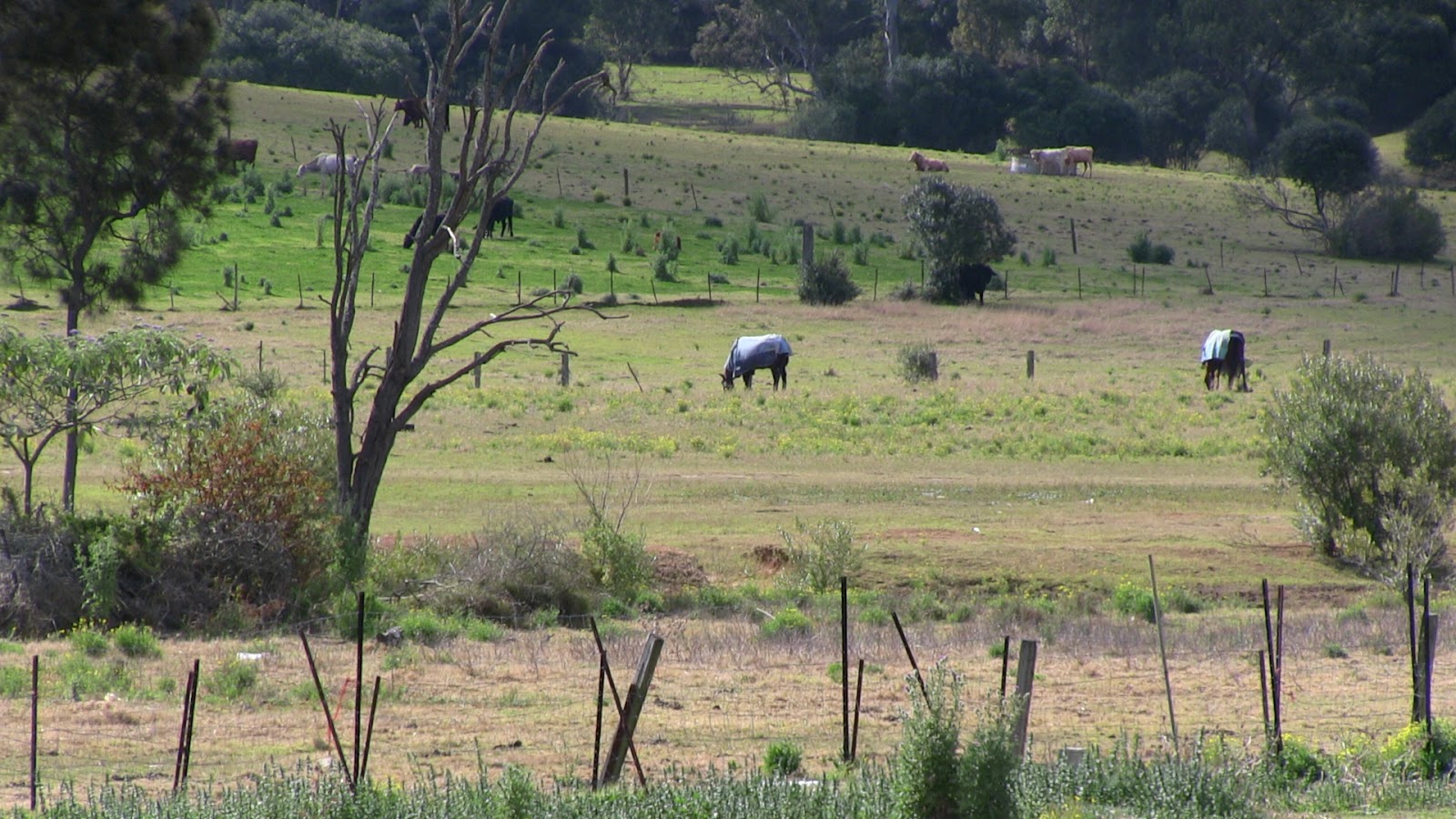
A few weeks ago I met up with author and racing enthusiast Bob Charley to see if we could locate where the area's first recorded race meeting took place. Former resident and local historian Verlie Fowler's research revealed that "A private racecourse was established on the flat below Varoville" and it was here that the races of 1827 were held in the vicinity of Bunbury Curran Creek. The land remains as open paddocks although partly covered by the Hume Highway. Carol Liston, the author of Campbelltown- The Bicentennial History, suggests that this 1827 meeting was held by Colonel Henry Dumaresq for the Sydney Turf Club.

After a visit to the flats below Varoville homestead Bob and myself came to the conclusion that this piece of land was the only area flat enough to have a race course constructed (see the photograph above). We looked out over the hills surrounding the flat and imagined the crowd roaring for their nag to bring them victory. The Australian reported that "The Campbelltown people had a prime day's sport on Monday. The place was crowded with up-country bucks, from far and near, and all was fun and bustle and activity." The following week, however, the same newspaper hinted at what had been publicised as the first "dead-un" in Australian racing: "The Campbell Town Races, which took place last week, though they were carried off with so much eclat, and afforded so much fine sport, has given rise to some dissatisfaction among many of the sporting gentry, in consequence of Spinks losing the race against Cullen's horse. Spinks rode Hammond's and though, throughout the race, some good judges declare he had not a chance for winning, yet others do not hesitate to call it a cross. A meeting, we hear, has been on the subject, and Spinks has offered to run the race over again, provided a bet, worth contesting for, be made by the owner of the winning horse." Nothing however came of the matter.

Bob Charley is working on a new book on early NSW racecourses. He has been involved in racing administration including Chairman of the AJC, Racing NSW and the Australian Racing Board. He was inducted as an Officer in the Order of Australia in 2001. He has previously published a book called "Heroes and Champions" about the history of horse racing in Australia.


Written by Andrew Allen