Saturday, 29 August 2015

St Peter's Cemetery Stonemason

Few of us today have the luxury of living close to work. Most of us waste long hours on clogged freeways endlessly staring at bumper stickers or tail lights. For one lucky Campbelltown identity however, work was literally just across the road.

Eugene Glyde Wells, better known as Hughie, was born in Shoreham in Sussex, England in 1886. At an early stage in his life he lived on The Isle of Wight where he was apprenticed as a stonemason. He moved to South Africa and later came to Australia. Hughie was a monumental mason in Campbelltown after arriving here about 1940.


Hughie and his wife Ethel lived and worked in a house in Broughton Street directly opposite St Peter's Church of England Cemetery. He was responsible for making headstones for the cemetery during his time living in Broughton Street. The house was demolished not long after the photo seen above was taken in 1977. The Scout Hall now stands on the site.

Not much is known about Hughie. A local resident remembers him staggering out of Lack's Hotel and getting into his little ute and wobbling his way down Queen Street before turning into Broughton Street. His son Frank, who lived in nearby Warby Street, worked with him at the stonemason's yard. Hughie died in Campbelltown in 1973.


             Hughie and Ethel's headstone in St Peter's Cemetery


Written by Andrew Allen

Friday, 28 August 2015

The Perfectionist Architect

Geoffrey Hamilton Gore's obituary described him as having a 'reputation as being an honest and articulate architect, a perfectionist in his profession.' He led an eventful and interesting life but it was through his prowess as an architect that his legacy will live on.

Geoffrey was born in December 1899 at Paddington and moved to Campbelltown in 1910 when he was 11. The family moved to a house in Sturt Street called "Rossmoyne". He attended Campbelltown Primary School. Most of young Jeffrey's spare time was taken up with going shooting with his father. They would walk side by side for miles and miles, around the town and over the hills now so densely populated. He also remembered going around Campbelltown in the school holidays with the local baker helping him deliver bread.

After leaving school he initially thought he would try being a dentist but soon discovered that he had a talent for drawing. He commenced his architectual education in 1916 at Sydney Technical College. His training was put on hold however when he enlisted in the Great War. Geoffrey had an inclination to go to war from a young age. In fact it began as early as Primary School, when during an afternoon game of tennis, the Head Master came to the court and announced that England had declared war on Germany. Of course all the boys were determined to go if the war lasted long enough. He declared that he would like to go as a Drummer Boy, being small, and thinking that would be the only way to get there on account of his age. Highly amused by this idea, his family told him he would have to bide his time until he grew older. At the age of 17 years young Geoffrey did bluff his way into the army and in 1918 travelled to England to support the war effort. He wrote a diary of his time serving overseas which included many sketches of the buildings he saw whilst in the army.

In 1919 he returned to Australia and began as a registered architect. His work lasted from the early 1920s to the late 1970s. Much of his work was designing residential housing, especially in Campbelltown. Many of Campbelltown's well-known families had Geoffrey design their house. He also designed the original Campbelltown Golf Club and the Campbelltown Scout Hall. Geoffrey also designed his own house that he and his wife Jeanne moved into in 1928. This was located at 82 Broughton Street. It was very modern for the time, including a double brick exterior, Italian imported glass, a sunken bath and a dressing room off the main bedroom. It was in this same house in 1978 that he gave an interview about his life. Sadly the house was later demolished.

Geoffrey Gore had many other interests. He was involved in the School of Arts, Campbelltown Scouts and was a member of the Labor party. He was also a supporter of local rugby league. It was Geoffrey that fired a revolver in the air to stop brawling spectators during one memorable game in the 1930s (see my blog post on A day at the Football).

His daughter Bev who passed away recently fondly remembered assisting her father to hold his measuring tape whilst he was surveying local building sites. She also helped him with checking measurements and calculations when she was older. She remembered the family dining room table being covered with architectural plans and measurements.

Geoffrey Gore passed away in March 1985 aged 85 years.


Written by Andrew Allen


Wednesday, 19 August 2015

Where was our first racecourse?


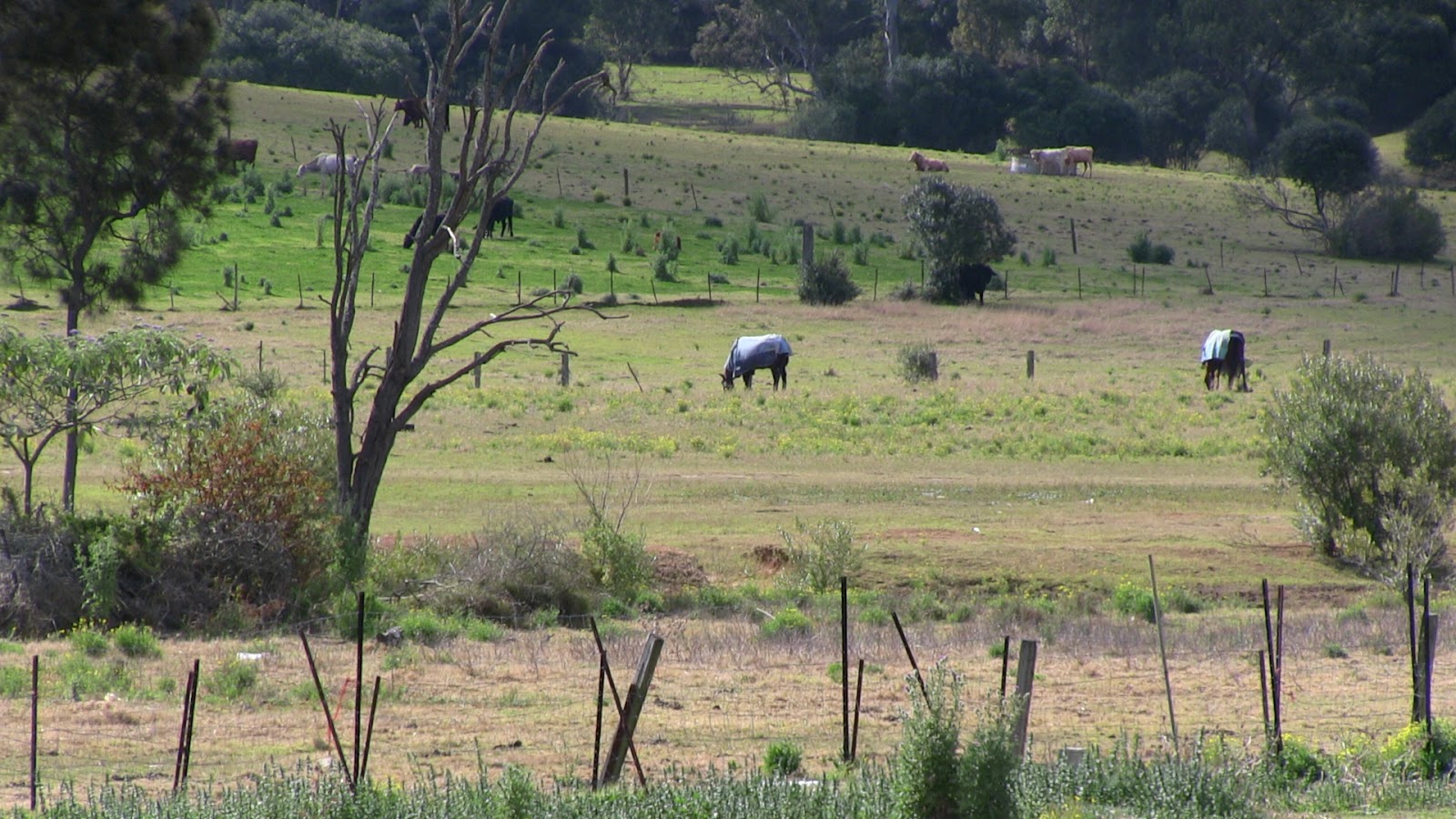
A few weeks ago I met up with author and racing enthusiast Bob Charley to see if we could locate where the area's first recorded race meeting took place. Former resident and local historian Verlie Fowler's research revealed that "A private racecourse was established on the flat below Varoville" and it was here that the races of 1827 were held in the vicinity of Bunbury Curran Creek. The land remains as open paddocks although partly covered by the Hume Highway. Carol Liston, the author of Campbelltown- The Bicentennial History, suggests that this 1827 meeting was held by Colonel Henry Dumaresq for the Sydney Turf Club.

After a visit to the flats below Varoville homestead Bob and myself came to the conclusion that this piece of land was the only area flat enough to have a race course constructed (see the photograph above). We looked out over the hills surrounding the flat and imagined the crowd roaring for their nag to bring them victory. The Australian reported that "The Campbelltown people had a prime day's sport on Monday. The place was crowded with up-country bucks, from far and near, and all was fun and bustle and activity." The following week, however, the same newspaper hinted at what had been publicised as the first "dead-un" in Australian racing: "The Campbell Town Races, which took place last week, though they were carried off with so much eclat, and afforded so much fine sport, has given rise to some dissatisfaction among many of the sporting gentry, in consequence of Spinks losing the race against Cullen's horse. Spinks rode Hammond's and though, throughout the race, some good judges declare he had not a chance for winning, yet others do not hesitate to call it a cross. A meeting, we hear, has been on the subject, and Spinks has offered to run the race over again, provided a bet, worth contesting for, be made by the owner of the winning horse." Nothing however came of the matter.

Bob Charley is working on a new book on early NSW racecourses. He has been involved in racing administration including Chairman of the AJC, Racing NSW and the Australian Racing Board. He was inducted as an Officer in the Order of Australia in 2001. He has previously published a book called "Heroes and Champions" about the history of horse racing in Australia.


Written by Andrew Allen

Friday, 14 August 2015

Eight Days in Glenfield


During the week of the 2nd to 10th July 1968, Wally Mellish, a minor criminal and car racketeer, managed to hold the attention of the NSW Police Commissioner, and over 30 policemen.  Wally was holed up in a fibro cottage at Glenfield, with his girlfriend, Beryl Muddle, and her baby son.

Police had come to the cottage to speak to Wally about some stolen car parts, and to deliver an arrest warrant for car theft.  Wally, who had been released from gaol five months earlier after serving a sentence for stealing, did not wish to engage with the police, and fired a shotgun over their heads. Thus began the dramatic week, which made headlines not only in the local Campbelltown Ingleburn News, but also in the Sydney papers. 

Norm Campbell – local newspaper photographer for the Campbelltown Ingleburn News at the time, tells the story.  “Wally Mellish made some outrageous demands, so Police Commissioner Allen decided to take charge and gave Mellish an army rifle. Mellish said he wanted to marry his girlfriend; I think it was Beryl Muddle, and so he arranged for the wedding. Then Mellish wanted to join the army. The whole thing was a real farce. They closed off Glenfield Rd to the Crossroads, that was one of the most amazing things that happened.”

Ultimately Wally gave himself up on the proviso that he be allowed to join the army and go to Vietnam “to make up for the trouble I have caused”.  He was taken to Ingleburn Army Camp to be interviewed by Army officers, and then taken to Morisset Hospital near Newcastle for psychiatric treatment.

To add an interesting twist to the tale, years later in his book “Bristow – Last of the hard men”, author Kevin Perkins claimed that Wally had been part of a car-stripping racket, which was being investigated by the Motor Squad, and who were about to be arrested and charged. One of the racketeers arranged for someone to see Tim Bristow about it (Bristow being a larger than life private eye and enforcer), and Bristow arranged for them to bribe their way out of it through the Motor Squad. Unfortunately, Wally couldn’t afford the bribe, and, upset at being left to be the fall guy, staged the siege. It was said that Commissioner Allen had rushed to the scene to try and keep a lid on a police scandal!

Written by Claire Lynch

Sources

Sydney Morning Herald

Campbelltown Ingleburn News

“Bristow : last of the hard men” by Kevin Perkins, 2003

Scratchingsydneyssurface.wordpress.com


Police Commissioner Norm Allen, Wally Mellish, Beryl Muddle, and the Reverend Clyde Paton, after Wally’s surrender.

Thursday, 30 July 2015

First Town Clerk


                               Thomas Jenner Winton photographed in 1884

It was commonplace for newspapers in the nineteenth century and well into the next to give the deceased a highly complimentary obituary. Although the obituary for Thomas Jenner Winton is lost to history (no copies of the Campbelltown Herald for 1887 survive), existing documents and oral tradition provide adequate proof that this man's character was exceptional.

Thomas Jenner Winton, often referred to as TJ, was born at 'Sugarloaf', Menangle in 1846 to William Winton and Mary Anna Larkin. His parents had migrated from England in 1840. The name Jenner was his grandmother's surname. Not much is known about Thomas's early life. We do know that he was educated  by a private tutor with his Uncle Edward Larkin at Windmill Hill, Appin. In 1868, Thomas married Helen Sophia Nicol at Campbelltown.


                            Helen Sophia Winton (Stan Thomson Collection)

Thomas was bailiff at Campbelltown District Court for several years where he had a reputation as a kind-hearted man who frequently paid the small debts of locals rather than see their homes repossessed.

He was chosen from two applicants for the position of first Town Clerk of Campbelltown in 1882. His friendly advice and opinions and his ability to perform unpleasant tasks in a kindly manner assisted the town through its transition to modern government and won him high praise from the community.

When Thomas died unexpectedly in 1887 Campbelltown was shocked. News of his death sped rapidly around the town and work was 'almost entirely suspended'. His funeral was enormous. The procession to the Congregational cemetery was headed by members of the Oddfellows Lodge, followed by the mayor and aldermen and other dignitaries from the town. The rest of the town followed. James Bocking made the comment that 'A prince in Campbelltown has fallen today'. A marble memorial was erected by public transcription over his grave.

Thomas and his family lived at "Jennerville" in Dumaresq Street. When he died in 1887 he was living at 'Belmore Farm' at Campbelltown. Thomas and Sophia had eight children.


Family of Thomas Jenner Winton outside their house "Jennerville" in Dumaresq Street 1882-1899 (Stan Thomson Collection)


Written by Andrew Allen


Sources:

LISTON, Carol 1988
Campbelltown: The Bicentennial History

HOLMES, Marie
The Congregational Cemetery
In Grist Mills, Vol.17, No.2, July 2004, pp40-41

Friday, 24 July 2015

There was an old mayor who swallowed a fly...


Gordon Fetterplace served three terms as mayor of Campbelltown for a total of seven and a half years. His first term began in 1976 and his last year was in 1992. One of his favourite phrases according to local author and editor Jeff McGill was "good for the town". He always backed anything that would help Campbelltown. He was very popular with voters with his man-on-the-street personality.

In 1985, he was in to his second term as mayor. One day that year he arrived at Hurlstone Agricultural High School for speech day and was walking towards the stage as part of the official party when he accidently swallowed a fly. "Everyone was in academic robes, and everything was very proper, with me walking down in my mayoral robes as the kids got up to sing the national anthem" he said. "Somehow the fly got into my mouth and I just swallowed. But maintaining the dignity of the occasion, I just had to keep on walking and just let him flutter all the way down...it was the most nauseating-and embarrassing-experience of my life. I survived, but I don't know about the fly."


Written by Andrew Allen

 
Sources:

Macarthur Advertiser, 20.11.1991

McGill, Jeff 1996
First Citizen: Mayors of Campbelltown since 1982

Wednesday, 22 July 2015

Ivy Cottage

I'm forever wishing I could go back in time. To be able to walk the streets of Campbelltown 50, 100...even 150 years ago would be amazing. One of the buildings I'd make a priority to visit would be Ivy Cottage in Allman Street. There was nothing grand about it. Just a simple little cottage but one full of charm and character that many happy families called home.

Local storekeeper William Gilchrist purchased land in Allman Street and built Ivy Cottage on it for his brother, Rev. Hugh Gilchrist, a Presbyterian minister appointed in 1838 to take charge of Campbelltown and many other surrounding towns. The cottage became the Presbyterian Manse and served as such until about 1882. The cottage would've held weddings in its early years as Presbyterian marriages were not conducted in church but in private houses.


An undated photograph of Ivy Cottage (Campbelltown and Airds Historical Society)

After Gilchrist's death in 1852, his brother sold Ivy Cottage to Alick Osborne. It then passed through many owners including John Hurley who rented it out after the death of his wife Mary in 1859. John and Ellen Thurston were living there in 1865. In 1882 it was owned by a W.J. Wilson followed by a Patrick Cullen who died in the cottage in 1893.

The cottage became home to the Vardy family some time around the early 1900s. It's unclear exactly when they moved in. The Vardy family numbered 12 with Michael and Mary the parents. Michael and Mary had lived at the cottage for a period prior to 1877 when it was still the Manse. When his father died, Michael inherited Springfields at Menangle, and he moved there. He returned to Ivy Cottage when he retired.


Members of the Vardy family outside Ivy Cottage c.1920 (Tess Holm Collection. Campbelltown and Airds Historical Society)

Photographs of the cottage show a building that was symmetrical with a picket fence around it. A newspaper advertisement in 1861 describes it as containing a dining room, drawing room, 3 bedrooms with attics, detached kitchen, servants' room and sheds. Also a flower garden in front and a spacious kitchen garden at the rear.

The cottage was occupied by members of the Vardy family right up until the late 1950s. In 1957 unmarried siblings, Cyril and Gertrude, still resided there. For many years piano music could be heard playing inside the cottage. Gertrude was the sister who played the most and apparently played so loudly as she was deaf. The piano was owned by her mother Mary who would play for many years as the organist for the Catholic Church.


Unidentified group of women and children on verandah of Ivy Cottage (Campbelltown and Airds Historical Society)

Another sister was Cora who lived with her husband in the same street as Ivy Cottage. Her husband would look after the garden at the back of the cottage and in the forties and early fifties kept between 200 and 250 hens in the backyard to supply the Egg Board.

Ivy Cottage was sold for re-development after 1957 when Cyril Vardy died and Gertrude moved out. I'm unable to locate an exact date for its demolition. It stood at 31 Allman Street.


Written by Andrew Allen


Sources:

Sydney Morning Herald, 10 October 1861 p8

HOLM, Tess et al 1985
Campbelltown 1930-1940: Dumaresq Street and Environs

THORNTON, Kathryn
People, Places and a Piano
In Grist Mills, Vol. 24, No. 1, February 2011 pp 3-9

Demolished Heritage Buildings of Campbelltown
November 2005