Wednesday, 23 April 2014

Menangle House

This two storey brick building on the Menangle Road just outside of Menangle on the Campbelltown side was once the Horse and Jockey Inn. It was built in the 1820s. The inn was divided into two sections- one for the lower class and one for the upper. A library was also located on the lower level of the inn but only available for the upper class to use!

George Taber used the building as an inn for some years but then closed it. The advent of the railway opening in the early 1860s caused it to be re-opened with the licence held by a Mr Curtayne. George Taber soon took it over again however.

The building is an impressive example of colonial architecture. It has typical characteristics of the colonial era, the symmetrical arrangement of the doors and windows, shutters, a fanlight above the front door. The cast iron lace verandah is a later embellishment, as is the brick front extension. The extension dates back to 1865.

The inn has been restored to its original form of a bar. The old servery hatch is still there and is the only working one left in Australia.

The sandstone building located to the side of the old inn is the original homestead. This main house was built by George Taber and his convicts in 1834. The external part of it has been restored. It was once surrounded by a magnificent orchard.

Menangle House is featured in an historic photograph display of Menangle created by the Menangle Community Association and displayed at Campbelltown Library for a short time.


Members of the Taber family outside Menangle House. Date is unknown. (Walker Collection)


Written by Andrew Allen

Sources:

Moloney J J, 1929
Early Menangle

www.menanglehouse.com.au


Friday, 4 April 2014

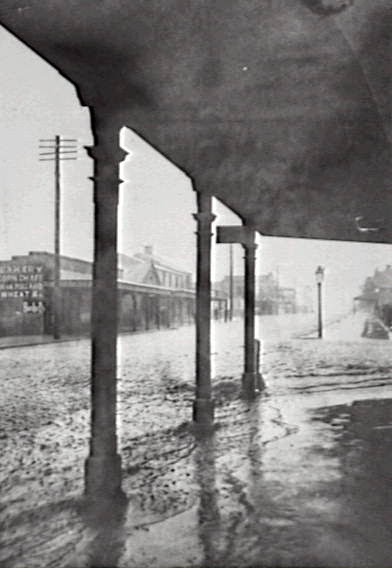
Flood in Queen Street

(Photograph courtesy of Campbelltown and Airds Historical Society)


This remarkable photograph was taken on the corner of Queen and Lithgow Streets in Campbelltown between 1910 and 1920. It shows Queen Street transformed from a dusty street to a fast flowing river. It's hard to imagine the scene from this same spot with today's modern drainage and guttering.

The shot was taken by Percy Marlow from his shop on the southern corner. It was called Marlow Bros. Premier Store and later became Solomon Bros. Store. Percy Marlow was a prolific photographer from this time. The ANZ Bank stands on the site in 2014.


Written by Andrew Allen


Wednesday, 2 April 2014

Dr William Bell

The bulk of the information for this post comes from the extensive research performed by Lois Sabine from the Blue Mountains Historical Society. Lois spent countless hours researching material for her article on Dr Bell in the Blue Mountains History Journal cited at the end of this post.

Few men have left such an indelible mark on Campbelltown as Dr William Bell. Although he only lived in Campbelltown for six years, his medical contributions helped him earn the reputation as one of the finest doctors the town has seen.

William Bell was born in Newry, Ireland in 1815. He sailed to Sydney in 1839 as Surgeon Superintendent and after arriving established a practice where he offered free consultations for the poor. He then moved to Parramatta and Windsor where he performed more medical work. However Dr Bell soon became insolvent as a result largely of the economic conditions of the 1840s. In fact money problems plagued him for the rest of his life.

Dr Bell wrote a number of medical publications during his life. His first work written in 1849 was "The Settlers Guide" or "Modern Domestic Medicine and Surgery". This book arose from Bell's observation of the need to help the many settlers who lived out in the bush, and who were far away from medical assistance. He also hoped that the book would solve his financial problems.

Bell moved to Carcoar near Bathurst in 1850 and then Orange the following year. In 1854 he had a practice at nearby Sofala on the goldfields. A coroner's report from his time there reported that he had performed a post mortem on a notorious drunkard, a woman who had been missing overnight and was found next day standing upright in the middle of a water hole but when rescued she immediately expired.

In 1855 the miners were moving on from the goldfields and Dr Bell thought Campbelltown would be a good place to move to. He rented a well furnished house that had a surgery, two parlours and three bedrooms.

In 1857 he became a coroner for the area. Using whatever transport was available to him, he was required to reach a body before decomposition set in. The court would then sit at the inn nearest to the incident.

Dr Bell was soon in financial trouble again and became insolvent for the third time in his life. He had run up accounts after buying a piano forte for his parlour, books for his daughters, furnishings and expensive clothes. Perhaps to overcome these financial problems, he wrote and published an essay titled "The Wear and Tear on Human Life" and another one titled "On the Origins, Progress and Treatment of Smallpox". It was however more likely that Campbelltown's healthy population had reduced his income. His business had fallen by 400 pounds from 1858 to 1859. He was charging 1 pound and 1 shilling for a visit and about 10 shillings for medicine.

Despite his financial worries, Dr Bell was involved with a number of committees in the town. Some of his activities included: the formation of a Benevolent Socity, chairman to raise funds for the celebrations for the opening of the railway in 1858, raising funds for the Donegal Relief Fund for the starving peasantry and an inaugural member of the Campbelltown School of Arts Committee.

It was his experiences as a doctor that most fascinated me. A search of Trove revealed some interesting, challenging and distressing calls for Dr Bell during his years in Campbelltown. Some of these included amputating a boy's thumb after a shooting accident, attending to a child after a tree had fallen on him, a girl who had died after falling out of a cart, a 17 year old girl dying after her clothes caught on fire and the scalding of a 20 month old girl who pulled a plate of boiling milk and flour over her. There were many inquests that he was needed for and many of these were as a result of intemperance.

Dr Bell moved to Picton in 1862. He later moved to Ashfield and practised in the city. His health began to decline and he became insolvent for a fourth and fifth time. He was advised to take a holiday to a warm climate but he never made this. Instead he moved back to Picton where he died in 1871. The end had come for a wonderfully talented medical man whose brilliance had touched the lives of many.


Written by Andrew Allen


Sources:

LISTON, Carol 1988
Campbelltown: The Bicentennial History
North Sydney: Allen and Unwin

Dr William Bell (1815-1871): Experiences of a 19th Century Doctor on either side of the Blue Mountains
In Blue Mountains History Journal
1; 2010

Thursday, 20 March 2014

National Trust Heritage Festival 2014


Step back in time and trace the journey of our early settlers by participating in a tour of our local cemeteries, to be hosted by Campbelltown City Council’s Library Service in celebration of this year’s National Trust Heritage Festival.   

The festival will run from 12 April to 26 May and celebrates the theme, ‘Journeys’.   

Embracing this year’s festival theme, Campbelltown City Library will host a walking tour of  St Peter’s Anglican Cemetery on Wednesday 30 April, and of St John’s Catholic Cemetery on Thursday 8 May. Both tours will be held from 11am to midday and will focus on convicts interred in the cemeteries and their ‘journey’ from their homeland to Campbelltown. Cost is free, but bookings are essential. Participants will meet at the front gate of each cemetery at 11am. 

Accompanying the tours will be a display at HJ Daley Library featuring the lives of the convicts discussed in the tours. The display will also feature Campbelltown library staff that settled in Australia from overseas, highlighting their journey as refugees or migrants. 

For more information, or to book for the tours, phone 4645 4436 or visit campbelltown.nsw.gov.au/whatson 

Visit nationaltrust.org.au for more National Trust Festival events.  
 
 
The graves of convicts James and Elizabeth Ruse in St John's Catholic Cemetery. Both will be featured in the library's cemetery tours.
 

Sunday, 16 March 2014

Macquarie Fields Gatehouse

Exciting news! Campbelltown Library has acquired artefacts from an archaeological excavation of Macquarie Fields Gatehouse. The excavation was undertaken by Archaeological and Heritage Management Solutions in late 2011 after they were commissioned by the Glenfield Junction Alliance  to carry out the excavation. Road works unearthed brick features leading to the archaeological investigation. The find included bottles, glass, ceramics, building material, metal and bone.

The site area was adjacent to Campbelltown Road, Glenfield, near its intersection with Beech Road. It was situated in the extreme north of the Campbelltown Local Government Area boundary.

In 1810 the Surveyor General James Meehan had 10 acres of his land grant at Macquarie Fields in cultivation, 40 acres cleared and a house with 4 men employed. At the end of 1820 the Rev Thomas Reddall rented out the main building at Macquarie Field for a school. The building became known as Meehan's Castle.

A larger house known as Macquarie Field House was constructed in the late 1830s or early 1840s. George Fairfowl Macarthur headmaster of St Mark's Collegiate School Darling Point moved his school and family to Macquarie Field House in 1858 when the facilities at St Mark's proved inadequate for expanding the school. It was at Macquarie Field House that the first school cadet corps was founded and the cadet uniform was worn by the boys as a general school uniform.

The gatehouse at Macquarie Field appears from historical evidence to date from the latter part of the 1820s and the available evidence from the occupation deposits do not contradict that date. Archaeological evidence suggests that the gatehouse was demolished in the 1870s. The death of the owner and subsequent sub-division of the estate would have been the probable reason.

In the early 1900s, the architect William Hardy Wilson embarked on a personal quest to record the finest colonial architecture still extant around the Sydney district. One of the sites he recorded, using just art paper stained with tea, was the gates at Macquarie Field. The drawing was made after the gate house was demolished yet it was recorded in the drawing. Wilson was presumably informed of its presence or perhaps some of the footings were still visible and he was able to use these for his sketch.

Between 1917 and 1924 the northern part of the property was sold. The gates had probably gone by 1924 as they are not mentioned by the owner in his reminiscences on the estate.

Gate lodges or houses were considered more than structures to provide security or simple shelter for gatekeepers. As the historian Timothy Mowl said "Lodges were not merely garden structures, they were designed as entrances, garden buildings on the perimeter to lure respectable visitors to view similar pleasures within."

The artefacts will be stored in the Local Studies Collection and will be displayed to the public on a date to be decided.


The convict built gates to Macquarie Field Estate and the site of the archaeological excavation


Written by Andrew Allen


Friday, 7 March 2014

Kathleen Whitten - Our First Woman Mayor


She has been referred to as a headline generator, a mould-breaker and a trailblazer, elected as mayor of Campbelltown at the end of 1961, Alderman Kath Whitten became the first woman to ever hold that position.
The idea of a woman holding such a senior rank dismayed many men and they made no secret of the fact that she had been elected because of a tactical mistake, the result of a political tug of war between council’s two most influential men, Greg Percival and Clive Tregear.

Nonetheless the new Mayor proved both talented and capable and the public grew to be proud of their “novelty” mayor, her biggest problem was winning over her colleagues.

There was friction from the start between the Mayor and her male colleagues, with Council refusing to buy her a better fitting mayoral robe (the existing robe was fitted for a large man and held together by safety pins) so she purchased her own sable–trimmed robe. Sympathetic media coverage of the matter only angered her opponents but her biggest confrontation was to be with councilor Guy Marsden over Government plans for Campbelltown to become a “satellite city”.
Whilst her one year term included walkouts by aldermen, an unsuccessful vote of no-confidence and the eternal opposition of several key councilors that resulted in a failed bid to regain the mayorship, even her harshest critics acknowledged her dignity and decorum that she showed in office.

Retiring from council in 1971, she remained Campbelltown’s only female Mayor until Cr Meg Oates was elected mayor in 1993.
 
By Samantha Stevenson
 
Opening of Campbelltown Fire Station in Broughton Street including (l to r) Norm Campbell, Mayor Kathleen Whitten (nee Robinson) and Mr Andrews (former president)
  
Sources :
McGill, Jeff Campbelltown : a modern history 1960-1999
Local Information Pamphlets

Thursday, 27 February 2014

Swimming in the Cattle Tank and Reservoir

Located in Allman Street, Campbelltown are the historic Cattle Tank and Reservoir. Both were constructed and completed by convict labour in the 1830s. They were regarded as necessary as water supply was a constant problem for both farmers and townspeople living in Campbelltown.

Both the Cattle Tank and Reservoir appear mostly to have had an ample supply of water, even during droughts. So of course one can imagine how alluring they were to the locals on a sweltering Campbelltown day. An interesting photograph in our collection is of "Jack's Day"- a regatta held at the site in 1917. It shows a crowd of people gathered around the Reservoir and a couple of local lads cooling off in the water. The newspaper reported "A band of 20 performers headed a procession from the railway station to Hurley Park, where juvenile sports and aquatic displays in the once tabooed reservoir exhilarated spectators".

The Cattle Tank has also been the scene of drowning tragedies over the years. In 1925 seven year old Leniel Johnson drowned after she accidently fell in while playing with her sister. She had been in the water for 20 minutes before she was found but couldn't be revived. Ten years later sixteen year old Betty Humphreys drowned. She had been suffering a nervous breakdown according to the 'Campbelltown News' and ran from her home in Allman Street and jumped in the Cattle Tank. Despite attempts from a young boy named Jack Hadden, she was unable to be revived. The newspaper mentions a mass of tangled wire and rubbish under the water so the days of a clean place to swim appear to be gone by then.

I interviewed both Jim Summers and David Milliken and they described their experiences of swimming in the Cattle Tank when they were boys. Jim, who was born in 1929, recalls his days of swimming there: "we used to swim in those and when I was a kid they were always full of water. We used to catch fish and eels in the smaller one on the bottom side. The tanks would dry up and you could walk in them. Then they would fill up and the fish and eels would be back, they must stay under the mud." He also went on to explain how there used to be a creek that ran down from the tanks in Allman Street. It ran down to Oxley Street and came out in Dumaresq Street. In the late 1930s council, worried about flooding from the Reservoir and tank, decided to drain water from them. Only a year earlier however, there were plans to convert the Cattle Tank into a 'glorified swimming hole', with preliminary estimates of the cost put at 400 pounds for cleaning out and concreting the tank, plus 5 pounds per refill. The proposal was eventually dropped in the late 1930's after another expert calculated a more realistic cost of 2500 pounds for the conversion.

David Milliken described swimming in there as a kid with whatever was underneath! "Every now and again you would get a bite on your foot from a yabby."

The Cattle Tank continued to be used to water stock as late as 1960. By the early 1960s, both the Reservoir and Cattle Tank were all but dry. Subsequent earthworks for a playing field at the top of Hurley Park radically changed the topography of the site. Although dried out today, both catchments continue to provide recreational facilities for nearby residents- albeit in the form of a cricket pitch or sunken volleyball arena.

 
The photograph above shows the regatta held on the cattle tank in 1917. Note the young boy in the water.


Written by Andrew Allen


Sources:

PEDDELL, Wendy
Conservation Plan Stage 1: Campbelltown Reservoir and Cattle Tank

Campbelltown Water Supply and Cattle Tank: A Conservation Plan

Interviews with Jim Summers and David Milliken held at Campbelltown Library