Wednesday, 28 March 2012

Gracius Broinowski

Gracius Joseph Broinowski, artist and ornithologist, was born in Poland in 1837. He sailed to Australia in 1857 on a windjammer from London and first went ashore at Portland in Victoria. Broinowski soon began painting landscapes and scenes of various towns around Victoria, New South Wales and Queensland. After settling in Sydney in 1880 and teaching painting to private pupils and at colleges, he then lectured on art and exhibited at various showings of the Royal Art Society.

Broinowski was commissioned by the Department of Public Instruction in New South Wales to draw pictures of Australian birds and mammals. These would be hung in classrooms in many schools. They later became bound and the Mitchell and National Libraries showed them as "Birds and Mammals of Australia". In 1888 he published "The cockatoos and nestors of Australia and New Zealand".

Broinowski had begun in 1887 to prepare a series of volumes entitled "The Birds of Australia". The works were accomplished while he was farming at Wedderburn and was completed in 1891. He took up a tract of land on today's Minerva Road, intending to divide it amongst his sons, and for some years endeavoured, with the help of his sons, to make farming pay. However, this was not a success and he lost money. Although he was able to build an attractive home with outstanding gardens, his financial difficulties meant he was unable to keep it going.

The house he built at Wedderburn with his wife Jane and children was called "Morning Glory". It was one of the earliest cottages built in Wedderburn. The building as it stands has a series of three pitched roofs (resembling a saw tooth roof). The building is an unusual design but it appears most of the original outside fabric has been removed. It is listed under the New South Wales Heritage Act. Today it is used as a church camp or retreat.

Gracius Broinowski died at Mosman on April 12, 1913. His reputation survives, not just as an artist, but as an advocate of fauna conservation.


                       "Morning Glory" is now the Christian Campsite at Wedderburn. This shot was taken in 1984 by Verlie Fowler (Fowler Collection).

Sources:

Australian Dictionary of Biography: Melbourne University Press
"The Emu" Vol. 16, 1942


Written by Andrew Allen

Wednesday, 21 March 2012

The Woolwash

Whenever I ask the older generation of Campbelltown where they swam as children the answer is almost always at the Woolwash. The area known as the Woolwash is 4km east of Campbelltown and is a deep gorge along the Georges River around its junction with O'Hare's Creek. Although rumour has it that the Woolwash was at one time used for washing wool, there appears to be no evidence to support this story. In the early days people used the water for their own purposes, and also to water their cattle. But it was as a swimming hole in the searing summer heat of Campbelltown that the Woolwash gained its reputation.

It was during the 1930s that the Woolwash began to be the town's most popular swimming and picnic area. Many Campbelltown residents of that time remember crowds of about 100 people sitting and sunbaking on the sandy beach on the eastern side of the river. Unlike the muddy water hole at Bow Bowing Creek, the Woolwash water was normally very clear, unpolluted and nearly always flowing. It became so popular that in 1946 a kiosk was built and leased by Fred Lower. In 1955, council constructed a parking area near the top of the Woolwash road. Prior to its construction there were often up to about 50 cars parked along the road down to the turning area on a good weekend. A second car park was constructed in 1969 along with a kiosk and dressing sheds.

The area around the Woolwash was very popular for boy scout camps between the two world wars. Two camping areas were established in the 1930s about 200 metres up O'Hare's Creek, one on either side of the creek.

According to local resident Col Braithwaite, broken glass bottles were a major hazard in the area. People drank the contents of the glass soft drink bottles, threw the bottles into the water, then proceeded to throw stones at the bottles until they broke and sank. Many children often received bad cuts to their feet. Still, this was a small price to pay for a day at Campbelltown's charming piece of paradise.

Four unidentified children of the Denison family at the "The Woolwash" A. Denison Collection


Sources:

"Around the Woolwash in the 1930s and 1940s" by Col Braithwaite in "Grist Mills" vol 16 no 1 p26


Written by Andrew Allen

Saturday, 25 February 2012

Performing their duty or "legalised vandals"?

The demolition one quiet Sunday morning in 1981 of an old curiosity shop divided Campbelltown. The shop was built in 1840 and was once owned by former mayor C.J. Marlow who used it as a drapery. It stood between Dredge's Cottage and the old fire station and Town Hall Theatre. The last owner of the building was Gladys Taylor. Mrs Taylor left instructions in her will to use the proceeds of the sale of the land to go to institutions assisting the suffering and needy. This amounted to more than $60,000. Yet in carrying out their lawful instructions under the terms of her will, her executors were dubbed "legalised vandals" by some sections of the community.

The building was dilapidated and in a sad state of repair. The flooring was rotted and the stairs were too unstable to carry any weight. It was also not classified by the National Trust or Heritage Council. Yet it was just over 140 years old and recommended to be retained as it was seen as part of the old facade of the buildings lining the southern end of Queen Street. The demolition resulted in many letters of disapproval from some sections but as many in support of the demolition. One executor told the local newspaper "It was an old patchwork property and not even as 'historic' as at least one man still alive in Campbelltown today". Surprising then that this 140 year plus person escaped the attention of the world!

The demolition of C.J. Marlow's former drapery was just one of many fine historic buildings demolished in Campbelltown during the 1980s in the name of progress. One must ask however, if their demolition has added to the appeal and character of the town's business centre. At least in this case the generosity of Mrs Taylor meant that some people at least benefited from Campbelltown's loss.

The site of the shop is now the drive in entrance to the outside car park for Campbelltown Mall between Dredge's Cottage and the Town Hall Theatre.

C.J. Marlow's Drapery Store taken in the early 1900s
(Campbelltown and Airds Historical Society)


Written by Andrew Allen

Friday, 24 February 2012

National Trust Heritage Festival 2012

Campbelltown City Library will again be involved with activities for the annual National Trust Heritage Festival. The library is running an Inventing Competition for young people from under 9 to under 15 ages. Use your own ideas and materials to create a unique invention. Entries must be no larger than 50cm x 50cm x 50cm. The closing date for entries is April 5 and the winners announced on April 13. Entries will be displayed at HJ Daley library as part of a celebration of the festival. There's a great prize to be won for each category!

The library will also show a display based on the theme Creative Campbelltown. This display will reveal the creative side of Campbelltown from the past to the present. Included will be popular inventions throughout time and how Campbelltown adopted these. Also included will be some remarkable innovations and inventions from the local area over the years.

Friday, 10 February 2012

Politics in the Blood

I recently received a visit from former Campbelltown Council Alderman Frank Ward who now lives on the North Coast. He explained to me that he recently discovered the remarkable coincidence that his ancestor Charles Bull served as the second mayor of Campbelltown in 1883. He commented that had he known at the time he may well have got the few hundred extra votes he needed to win the State seat of Campbelltown in 1968. Frank served on Campbelltown Council from 1960 to 1969. He was proud to initiate the Council policy which required the electricity supplier to place its network underground. Campbelltown is today relatively free of unsightly and intrusive electricity poles.

Frank's great grandfather Charles Bull served as mayor from 1883 to 1884. Although gifted with using words and a smooth operator, he had an abrasive personality which quickly made enemies. He was replaced as mayor after one year by the more charismatic Alex Munro. Charles went on to later become mayor of Hurstville from 1891 to 1893 and later represented the seat of Camden in State Parliament. He died of blood poisoning after a bout of carbuncles in 1906, aged 60 years and is buried in Woronora Cemetery.

A new book on his son Charlie Francis Bull (Frank Ward's grandfather) is now available in the local studies collection at H.J. Daley Library.


                       Charles Bull, Campbelltown's second mayor from 1883 to 1884.

Sources: Charlie Francis Bull: His Life and Line by Diana Playford and Barbara Downie
              Boolarong Press 2011

              First Citizen: Mayors of Campbelltown Since 1982 by Jeff McGill
              Campbelltown and Airds Historical Society 1996


Written by Andrew Allen

Thursday, 2 February 2012

Whatever Happened to Steven Roach?

Steve Roach was a remarkably gifted artist and teacher. His talent saw him commissioned to create many works, mainly focusing on drawing historical buildings in the local area and further a field. He supplemented his business by selling his works in shops throughout the region and teaching art to his students in a studio in his home. He took part every year in the Fisher's Ghost Art Festival.

In November 1993, Steve Roach vanished without a trace despite an intense police search for him. He was last seen on November 9 leaving his cottage and was seen in the Ingleburn shopping centre. He drove there in his 1980 Datsun which was also never located. Steve was suffering from Alzheimer's disease at the time of his disappearance and was believed to be worried about becoming a burden to people. The mystery of his disappearance remains unsolved.

Some time after his disappearance Campbelltown Library acquired the working papers, photos and associated ephemera of Steven Roach. Included in the collection is material related to his time as a Sergeant in Morotai and Dutch Borneo during the Second World War as well as drawings and paintings of local buildings.


Sketch by Steve Roach of Macquarie Field House (Steve Roach Collection)


Written  by Andrew Allen

Wednesday, 18 January 2012

Community Heritage Grant for our Local Studies Collection

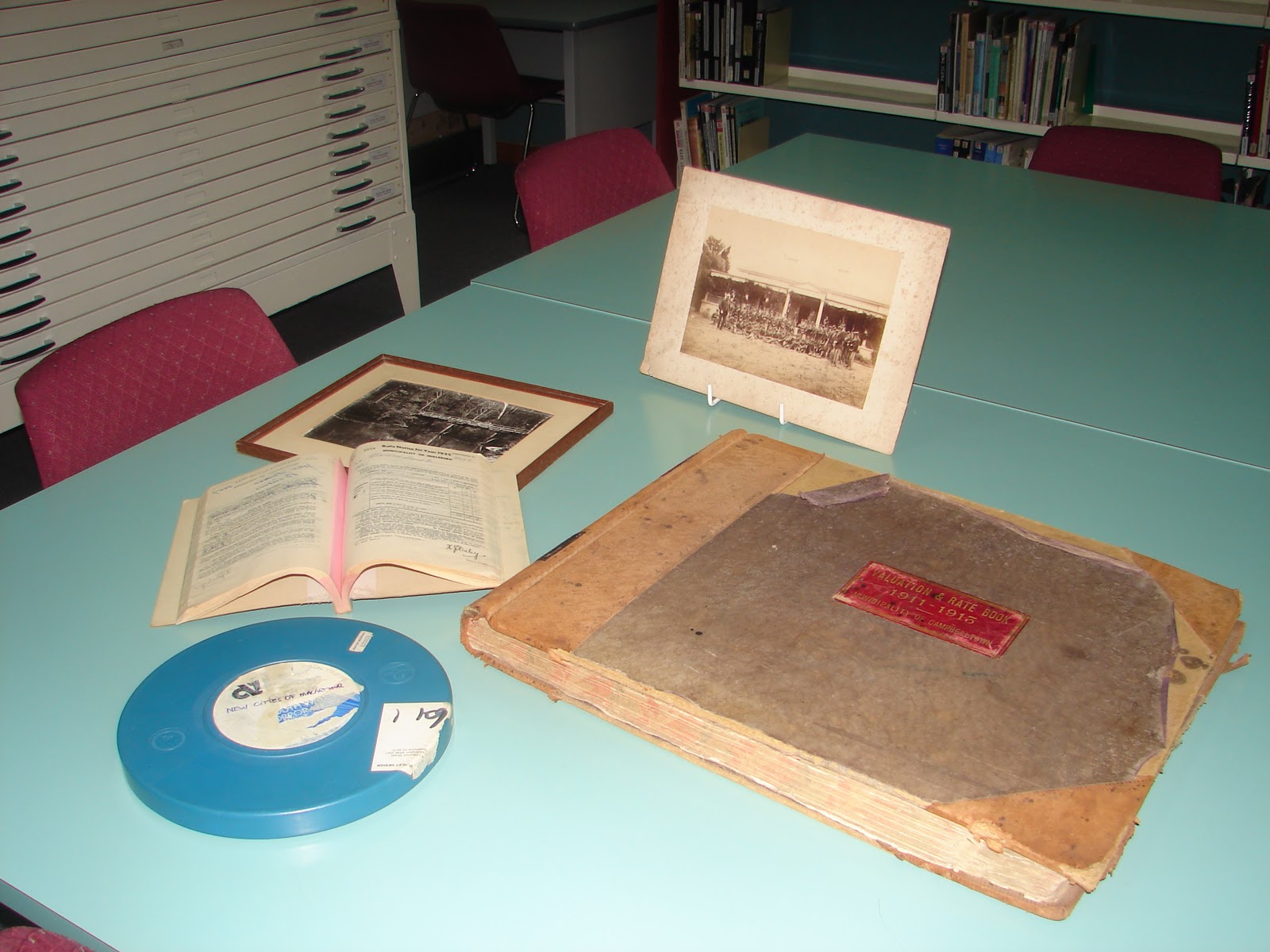
Late last year the library was awarded a $4400 grant to fund a significance assessment of its local information collection. This significance assessment is essential as it provides an understanding of why the collection is significant before appropriate decisions about long term management, conservation and interpretation can be made. It can lead to important outcomes including improved resource allocation, enhanced research value and greater community respect for cultural heritage preservation. A qualified assessor will undertake the assessment early in 2012.


Above are some of the items that will be assessed in the significance assessment of local studies.