
Welcome to the Campbelltown City Library Local Information Blog
Wednesday, 18 January 2012
Community Heritage Grant for our Local Studies Collection
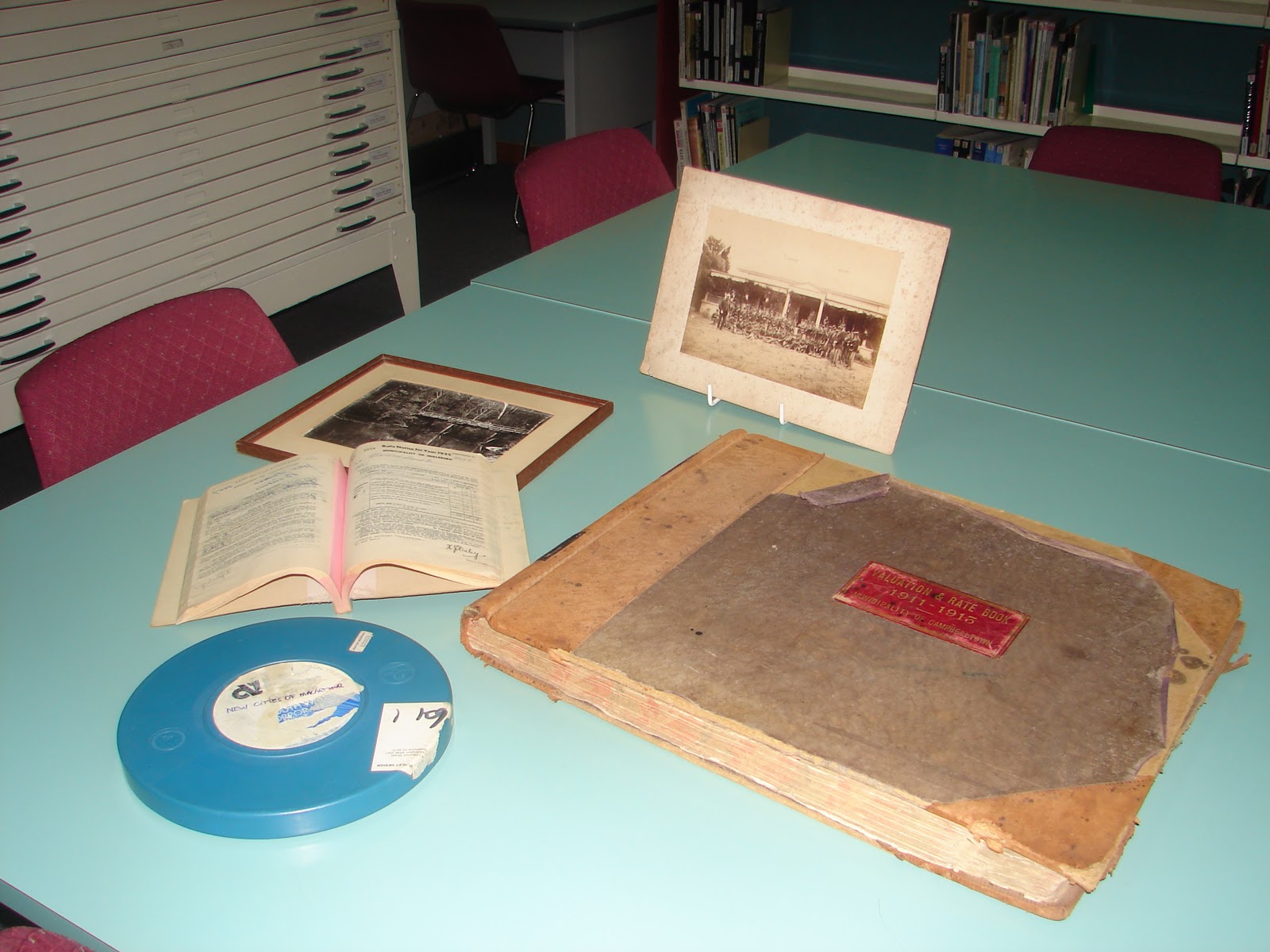
Late last year the library was awarded a $4400 grant to fund a significance assessment of its local information collection. This significance assessment is essential as it provides an understanding of why the collection is significant before appropriate decisions about long term management, conservation and interpretation can be made. It can lead to important outcomes including improved resource allocation, enhanced research value and greater community respect for cultural heritage preservation. A qualified assessor will undertake the assessment early in 2012.
 Above are some of the items that will be assessed in the significance assessment of local studies.

Friday, 13 January 2012
Just Not Cricket!
I recently came across an amusing article from the Australian Town and Country Journal dated December 30, 1878. The article was based on a report of a cricket match between Campbelltown and a combined team from Menangle and Morton Park played on December 28. After Campbelltown won by 13 runs the reporter described how "The losing team were most "splendidly" treated, being left to fish for themselves, not even a sandwich or a glass of beer being provided by the Campbelltown Club. The sooner the committee resign the better." One would hope they lifted their game!
 Above is a photograph taken in 1881 of a cricket match at "Glen Lorne" on Appin Road.

Written by Andrew Allen
Thursday, 5 January 2012
The Water Tower

Photo from the Moy Collection (Campbelltown and Airds Historical Society)
Written by Andrew Allen
Monday, 5 December 2011
Jubilee Cross Country Championships Of NSW come to Campbelltown
The library recently received a donation of photographs of the Jubilee Cross Country Championships of NSW when they came to Campbelltown on July 28, 1950. They were held along the course of Fisher's Ghost Creek. The local newspaper reported that many athletes feared a tough race as the creek was at high level, the water being 18 inches deep. We can assume then that the run included an icy water component that July day!
There were 200 athletes registered in 4 different events depending on age and distance. Famous cyclist Sir Hubert Opperman was there to present trophies on the evening of the event in the town hall. Added to the excitement was that Movietone News covered the race! Prior to the commencement a march of athletes and officials took place, that started from the railway station and proceeded along Queen Street to Fisher's Ghost Creek.
 The above photograph shows the runners on the starting line. This was in the vicinity of the area behind Domino's Pizza where Moore-Oxley Bypass extends and Bradbury Oval.
Source: Campbelltown-Ingleburn News
There were 200 athletes registered in 4 different events depending on age and distance. Famous cyclist Sir Hubert Opperman was there to present trophies on the evening of the event in the town hall. Added to the excitement was that Movietone News covered the race! Prior to the commencement a march of athletes and officials took place, that started from the railway station and proceeded along Queen Street to Fisher's Ghost Creek.

Source: Campbelltown-Ingleburn News
Written by Andrew Allen
Monday, 28 November 2011
The Amazing Mary Brookes
Campbelltown's second female alderman Mary Brookes gave an insightful interview to The Australian Women's Weekly in 1974. In the article she explained "I am not conscious of myself as a woman on the Council. The men are real nice to me." Then with a twinkle in the eye she added "I rationalise it this way: they can afford to be good sports, they have had it good for so long."

Mary was always kept busy with farming activities at St Helens Park. She would often be up through the night delivering lambs and later managed the herd of friesians on the property. So fond of her cattle was she, that each one was named; "Teacake", "Buttercup" and even "Faith", "Hope" and "Charity"!
In 1962 she became an alderman on the Campbelltown Municipal Council, a position she held for 12 years. Mary was the second woman ever to be elected to Campbelltown Council. She said in the Woman's Weekly interview "Pushing a trolley in the supermarket I make a point of speaking to everyone I see. It doesn't take a moment to say 'hello honey'. It was undoubtebly this friendliness and hard work that saw her constantly re-elected to council.
Mary "Honey" Brookes died on 13 January, 2001. A park, Mary Brookes Park, in the suburb of St Helens Park is named in her honour.
Do you have any memories of Mary Brookes that you would like to share?
Mary Brookes was born in Chicago on New Year's Day 1904. In the 1920s she worked for the Chicago Flexible Shaft Company (later to become the Sunbeam Corporation). She is credited with naming the newly developed electric mixer "The Mixmaster" in 1930. Mary and her husband moved to Australia when the company sought to grow the manufacturing operations there. They first lived at Elizabeth Bay but it was on a picnic that they first saw St Helens Park homestead at Campbelltown. Mary explained in the interview to the Weekly "I thought if only I could possess that house I would never see a cold day. It had eight fireplaces." Cyril and Mary Brookes were able to buy St Helen's Park in 1949.

In 1962 she became an alderman on the Campbelltown Municipal Council, a position she held for 12 years. Mary was the second woman ever to be elected to Campbelltown Council. She said in the Woman's Weekly interview "Pushing a trolley in the supermarket I make a point of speaking to everyone I see. It doesn't take a moment to say 'hello honey'. It was undoubtebly this friendliness and hard work that saw her constantly re-elected to council.
Mary "Honey" Brookes died on 13 January, 2001. A park, Mary Brookes Park, in the suburb of St Helens Park is named in her honour.
Do you have any memories of Mary Brookes that you would like to share?
Written by Andrew Allen
Wednesday, 16 November 2011
Ingleburn's First Car

I came across the gem in our photograph collection recently. Imagine taking this beast for a Sunday afternoon drive! The writing on the photograph taken in 1913 is ""Wells Family of "Jaclyn Park" in their Swiftsure car, the first car in Ingleburn". After doing some investigation I can confirm that the car is a Model T Ford and made in 1913. My research revealed that there was no Swiftsure cars listed for production in Australia. This was a surprise considering the mention of Swiftsure on the photograph. Swiftsure was used to describe cycle cars in the early 1900s and was used in the 1950s as a colloquial term for a car's ability to roll down and up hills.
Apparently, depending on where the car was purchased, the lights on the vehicles were extras as well as the horn!
There is little information about the Wells family. According to local historical researcher Marie Holmes "Jaclyn Park" was located about a half a mile from Ingleburn station and was a poultry farm.
*Update
More feedback has revealed that Swiftsure does appear to be a legitimate brand of car. There are 3 advertisements post 1910 for second hand Swiftsures in the Sydney Morning Herald. A search of the Trove database reveals that Swiftsure was more a pre-1910 manufacturer and another February 1907 article titled "Testing a Motor Waggon" states that "Messrs W. Arnott Ltd. are greatly pleased with the success of a test to which their Swiftsure motor biscuit waggon was subjected during a journey across the Blue Mountains to Bathurst and the return via Goulburn to Sydney". It appears the sole agent for Swiftsure motor cars was I. Phizackerley 187 and 171, Elizabeth Street, Hyde Park.
Thanks to the Model T Ford Club of NSW for their assistance.
Written by Andrew Allen
Tuesday, 1 November 2011
Fisher's Ghost Fun Run

The race has been organised every year by the Campbelltown Joggers Club. The club held its first run on January 11, 1976 at Bradbury Oval and has been meeting there ever since! Campbelltown Joggers welcomes runners and walkers of all abilities, with the main emphasis being on having fun while keeping fit. New members are welcome to turn up and try with no obligation to join. The club's website can be found at http://www.campbelltownjoggers.org.au/
Written by Andrew Allen
Subscribe to:
Posts (Atom)