Thursday, 26 May 2022

Then and Now Photographs

 Here are some more then and now photographs showing the changes to various local sites over time.


This is the corner of Hoddle Avenue and Grandview Drive, Campbelltown probably in the 1960s.


The same scene in 2022. Established trees now obscure the view!


This building was part of the Russian Orthodox settlement at Kentlyn.


I assure you the building remains relatively unchanged from the above shot!


The building known as the Coaching House at the southern end of Queen Street before it was renovated in the 1960s.


This what it looks like today. This group of colonial terraces was thankfully saved from demolition in the 1960s.


Written by Andrew Allen


Tuesday, 3 May 2022

The lost name of Riversford

I recently came across a reference to Riversford Railway Station, in relation to Menangle, which I had never heard of. I started to investigate the name Riversford, and have come up with the following information. The earliest reference I could find was the death notice in 1852 of Joseph Edwards, late of Riversford, Menangle. Edwards leased a farm of about 180 acres. In 1856 a Post Office was established at Riversford, described as being between Campbelltown and Picton. Another death notice was for John Ryan in 1859, late of Riversford, Menangle, who was also a lessee farmer at Menangle. Mrs Sarah Rose also appears in the newspaper – she was a washerwoman and midwife from Riversford. Her husband George Rose was a shingle splitter. In 1859 a place was appointed for the sale of spirits etc, wholesale, at Riversford. All the above persons are mentioned in the book “They worked at Camden Park”. In 1860, an article about railways in the Sydney Morning Herald states that “Beyond the Nepean a high embankment carries the railway to a cluster of houses known as Riversford, the residents in which are chiefly cultivators of the rich agricultural land though which the line runs for some distance, and which is the property of the Messrs. Macarthur”. The roads must have been pretty bad, as William Dawson, office and farm worker at Camden Park, was advertising for labourers for five weeks work of road repair in 1860. In 1861, another railway article in the SMH stated “Beyond the Menangle River, a long embankment is finished as far as it can be, pending the erection of the viaduct. The adjoining cutting, and some light embankments, extending though a small hamlet known as Riversford, are almost finished…” In the same year Riversford was appointed as a place where a Public Pound would be erected, established and maintained. William Dawson was appointed poundkeeper. Another lessee farmer, John Ryan of Riversford, Menangle, was also reported as deceased as well as John McCain, storekeeper and blacksmith of Riversford.
The Railway Hotel, shown above, built in the 1850s, was on the then Eastern side of Menangle Rd but the re-alignment of the road would now place it either under or on the Western side of the road. 
The Riversford area was also where the railway camp was located. Due to the activity in the area between 1862 and 1864, many workers were camped in that vicinity. In September 1st 1862, the Riversford railway platform was opened as a temporary terminus. It was built by the contractors for the line, at a cost of 115 pounds, and closed in July 1863, when the Menangle Bridge was opened. In 1863, the Riversford post masters wife, Mary Anne Kelly was reported deceased, her husband Dennis Kelly was also the Catholic school teacher. The name Riversford was beginning to fall from general use, being replaced by Menangle. In 1865 the Post Office was to be known officially as Menangle rather than Riversford. Bailliere’s NSW Gazetteer and Road Guide of 1866 referred to Menangle with Riversford in brackets after it. The last mention of the name Riversford I could find was 1879, when the public pound was abolished, and Riversford was no more. Riversford is remembered today only in the name Riversford Road in Menangle Village.

Written by Claire Lynch
Sources - 
Trove 
"They worked at Camden Park" Burnett, Johnson, Nixon & Wrigley
"Early Menangle" J.J. Moloney

Wednesday, 13 April 2022

Easter in 1945

It is fascinating to read old newspaper articles about Campbelltown and how much life has changed. I was reading the Campbelltown News in 1945 and an article describing what happened over the Easter period. The weekend was completely devoid of sport and unlike today where various football codes play on Good Friday, back in 1945 sport anywhere was strictly forbidden. This extended locally through to the Easter Monday.

Every Good Friday since 1936, the Maryfields Franciscan Novitiate celebrated the "Via Crucis" or "Way of the Cross". The service depicts Christ's journey to Calvary, and consists of the 14 stations of the cross, culminating in the preaching of the Passion sermon at the final station. In 1945, heavy rain reduced the number of pilgrims that attended, although 8000 still made the journey. I was amused by the language the paper used to describe how such an influx of visitors affected the town: The influx of visitors on that day very quickly depleted the edibles and cordials at the local Cafes and refreshment shops, and with Saturday being a closed day food commodities and these establishments were practically nil for Easter Monday's influx of visitors. Imagine how our current population would cope with this inconvenience today.


Crowds gather for the first Via Crucis at Maryfields in 1936


Written by Andrew Allen

 Source:

Campbelltown News, Friday 6 April 1945

Thursday, 10 March 2022

The 1961 Flood

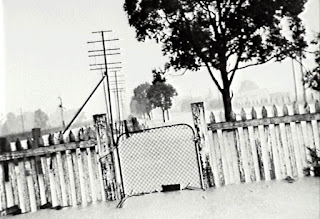
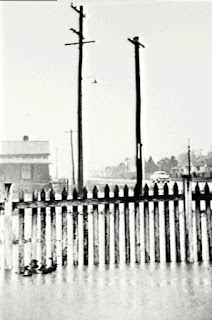
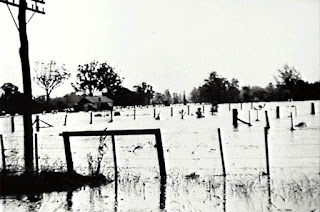
The Macarthur region experienced severe flooding this week and we are all looking forward to overdue sunshine. Floods are nothing new to Campbelltown. One of the worst was in 1961. Newspaper coverage was extensive and fortunately a number of photographs were taken to capture the extent of the inundation.

Locals Share The "Big Wet" was the headline from the Campbelltown-Ingleburn News that week, indicating that nowhere in the area escaped. The deluge started on the Saturday afternoon of November 18 and continued relentlessly through to the Sunday morning. The paper reported that "Residents awoke at dawn on Sunday morning to look out upon a sea of water". Traffic was driven to chaos as most of the roads around Campbelltown were closed. Residents in the low lying areas prepared to leave as the flood waters rose. The peak of the flood at Campbelltown was at 7.30am on that Sunday morning and downstream at Glenfield at 9am. Even Queen Street was under water and not trafficable until about 8am.

The severest flooding of homes in the municipality occurred at Macquarie Fields where Bunbury Curran Creek flooded adjacent areas. Police and rescuers there used rowing boats to visit the affected homes to ensure the occupants had left. This proved difficult however with the strong current.

The rain cleared up a little after Sunday and through to Monday. Then on the Tuesday morning just before 9am, a flash storm resulted in 160 points (40 millimetres) of rain in 20 minutes, and within 30 minutes caused flooding worse than on Sunday morning. The drainage from Sewer Lane (today's Dumaresq Street) blocked from excessive floodwater. Some of the places affected were Tripp's Garage and the Balalaika Cafe Library!

One of the areas heavily affected was Minto. Residents who has lived most or all of their life there thought it was the worst flooding in memory. The floor of the studio of well known sculptor Tom Bass was flooded and some models were affected.

The following photographs were taken at Minto from the Number 2 Railway Cottage.


Written by Andrew Allen


Source: 

Campbelltown-Ingleburn News, 21 November 1961 p1

Friday, 18 February 2022

Percival's Butchery


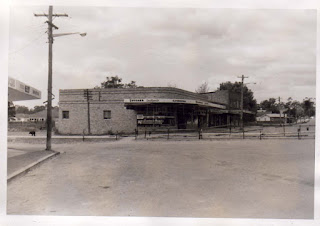
This is Percival's Butcher Shop in Oxford Road, Ingleburn. It was operated by former Campbelltown Mayor Greg Percival, following in the footsteps of his father and grandfather. The shop has been demolished but it served Ingleburn residents for many years and earned the reputation as a fine butchery.

Butchery had its origins in the Percival family from the late nineteenth century. In an interview with me in 2010, a year before he passed away, Greg Percival explained how his grandfather got started in the business. "So my great grandfather had two sons, one of whom was my grandfather. As a young man he got indentured as an apprentice to an uncle of his by the name of Caldwell in Campbelltown as a butcher." William Caldwell was one of the most brilliant mayors Campbelltown has had and turned to butchery after farming at Minto and Kenny Hill. Greg continued, "So he learnt butchery. He came to Ingleburn somewhere around 1893 from what I can deduce and he started a butcher's shop in Ingleburn. It was the centre of Ingleburn then, it was up to the east in Chester Road between Gertrude and Cumberland Roads towards the RSL. How long he was there, I am not sure maybe a year or two I don't know." 

At age 21 and frustrated doing office work, Greg realised that his father needed help in his butchery business as he was getting older. Ingleburn was growing and their was the potential for the business to grow, although his father could not see that. Greg resigned from the Public Service and joined his father. He would start work at 3am and get home at 7pm. The work was hard. In the days before refrigeration Percival's Butcher Shop had a big cold ice room for the carcasses. Greg then joined Council and combined this with his work in the business. Greg then borrowed money and built a new shop in Oxford Road pictured above. The site was later occupied by the Westpac Bank.


Written by Andrew Allen


Sources:

KERR, David

Old Ingleburn in Grist Mills Vol. 21, No. 1, p6


Greg Percival interview at HJ Daley Library, 18 May 2010


Tuesday, 25 January 2022

Taken too Young

Often in my job I come across a sad story from Campbelltown's past. One such tragedy that struck a chord with me for some reason was the accidental death of 10-year old Janet Riley in 1956. I came across Janet's story when researching for a cemetery tour of St David's Presbyterian Church a few years ago. I didn't know a lot about what happened then, however I have since discovered a few more details.

Janet Evelyn Riley was the only daughter of Claude and Gwen Riley and was born about 1945. Claude was born in Glasgow in Scotland in 1918 and came to Australia with his family at a young age. His father had a garage in Campbelltown at some stage. Claude joined the RAAF in World War II, working as an aircraft hand before being medically discharged in 1941. That same year he married Gwen Hayes from Oakbank at Minto and started work as a gardener at Kentlyn.

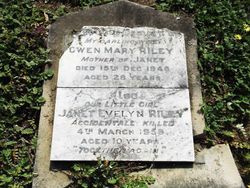
About a year after Janet was born, Claude's world fell apart when his beloved Gwen died of a bad asthma attack on 15 December 1946 aged only 28. He was suddenly left alone to raise his infant daughter Janet. They moved to a house at 49 Macquarie Avenue in the Soldier's Settlement while he continued to work as a gardener. Janet, popular with her classmates, attended Campbelltown Public School and became involved with Campbelltown Marching Girls. 

One Sunday afternoon just after 1 o'clock tragedy struck. It was 4 March 1956, when a vehicle backing out of a garage from a house that the Riley's were visiting on the corner of Waminda Avenue and Broughton Street struck Janet. She later died of her injuries. The pain that Claude must have felt after losing another precious member of his family would have been unbearable. The accident devastated the small community.

Claude eventually found happiness when he married Dorothy Darling three years later and they continued to live at 49 Macquarie Avenue. He got a job working as a railway employee at Campbelltown Station where he worked for the rest of his working life. He had a serious bicycle accident at some stage. Claude lived with Dorothy at Macquarie Avenue until his death in January 1984.

The exact spot where Janet was struck that fateful day is not far from my house and is on the regular track that I run most days. The house has been demolished and is now a vacant block however the concrete driveway is still visible. I often think of Janet when I pass it and often wonder how her life would have turned out.

If there are any older readers who remember Claude or Janet or possibly have photographs of them, I would love to hear from you!


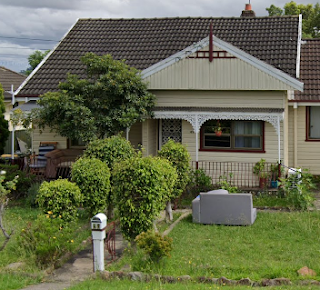
The house in Macquarie Avenue where Janet was living with her father at the time of the accident.


Janet and her mother's headstones in the Presbyterian Cemetery on the corner of Moore-Oxley Bypass and Broughton Street.


The spot where Janet tragically lost her life in 1956


Update: Thank you to Yvonne McMahon for sending this class photo of Janet. She is the girl in the white dress in the 2nd row and 6th from the left.


Written by Andrew Allen


Thursday, 13 January 2022

Matilda's "Mountain View"

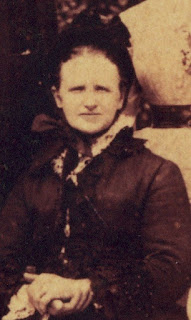
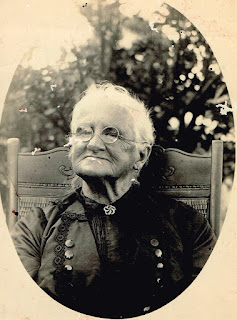
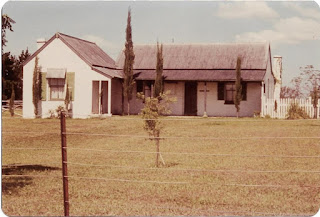
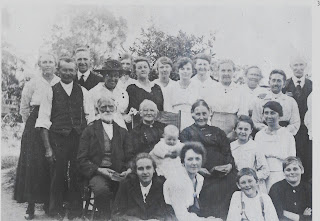
The library is always excited to receive donations of old photographs. Ken Denison visited before Christmas and kindly donated many photos from his collection of the Denison family that once lived in East Minto. The photographs show various generations of the Denison family, including the matriarch Matilda and the family home "Mountain View". Matilda led an amazing and long life. Some of her experiences and images from the collection follow below.

It was common in the early days for women to miss out on the glowing obituaries reserved for men. When Matilda Denison passed away in 1927, she became an exception to the normal. Matilda Clarke was born in Birmingham, England in 1840 and moved with her family to Australia three years later. The first of many set backs in her life occurred the following year when her mother passed away, leaving six children to the care of her husband. John Denison passed away in 1897 and tragically their two sons William and James drowned 13 weeks later after being washed off rocks at Botany. Matilda undoubtedly drew on her strong faith to get her through those difficult days.

Aged 17, Matilda attended the service held for the victims of the Dunbar after it was wrecked outside South Head in August 1857. She also saw the first sod cut for the first railway in the colony and witnessed the first train leave from Sydney to Parramatta. The last thing she heard over the new wireless was the first underground train leave Central for St James Station.

According to her great grandson Ken Denison, Matilda was extremely family orientated. In her will she stated that the property "Mountain View" was not to be sold, and to be used by the family for gatherings and holidays. Records show that Matilda bought the property in 1908 and at the time "Mountain View" was already built. She changed the name from possibly Eagleview to Mountain View.

Matilda Denison died on Sunday, 30 January 1927 at "Mountain View" aged 86 and was buried at Rookwood Cemetery. About 200 people attended the funeral- indication of the high regard her family and the community held for her.

Photographs below:

A younger Matilda Denison; Matilda Denison in her later years; "Mountain View"; Members of the Denison family in the 1920s.


Written by Andrew Allen